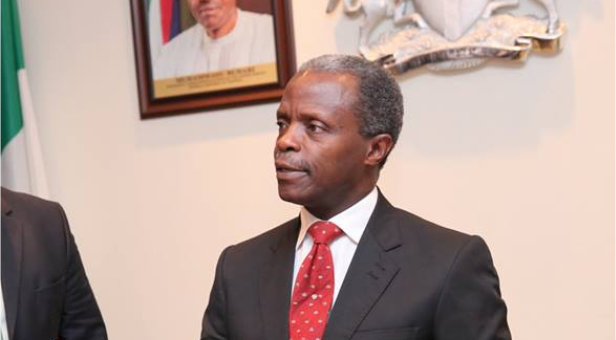
SAN FRANCISCO, January 19, (THEWILL) – Vice President, Prof. Yemi Osinbajo, SAN, has declared that the 2016 Budget, submitted by President Muhammadu Buhari, contains specific provisions in the proposals that will confront poverty in the country in a bold and direct way.
“We are dealing with the issues of poverty with the 2016 Budget that is currently being debated. Altogether, there are 6 social protection programmes of the Buhari administration for which funds have been allocated in the 2016 budget,” the Vice President said.
“These are Teach Nigeria, where 500,000 graduates would be hired as teachers, Youth Employment and Empowerment-where between 300,000-500,000 youths would go through skills acquisition and vocational training, the Conditional Cash Transfer, where one million extremely poor Nigerians will receive N5000 monthly, Homegrown School Feeding where one meal a day would be served to public primary school children across the country, Free Education for tertiary education of 100,000 students of Science, Technology, Engineering and Mathematics and the Micro-Credit Scheme that will give N60,000 one time soft loans to market women, and artisans.”

He made the declaration during a courtesy visit by a delegation from Reckitt Benckiser West Africa, a household care products’ company lead by its West Africa Managing Director, Mr. Rahul Murgai and the Chairman in Nigeria, Chief Olu Falomo.
The company had earlier discussed with the VP its Safe the Children Initiative, a Corporate Social Responsibility programme designed to curb the deaths of Nigerian children caused by diarrhoea.
Mr. Murgai said Reckitt Benckiser, which has been doing business in Nigeria for several decades, is worried about Diarrhoea deaths in the country and has set aside about N1.2 billion to fight the situation in order to ensure that the people of Nigeria are healthier and happier.
While welcoming the initiative, the VP commended the company for its intervention saying “this is the sort of thing we expect from those who have the resources.”
According to him, “when you have the number of extremely poor Nigerians that we have in this country we are bound to have these kinds of health problems.
Story by David Oputah