BEVERLY HILLS, September 26, (THEWILL) – The African Development Bank (AfDB) has pledged the sum of $4.1 billion, in concessional credit, to Nigeria with a total investment of $10 billion in Nigeria by 2019.
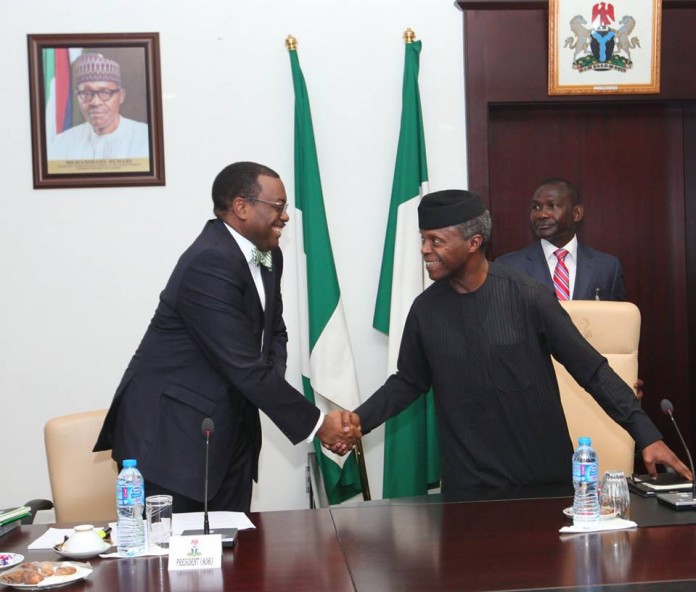
AfDB President, Akinwunmi Adesina, former Minister of Agriculture, made the announcement when he led the bank‘s delegation to a meeting with Vice President, Yemi Osinbajo and the economic management team.
Speaking to State House Correspondents after the meeting, Adesina said the funding will be used to support Nigeria in the area of power, infrastructure, agriculture, the private sector, the SMEs financing and lending.

Adesina was optimistic that Nigeria will come out of the present economic recession as a better more diversified economy than it went into the recession promising that the bank will support the Federal government to deal with some of fiscal imbalance that may arise in the budget.
“We have said that we are going to support the Nigerian government with the budget support to be able to deal with some of fiscal imbalance that they have, we are looking to consider for an award $1 billion to help to deal with that particular deficit,” he said.
“In addition to that, the are other challenges that the economy has which is in terms diversifying and deepening the level of diversification in critical sectors, so agriculture, solid minerals, manufacturing as well as industrial sector is very important.
“So the bank is going to provide in total between 2016/2017, $4.1 billion to Nigeria in several areas of power, infrastructure to agriculture and for the private sector the SMEs financing and lending.
“I expect that our portfolio in Nigeria will not decrease it will actually grow, we expect to invest in Nigeria by 2019 a total of $10 billion.
“So let me just say that the issues that we think are important is the need to further deepen the diversification of the rest of the economy, also to make sure that the macro-economic stability as well as fiscal stability in the country.
“We have asked for the need for better synergies between the macro policy side and monetary policy side and also the fiscal policy side of the economy.
“And of course, we also recognize that power is perhaps the most important challenge that is driving inflation in the country. So we expect in our portfolio this year to invest a total of 1.400 megawatts of projects to focus on the energy sector and by 2017 we plan to invest in 1,387 megawatt of project for the sector.
“We discussed with the vice president and minister of finance about how to invest in areas of women and youths employment in the country as well as to look for opportunities to support access to finance by supporting the Development Bank of Nigeria (DBN) with $500 million which will help to provide cheap financing for the real sector that the country wants to grow.
“We are providing $100 million to the Bank of Industry (BoI) to be able to lend to small and medium size enterprises adding that the bank also want to finance the Bank of Agriculture to be to reform itself to be able to get more financing.
“So all in all, I want to say that we are not fair weather friends of Nigeria, we are here to provide strong support to the Nigerian government.
“Let me just say that Nigeria has tough times but Nigeria is not falling apart and when people talk about debt crisis, Nigeria is not in debt crisis. If you look at the fiscal deficit of this country with regard to the GDP, is about 3 or 3.5 per cent is still way below the five per cent for the Fiscal Responsibility Act.
“If you look terms of the debt to the GDP ratio for Nigeria is 15 per cent. So there is no debt crisis in Nigeria, what you have is liquidity problem and we are trying about to be able to the country to be able to drive down inflation and to be able to make sure we are working with the government to be able to provide incentives to the private sector.”
On the interest rate on the loan, the Minister of Finance, Kemi Adeosun, revealed that “the concession is way below 2%, is about 1.2 %.We are not over borrowing what we are trying to do is to ensure that this money we are borrowing we use it on the key infrastructure that will drive the economy.”
Story by David Oputah