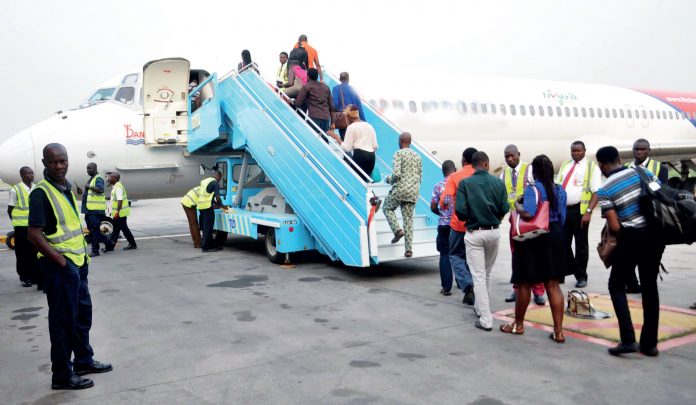
August 15, (THEWILL) – The aviation industry witnessed the worst fortune in 2020 across the globe. ANTHONY AWUNOR x-rays the unusual development which led to the huge losses suffered by operators and other stakeholders in terms of money and business opportunities.
The International Air Transport Association (IATA) has released the IATA World Air Transport Statistics (WATS) publication with performance figures for 2020 demonstrating the devastating effects on global air transport during that year of the COVID-19 crisis.
The data shows that 1.8 billion passengers flew in 2020, a decrease of 60.2% compared to the 4.5 billion who flew in 2019. Industry-wide air travel demand (measured in Revenue Passenger-Kilometers, or RPKs) dropped by 65.9% year-on-year.

International passenger demand (RPKs) decreased by 75.6% compared to the preceding year. Also domestic air passenger demand (RPKs) dropped by 48.8 percent compared to 2019. Air connectivity declined by more than half in 2020 with the number of routes connecting airports falling dramatically at the outset of the crisis and was down more than 60 percent year-on-year in April 2020.
According to IATA, total industry passenger revenues fell by 69 percent to $189 billion in 2020, and net losses were $126.4 billion in total. So far, the decline in air passengers transported in 2020 was the largest recorded since global RPKs started being tracked around 1950.
Commenting, Willie Walsh, IATA’s Director General said “2020 was a year that we’d all like to forget. But analysing the performance statistics for the year reveals an amazing story of perseverance. At the depth of the crisis in April 2020, 66 percent of the world’s commercial air transport fleet was grounded as governments closed borders or imposed strict quarantines.
“A million jobs disappeared. And industry losses for the year totalled $126 billion. Many governments recognised aviation’s critical contributions and provided financial lifelines and other forms of support. But it was the rapid actions by airlines and the commitment of our people that saw the airline industry through the most difficult year in its history”.
Airlines’ Passenger Performance
System-wide airlines carried 1.8 billion passengers on scheduled services, a decrease of 60.2 percent over 2019. On the average, there was a $71.7 loss incurred per passenger in 2020, corresponding to net losses of $126.4 billion in total. Measured in ASKs (Available Seat Kilometers), global airline capacity plummeted by 56.7 percent, with international capacity being hit the hardest with a reduction of 68.3 percent.
System-wide passenger load factor dropped to 65.1 percent in 2020, compared to 82.5 percent the prior year. The Middle East region suffered the largest proportion of loss for passenger traffic with a drop of 71.5 percent in RPKs versus 2019, followed by Europe (-69.7 percent) and the Africa region (-68.5 percent).
China became the largest domestic market in 2020 for the first time on record, as air travel rebounded faster in their domestic market following their efforts to control.
Cargo Performance
Air freight was the bright spot in air transport for 2020, as the market adapted to keep goods moving — including vaccines, Personal Protective Equipment (PPE) and vital medical supplies — despite the massive drop in capacity from the bellies of passenger aircraft. Industry-wide available cargo tonne-kilometers (ACTKs) fell 21.4 percent year-on-year in 2020. This led to a capacity crunch, with the industry-wide cargo load factor up 7.0 percentage points to 53.8 percent. This is the highest value in the IATA series started in 1990.
At the end of the year, industry-wide Cargo Tonne-Kilometers (CTKs) had returned close to pre-crisis values. However, the yearly decline in cargo demand (CTKs) was still the largest since the Global Financial Crisis in 2009, at a sizable 9.7 percent year-on-year in 2020. The top five airlines ranked by scheduled cargo tonne-kilometers (CTKs) flown were: Federal Express (19.7 billion); United Parcel Service (14.4 billion); Qatar Airways (13.7 billion); Emirates (9.6 billion); Cathay Pacific Airways (8.1 billion)
Airline Alliances
Star Alliance maintained its position as the largest airline alliance in 2020 with 18.7 percent of total scheduled traffic (in RPKs), followed by SkyTeam (16.3 percent) and Oneworld (12.7 percent).
Meanwhile, the global aviation industry has not remained the same. The industry has been one of the hardest-hit since the outbreak of COVID-19 late 2019. With the virus ravaging the entire world resulting in more than four million deaths, the industry was brought to its knees and virtually all the airlines, domestic and/or international, ceased to operate due to flight restrictions.
As the coronavirus continued its global spread, the air industry came to a virtual standstill for the most part of 2020; businesses slid and technical personnel in different fields lost jobs, while families were in disarray.
In the midst of the crisis, the aviation industry and the fragile airline sub-sector lost a substantial fortune. No fewer than 400,000 airline workers out of the estimated global 46 million aviation employees are yet to return to work; some were laid off or furloughed, while potential aviators are still unable to find jobs in the sector.
In its ‘The impact of COVID-19 on the airport business and the path to recovery,’ the Airports Council International (ACI) reported that impact of the COVID-19 crisis removed more than 1 billion passengers for the whole year 2020 compared to the projected baseline (pre-COVID-19 forecast for 2020), representing a decline of 64.6% of global passenger traffic
Following the “Great Lockdown” of April 2020, ACI said international passenger traffic was virtually non-existent in the second half of 2020. International passenger volume ended the year below 1 billion passengers, a decrease of more than 75% compared to 2019 volume. Along with the human tragedy, the coronavirus pandemic has affected all aspects of economic and social activities, resulting in several measures taken to revive the aviation industry and travel business.
Wider Economic impact
The disruption in air travel by the COVID-19 pandemic caused economic slowdown globally as the demand and supply value chain dropped. Several airlines, airports, and other aviation-related operators lost a significant part of their income since mid-March 2020 when the pandemic became more pronounced.
The International Civil Aviation Organisation (ICAO) in its report claimed that international passenger traffic suffered a dramatic 60 per cent drop in 2020, bringing air travel totals back to 2003 levels.
According to ICAO, only 1.8 billion passengers took to the sky last year, compared to 4.5 billion in 2019 and the airline sub-sector lost an estimated $370 billion directly resulting from the impacts of pandemic, with airports and air navigation services providers (ANSPs) losing a further $115 billion and $13 billion, respectively.
The global $370 billion drop in gross airline passenger operating revenues represented losses of $120 billion in the Asia/Pacific, $100 billion in Europe and $88 billion in North America, followed by $26 billion, $22 billion and $14 billion in Latin America and the Caribbean, the Middle East and Africa, respectively.

Anthony Awunor, is a business correspondent who holds a Bachelor of Arts Degree in Linguistics (UNILAG). He is also an alumnus of the Nigerian College of Aviation Technology (NCAT), Zaria Kaduna State. He lives in Lagos.