
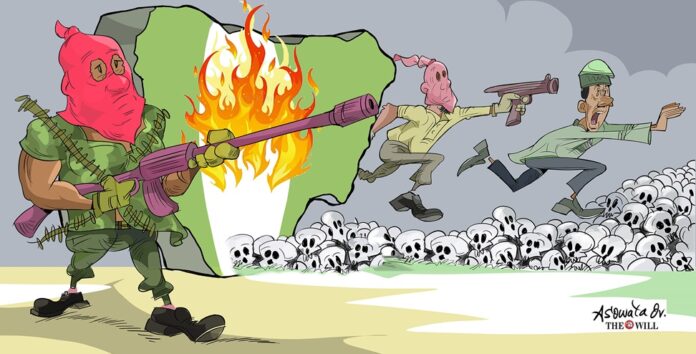
April 27, (THEWILL) – It was a visibly relieved Governor Babagana Zulum of Borno State who welcomed a high-level Federal Government delegation to the Council Chamber of Government House in Maiduguri on Friday.
Comprising the Minister of Defence, Alhaji Mohammed Badaru Abubakar, Minister of State for Defence, Bello Matawalle, Chief of Defence Staff, Lt Gen Chris Musa, representatives of the service chiefs; outgoing and incoming Theatre Commanders of Operation Hadin Kai, as well as Principal Staff Officers and senior military personnel, the delegation was on a reassuring visit to a state that is perpetually under attack by terrorists.
While welcoming his august visitors, the outspoken governor, Zulum canvassed renewed military offensive in Lake Chad Islands, the Tumbus and Madara Mountains, as well as the deployment of weaponry to end terrorism in Borno.

What was quite obvious was the feeling that the state had been neglected, in terms of security, since the attention of the armed forces was redirected to the troubled North-West geo-political zone following a September 2024 presidential directive.
That singular act, THEWILL investigation shows, has contributed to weakening the required military response to the renewed onslaught by Boko Haram, Islamic State West Africa Province, ISWAP and other terrorists in Borno, amid other factors such as the hostile terrain and the superior fire power of the terrorists.
THEWILL checks can confirm that if these challenges are left unaddressed urgently, the deadly attacks and killings will continue, even on a higher scale.
What is true of Borno State where the situation is so bad that only the higher numbers that get killed in continued attacks appears worth reporting, is also correct about Benue where repeated attacks have continued unchecked as at the time of filing this report.
But unlike Borno where Governor Zulum identified the major causes of violence, Benue presents an interesting interplay of local politics and attacks by ‘strangers’, such that the issues at stake appear unsolvable, at least on the surface, according to THEWILL’s findings.
In Plateau State where the killings have surged into a carnage, community resistance in information gathering may hamper the push for respite and eventual solution as communities accuse the security agencies of looking the other way, even when provided with information on places targeted for attacks by gunmen.
In addition, the mercantile class are deviously at work in the state, given its mining capacity. It is one of the most widely recognised states with a capacity for mining in Nigeria and having a significant proportion of tin, silver and gold deposits besides coal, emeralds, fluoride, granite, iron ore, kaolin, lead and zinc.
The suspension of mining activities by Governor Caleb Mutfwang through an executive order early this year, citing environmental degradation and heightened insecurity, has infuriated the mercantile class, who have been engaged in illegal mining for decades.
Thus, the strong undercurrents of lack of adequate fire power, difficult terrain, requisite weaponry, local politics and lack of trust may combine to undermine solutions to continued attacks and killings in Benue, Borno and Plateau, if left unaddressed.
BENUE STATE
While Benue State and the federal authorities are mapping strategies to contain the ongoing bloodshed in the state, the attackers are still unleashing mayhem. At least, seven persons were reportedly killed by unknown gunmen on Thursday night in Agbo Vengav Udam, a community in Gwer West Local Government Area, just hours after gunmen hijacked two commercial vehicles and abducted about 14 passengers near Naka, the headquarters of the local government area.
The assailants were said to have stormed the community early in the morning and opened fire indiscriminately on some residents, leaving seven dead and many others injured.
Although Governor Hyacinth Alia has claimed that the attackers, “according to intelligence from locals” may be foreign nationals who just come and hit, kill and run back, marking a new and more dangerous phase of violence in the area, compared to previous confrontations with traditional herders,” THEWILL investigation shows that recent killings, especially in the notorious Sankera axis, which includes Ukum, Katsina-Ala and Logo LGAs, is being fuelled and sustained by supremacy battles among local gangsters.
What this newspaper would describe as the ‘insider connection’ to the current killings in the state, started almost a decade ago.
Before 2015, the security situation in Benue State, especially in Sankera Federal Constituency comprising Logo, Ukum and Katsina-Ala was at an alarming stage. A dreaded bandit leader from the Sankera axis, Terwase Akwaza, alias Gana, an indigene, was the lord whose word must be obeyed. He terrorised the people so much that the then governor of the state, Samuel Ortom, who made efforts towards reducing the menace to its minimum level, had to strike a deal with the bandit.
With his both the carrot and stick approach, Ortom first granted amnesty to criminals in the state with a condition for them to surrender illegal arms in their possession. Akwaza and his lieutenants surrendered to the government of the day to pave the way for resettlement.
The state government then promised to place them on a monthly stipend of N15,000 but later reneged on this agreement.
Many members of the gang returned to their old ways. When ‘Gana’ was intercepted by the military and killed in the course of amnesty, his lieutenants that survived him engaged in a bloody fight to succeed their late leader.
Thus, many factional leaders sprang up in the area and started carrying out attacks beyond their enclave to neighbouring towns in the state. Several militia groups leader like Terhemen Mzaga, alias ‘Full Fire’; others simply known as ‘Ichen’; ‘Overall Konyo’ and ‘Anyogo Tamen’, emerged as group leaders. While alive, ‘Gana’ was in the forefront of protecting the natives against criminal herders and other invaders.
However, the emergence of factional leaders following ‘Gana’s’ death has worsened hostilities as a result of frequent territorial fights.
An elder who knows these factional leaders, John Abya, told THEWILL that some of them align with attackers to terrorise the people in an attempt to dislodge their rivals and gain control over territories.
Abya, added that ‘Fullfire’ and his group, for instance, has links in Taraba State from where they return to kill and maim rivals and their supporters.
“In the recent past, the invasion and killings in Logo and Gbagir in Ukum LGA left over 72 persons dead. From Agatu, Gwer West, Kwande and Makurdi, the state capital, no day passes without one incident of killings by these bandits,” Abya said.
Yet at a recent stakeholders meeting held at Government House in Makurdi during the visit of National Security Adviser, Mallam Nuhu Ribadu over the rising insecurity in the state, Governor Alia blamed foreign mercenaries for attacks on Sankera.
He urged the Federal Government to urgently intervene to restore order as the increasing number of Internally Displaced Persons is having a negative effect on the finances of the state.
PLATEAU STATE
Most of the villages sacked and annexed by the said murderous land grabbers are in Barkin Ladi, Bokkos, and Riyom local government areas. For instance, in Garshish District of Barkin Ladi, most of the villages have been sacked, leaving the original natives to be languishing in Internally Displaced Persons Camps, IDPs or other makeshift homes.
The situation is so deplorable that one village, Mahanga, in Barkin Ladi LGA, has been renamed by the usurpers as ‘Palestine’, a no-go area where local reports claim unidentified helicopters and choppers often drop in the nights possibly to drop sophisticated weapons and other high calibre warfare facilitators and foreign militia groups, as locals say the attacks are normally carried out by ‘strangers’.
Bokkos and Barkin Ladi LGAs have significant mining activities in Tin for which Plateau State in famous. Mahanga village became a victim for those who want to use it as a base for their nefarious mining activities, THEWILL checks can confirm.
Governor Mutfwang’s ban on mining activities in the state including this area has not gone down well with the mercantile class, who are hiding under the perceived inter-ethnic conflict, to unleash mayhem, thus compounding the situation that makes for unanimity in arriving at a consensus on the way forward.
However, according the Governor Mutfwang, the scales are beginning to fall from the eyes of doubters and reveal the true picture of the sustained killings in Plateau State.
“We are left with the suggestion that this is about land grabbing,” he said.
He argued that though people dispute that land grabbing is not the motive “but we are yet to find evidence to the contrary.”
“These communities have lived in peace with other ethnic nationalities, with other people of religious persuasions. The interesting thing you will know on the plateau is that many families are inter-religious and so religion is not so much the issue. I think that here we are dealing with some powerful forces who mobilise these faceless people and come and unleash it on these natives. And at the end of the day, the natives are left defenseless because they never envisaged that this kind of attack will happen,” he said.
Mutfwang has since revived the state security outfit, Operation Rainbow, which was politicised and rendered moribund by his predecessor, Simon Bako Lalong, to become a major player in peace initiatives, especially in gathering and sharing security intelligence with agencies of state security.
As part of efforts aimed at managing the aftermath of the recent attacks, Operation Rainbow has been further strengthened, amidst stakeholder engagements, meeting with religious elders and leaders, the constituting of an inter-religious council, holding of security council meetings, making a state-wide broadcast to reassure the citizens and pledge that “Plateau State will not fall” to its aggressors and enemies. He has, in reaction to the attacks, outlawed night grazing, transportation of cattle after 7pm and the restriction of motorcycle movement from 7pm to 6am state-wide. Community vigilante has been activated to work in synergy with conventional security.
BORNO
The upsurge in terrorism- linked killings in Borno State is owing to three major challenges that may worsen the situation if left unaddressed urgently. The first is terrain, the second is manpower and the third is weaponry.
Fortunately, Governor Zulum agreed to the danger posed to the state by all of these problems during the weekend visit of the Federal Government delegation to the state.
Describing the Tumbus islands in the Lake Chad region, as a safe haven for Boko Haram and ISWAP terrorists, Zulum called on the military to launch an aggressive offensive in the area to flush out insurgents from their enclaves.
The governor described the Tumbus as critical havens for insurgents where they regroup and sustain their activities, calling for a special military operation to be carried out in the area.
“These islands serve as breeding grounds for insurgents who depend on the area for sustenance. It is imperative to consider launching coordinated operations to flush them out,” Governor Zulum stated.
The Tumbus region of Borno State is considered a safe haven for terrorists, who are known to occasionally relocate from the North-West, North-Central and North-East because its mountains and forest, sharing borders with Cameroun, Chad and Niger, presents an ungoverned space that provides terrorists with shelter and cover.
Similarly, Gwoza Hills, which is over 1,300 metres above sea level, with the Mandara Mountains, provides a buffer between Nigeria and Cameroon.
Then, there is the area known as Timbuktu Triangle, which is located in four local governments areas of the state, namely, Damba, Jere, Konduga and Koga and one LGA in neighbouring Yobe State, Gubja.
Finally, there is Sambisa Forest, which has remained a stronghold of terrorists for over two decades. These four terrains have proved formidable enclaves for terrorists within Borno in Nigeria and others arriving from Niger, Mali and Chad.
Because of the presence of these ungoverned spaces in the state, terrorists find it easy to migrate to any of them anytime they are displaced from any of them.
“If the Sahel is not secured, the entire country remains vulnerable. There is a pressing need to fortify the Sahel region to end insecurity,” the governor lamented at the weekend.
That is why he pressed his august visitors for increased troop deployment to areas such as the Mandara Mountains and for continuous and sustained military operations to prevent the reoccupation of previously reclaimed territories.
For example, the Nigerian Army on April 8, 2025 eliminated six terrorists following an intelligence operation, recovering a cache of arms. Then on the next day, Boko Haram terrorists ambushed an army vehicle heading to Damaturu, the Yobe capital for fuel on the Biu-Buratai-Buni Yadi Road. The road is so bad that terrorists are known to often set up checkpoints on it and collect levies from the people.
According to Governor Zulum, three local government areas are currently controlled by the terrorists. They include Abbadam, Marte and Guzamala.
The third issue that leaves Borno State vulnerable to further attacks and killings is inadequate weaponry. There is no gainsaying the fact that the terrorists have sophisticated weapons that embolden their assertiveness. Apart from the regular AK-47 rifle, they have Rocket Propelled Guns, RPGs in quantity, enabling their attacking strength and reach.
Praising the President Bola Ahmed Tinubu, the Chief of Defence Staff, and Service Chiefs for their unwavering support, Zulum further requested the deployment of more military hardware, including Mine-Resistant Ambush Protected Vehicles (MRAPs), Unmanned Aerial Vehicles (UAVs), and additional personnel to improve surveillance and fortify vulnerable zones.
“There should be forces that will keep the ground, otherwise they will come back. What brought about the recent situation is we felt everything was okay, but they are regrouping now and I believe the Nigerian military will not allow them to regroup,” Governor Zulum told the visiting Federal Government security team at the weekend.
WAY FORWARD
Minister of Defence, Alhaji Mohammed Badaru Abubakar, during the weekend visit to Borno State gave the assurance that the Federal Government was committed to providing the necessary personnel and equipment to combat insurgency and facilitate the resettlement of affected communities in the country.
“The President has directed that we provide the military with all necessary manpower and equipment to halt the recent resurgence of insecurity in Borno and the North-East as a whole,” the Minister added.
Despite the havoc, Governor Mutfwang and his Borno and Benue counterparts are optimistic that with determination, adequate weaponry and manpower deployment, good will eventually triumph over evil.
Mutfwang expressed hope that the Federal Government “will continue to collaborate with us, cooperate with us to bring the perpetrators to book. Like the Chief of Army Staff confirmed, a few arrests have been made. They are making useful disclosures to the security agencies. We’ll take it up from there. For once, we are determined that people who are found to be guilty will be prosecuted, and we want to ensure that external forces are not allowed to interfere in this matter.”
The National Security adviser, Nuhu Ribadu urged Nigerians to rest assured that the government is handling the challenging insecurity with all sincerity.
During his visit to Benue State in response to the recent spate of killings in the Sankera axis, Ribadu appealed to Nigerians to give the goverment understanding and appreciate that there are people who are working. It’s a matter of time.”
“We need help – like yesterday. The president has shown support, and we are hopeful more will come,” Governor Alia said. The government appeared to have heard him.
The National Economic Council meeting, presided over by Vice President Kashim Shettima in Abuja last week, passed some resolutions, which, among others on the economy, dealt with the current state of insecurity.
Chief of Defence Staff, General Christopher Musa, was said to have made “an innovative security initiative aimed at strengthening national and subnational capacity for early threat detection and coordinated response.
“The project envisions the phased deployment of advanced technology and infrastructure to improve surveillance, crisis management, and public safety.” The government also plans to move against open grazing, while the Minister on Livestock Development is expected to expedite action on ranching.
In a note to THEWILL Managing Director of Beacon Security and Intelligence Limited, Dr. Kabir Adamu, made some suggestions.
He said that to ensure that President Tinubu’s ‘enough is enough’ directive on insecurity, and indeed, all subsequent directives and the NGF’s commitments deliver tangible results meet their desired targets, “we must prioritise the following recommendations:
“Strengthening the Administrative Machinery; Enhancing Accountability Mechanisms; Performance Monitoring and Evaluation; Legislative Oversight; Active Citizen Engagement:
“By strengthening the administrative machinery, enhancing accountability, leveraging technology responsibly and fostering active citizen engagement, we can translate presidential directives into tangible security gains and build a more secure and prosperous Nigeria.”
Notice: Function wpdb::prepare was called incorrectly. Unsupported value type (object). Please see Debugging in WordPress for more information. (This message was added in version 4.8.2.) in /home/thewilln/public_html/staging.thewillnews.com/wp-includes/functions.php on line 6170
Notice: Function wpdb::prepare was called incorrectly. Unsupported value type (object). Please see Debugging in WordPress for more information. (This message was added in version 4.8.2.) in /home/thewilln/public_html/staging.thewillnews.com/wp-includes/functions.php on line 6170
Warning: Undefined variable $show_related in /home/thewilln/public_html/staging.thewillnews.com/wp-content/plugins/molongui-authorship/views/author-box/parts/html-tabs.php on line 30

Amos Esele is the Editor of THEWILL Newspaper. He has over two decades of experience on the job.

