January 18, (THEWILL) – With a battered economy caused by over a decade of terrorist attacks, both in human and economic development; Borno state has moved with a new approach to tackling the state’s financial status, Ladi Dapson reports;
The insecurity – Boko Haram/ISWAP in the Northeast has ruined cattle rearing locations, diminished cattle rearing with a frightening speed and blocked the majority of the routes through which the trade was conducted across Nigeria and across the borders with the neighbouring West and Central African countries.
With cattle rearing and trade across the northern region, with its sister Southern region of Nigeria, and across the international borders with the neighbouring west and central African countries, Borno State built a strong bond of economic fellowship with the neighbouring African subregions.

It has also crushed the economy of the region to the most pathetic level, characterised by the most drastic reduction of agricultural production, cattle rearing and internal and transborder commercial activities, for which the region has been famous for centuries past.
Apart from agricultural production, Borno has, for centuries, been famous for cattle rearing and trade. The Borno state is committing the sum of N1.5 billion to revive the economy, starting with 1,000 bulls and cows of improved breeds.
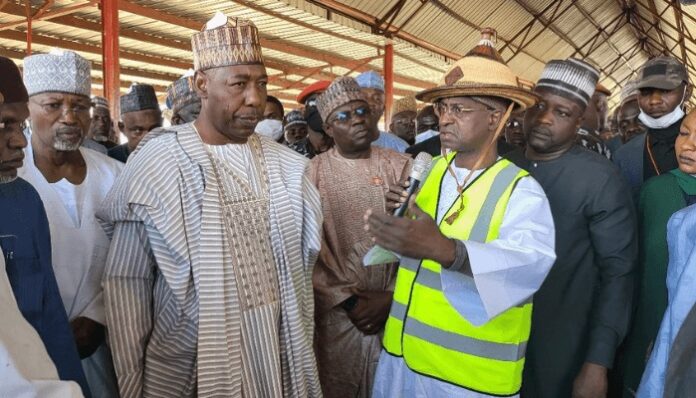
This initiative was disclosed by Babagana Zulum, the State Governor, at the launching of the Ngarannam Ranch in the Mafa local government area of the State, on Saturday, January 11, 2025, aims to rejuvenate the local economy and empower communities that were devastated by years of the Boko Haram conflict.
“The project has facilities that include a housing estate with road networks, schools, health clinics, veterinary services, and state-of-the-art dairy and beef upgrading centres. Other facilities are pasture development centres, milk collection centres, earth dams to secure water supply, markets to foster local trade, and security outposts to ensure a safe and secure environment for all.”
The occasion characterised the new phase of lives for a total of 461 households comprising women and men across 18 destroyed communities, who each received pairs of bulls, heifers, goats, and a humanitarian relief package containing essential food and non-food items.
He said the project is beyond economic and humanitarian benefits, the Ngarannam Ranch also offers educational programmes to guarantee the future of young nomads. The programmes teach sustainable farming practices and bring together diverse groups of nomads, fostering social cohesion and collaboration for a common purpose.
Zulum noted that Ngarannam Livestock Improvement and Ranch Settlement is a 4-square km project built for 461 nomadic families from eighteen communities affected by the Boko Haram insurgency.
He said, “In addition to a house, each of the 461 families received pairs of bulls and heifers, goats, and a humanitarian relief package consisting of essential food and non-food items.
RUGA would drive development growth, employment
Also, the events were attended by a university don and Co-Chair of the Presidential Livestock Reforms Committee, Attahiru Jega, who said the ranch is the first of its kind in the country, describing it as laudable projects and worthy of emulation which would ultimately enhance livestock exportation.
Jega said the initiative is highly commendable and encouraging that Borno State has shown leadership and commitment to livestock development.
“I must say that I witnessed something I had never seen in our country today. We have seen today the vision of a leader, the passion and commitment to what clearly will help drive economic growth, uplift the lives and livelihood of people and provide employment to our citizens.
He added, “It is gratifying that the state is ahead with the launching of the Annual Animal Vaccination Scheme and distribution of livestock for livelihood restoration and economic empowerment of the citizens. It is commendable that the state has both the Ministry of Livestock and Fisheries Development and Borno State Livestock Management Agency (BOLMA).”
He noted that the project aligns with the Federal Government’s vision for transforming the livestock sector into a more efficient and productive sector for national prosperity.
If commercialised livestock, and food crop exports are a game-changer
Mohammed Alkali, the past immediate executive chairman of Borno state Internal Revenue Service, a revenue/ tax professional and a public policy analyst hinted the Borno state government RUGA model project if commercially run and replicated across several areas of the state suitable for livestock farming can indeed generate revenue to the government outside the current known revenue streams.
He urged the initiative would be a game-changer for the state but the beneficiaries of the RUGA model should be given the requisite modern skills and techniques in commercial livestock production and management to improve livestock turnover and yield profit.
He noted, “For the above objectives to materialise, the Borno state government should commercially run the program perhaps by involving its investment arm, the Borno state investment company. We should be business-oriented in the project spotlight and systematically guarantee livestock and crop production export.
He added, “it’s possible for Borno state to lead in the export of livestock to the Persian Gulf countries and western Europe if livestock processing plants are set up that meet the food accreditation standards of these potential importers of livestock products. The upgrade of the Maiduguri International Airport for foreign operations is a welcome development that should aid in the export of livestock and food crops.
“As it were, the proposed meat processing firm owned by the Borno state government through its investment arm- Borno State Investment Company could also buy livestock from within the state and outside the state, process them and export the same to earn revenues to the state government. These initiatives combined should aid the state government in reducing its reliance on FAAC allocations.
“The markets for vegetables, fruits, meat and foods are indeed big and growing in the Middle East and western Europe for Borno state to explore given our proximity to these high-end markets. However, we wouldn’t be able to use these opportunities without meeting their strict import standards. Hence, the need to commercially run these projects while the state government gives its best political will. If these suggestions are followed, the state government could indeed earn more than its current FAAC in-flows.
Boko Haram steal at least 85 percent of livestock in Borno
Ibrahim Muhammad Mafa, immediate National Chairman of Al Hayah Cattle Breeders Association of Nigeria, revealed that before the advent of insurgency conflict there used to be clashes between farmers and herders as a result of encroachment of farmlands and cattle routes
He opined that Borno state is the largest domestic livestock apart from other livestock coming from Sudan, Chad and Niger Republic then which is being transported to the southern part of this country, based on the record from the Ministry of Agriculture almost 100 trucks of livestock leaving the Borno State to the southern part on daily bases from different locations like Bama, Banki, Dikwa, Ngala, Auno, Miringa, Kwaya-Kusar, Maiduguri, Monguno, Mainok, and Damboa.
“This is timely, with RUGA the animals would be stationed in one location, and this would ensure the safety of their livestock, recently Boko-Haram terrorists attacked farmers near Baga town so with this development Boko-Haram would not be able to steal their cow. We are the largest livestock producer in the country, and we have suffered severely from this decade-long crisis.
“At least 85 percent of livestock in Borno was stolen by the terrorists to fund their evil campaigns. I think insurgents have wreaked havoc on us as cattle rearers but the state government would provide pastures for them and other necessities. it would generate a lot of revenue, create value chains and boost our economy. Livestock is very important, it provides nutrients, employment and revenue to the governments.
Abu Muhammad, who lost two sons with their livestock, which were taken by the terrorists after their displacement and the destruction of their livelihood, also shared her struggles. Life has been incredibly tough for her and her family.
Abu received a bull, a heifer, a male goat, a female goat, a house, and relief materials, recalled that he lost a herd of cows to insurgents’ attacks in Karachi village in Mafa LGA.
He revealed that the ordeals were bad and the hardest time of his life, urging the state government to provide adequate security and safety for the RUGA community.
“We have our lost cows and bulls again, it is a good thing that has happened to us in this new year. We understand the trade, if you come back next to check the animals would be triple what you see. All we need is security so that terrorists will not rip off our labour again.
Saleh Banna explained that they were attacked several times by the terrorists. Madukni settlement lost over 12,000 cows, sheep, goats, and other livestock to the insurgents when they attacked their areas.
“The terrorists forced us out of our communities, leaving us homeless. I lost more than 100 cows, goats, and sheep along with our food supplies. They also killed my father and looted everything we had. We have been living in the camp for the past 10 years. Now that the government has provided us with a house and support, we are determined to make the most of this opportunity to improve our lives”, he said.
Bukar Alamin, a father of 17 children and three wives, also expressed the difficulties his family has faced since their displacement. He explained that the situation has been particularly challenging, as they have struggled to cope with the hardships of living in the camp since they were forced to flee their community.
He described life in the camp as a horrible experience, particularly due to the lack of privacy, which was especially difficult for him as a family man. He recalled the tragic story of one man, whose wife lost her pregnancy while fleeing the terrorist attack in their community. Despite the suffering, he expressed that the support they have received has rekindled their hope for survival.
Musa Yunus commended the government for providing them with another opportunity after enduring years of hardship. “With the support we have received today, our lives will improve. We are determined to use the livestock to turn our fortunes around. We are deeply grateful to both the Borno State government and the federal government for empowering us”, she said.