
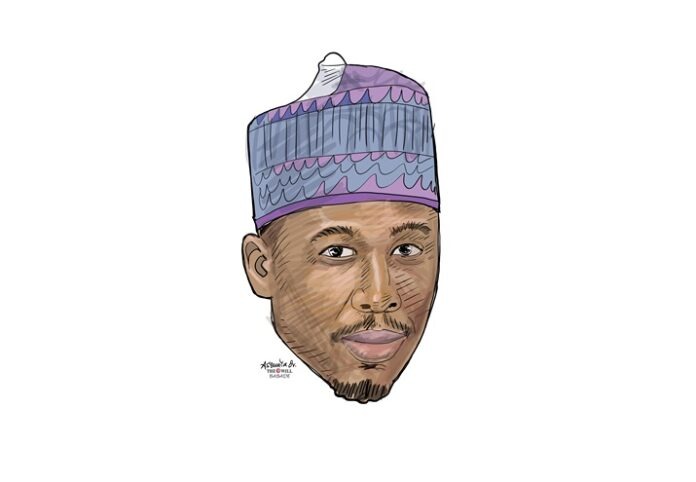
February 22, (THEWILL) — As Borno continues on its path of reconstruction and urban renewal, in pursuit of a 21st-century smart-city vision, many believe that the Borno Geographic Information Service (BOGIS) under Adam Bababe offers a clear roadmap for other public institutions seeking to align administrative competence with cultural consciousness.
From day one, BOGIS’s capacity to drive digital reform while safeguarding heritage has not only restored confidence in land governance but has also affirmed the potential of public service when placed in capable hands.
Most remarkable in this story-rewriting process is the transformation and upscaling of urbanisation in the state’s capital city, Maiduguri, and other principal towns, keeping pace with the restoration of peace and security. This is most strikingly evidenced by the construction of New Maiduguri and the broader shift in land governance from an age-old, fraud-prone, and accountability-weak traditional system to transparent digital platforms.

Beginning with the construction of New Maiduguri, necessitated by the city’s rapid expansion and the urgent need to decongest the metropolis, the state government, through BOGIS, has embarked on a massive transformation of land titles along the Ring Road cutting through the Maiduguri Metropolis, Mafa, Konduga, and Jere Local Government Areas.
Governor Zulum flagged off the construction of the ring road last year. The new city is to be developed on both sides of the road. BOGIS has designed five layout templates and is already allocating plots according to their classifications and the choices of individual or corporate applicants, categorised as high, medium, or low density, either residential or business/commercial.
Most striking in this development is the frenzy among estate developers and industrialists already acquiring plots. Projects in the pipeline include a solar panel plant, a gas plant, numerous filling stations, and an inland dry port.
Alongside these, an industrial hub is also taking shape in the area. The Zulum administration is currently building the Kashim Ibrahim University Teaching Hospital and staff quarters, as well as the Mai Mala Buni Estate and a modern trailer park, all situated within the new layouts.
Seven estate developers are among the top investors that have applied for plots to establish business enterprises. Three have already begun building massive housing estates, while the other four are finalising their paperwork.
“We are telling the whole world that Borno is safe for investors, and they should come and invest in the Borno economy. Some of these investors are from Abuja and Lagos; many have reached out to us, but we are taking our time studying their MoUs,” said Engr. Adam Bababe, Executive Secretary of BOGIS.
“The layouts we are presenting today are not merely parcels of land. They represent Governor Professor Babagana Umara Zulum’s unwavering commitment to urban renewal and sustainable development as enshrined in our 25-Year Development Plan and its 10-Year Implementation Strategy.”
THEWILL recalls that nearly two years ago, Governor Zulum flagged off the ring road that encompasses the entire Maiduguri metropolitan area, connecting critical locations from the Njimtilo axis through Gwange, Tungushe, and the Chad Basin Research Institute area, extending to Dalori and Silvaz in Mafa, and looping back to Njimtilo near the University of Maiduguri Teaching Hospital.
Phase one of the project, spanning 16.5 kilometres, is already underway, with 10 kilometres paved and fully operational. Along this transformative corridor, BOGIS has meticulously designed multiple residential and commercial layouts to accommodate the state’s growing population and facilitate economic expansion.
“As of today, we have launched four layouts comprising 2,777 plots, offering a mixture of residential, commercial, industrial, and recreational spaces. Within the week, a fifth layout with an additional 2,100 plots will be released, bringing our total to approximately 4,877 plots available for allocation,” Bababe said.
“What makes this initiative truly revolutionary is not simply the impressive number of plots, but rather the seamless, transparent, and corruption-free digital process through which they are being allocated to deserving citizens.”
He declared emphatically that the days are gone when citizens needed to interact with officials, pay bribes, or seek connections to secure land. “You apply online, your application is processed online, and approval is granted online. No one needs to know your face. No one needs to like or dislike you. The system is fair, transparent, and incorruptible.”
For citizens less familiar with digital technology, BOGIS has thoughtfully incorporated a representative-appointment feature, allowing applicants to designate trusted individuals to manage their applications on their behalf. All such arrangements are fully documented within the system for complete accountability and transparency.
BOGIS has demonstrated remarkable technical mastery and urban planning expertise by segmenting available plots into three carefully designed density categories. High-density plots measure 450 square metres, equivalent to the traditional 50 feet by 100 feet plot size, and are priced between N750,000 and N4 million, depending on location.
Bababe noted that the agency has also adopted strategies to control the circulation of fake land titles, and emphasised that since the inception of the Zulum administration, reforms have made land more accessible and affordable to the general public.
Since his appointment as Executive Secretary of BOGIS, Adam Bababe has presided over one of the most ambitious and successful transformations in the history of land administration in Borno State.
BOGIS has not only achieved unprecedented institutional efficiency but has also restored critical elements of Borno’s cultural identity. One of the most significant efforts in this regard was the restoration of Maiduguri’s original street names, many of which had been replaced over time with names bearing no relevance to the state’s heritage.
These actions reflect a deliberate effort to protect Borno’s indigenous values from what Bababe described as creeping cultural imperialism. The restoration of historically and culturally appropriate street names has renewed pride and a sense of ownership among local communities, strengthening the bond between citizens and their environment.
The results achieved by BOGIS over the five years from 2020 to 2025 provide a compelling case study in public-sector transformation. During this period, the agency conducted valuation assessments for compensation in more than 2,000 cases and successfully executed 1,604 valuation assignments.
Additionally, 597 survey and subdivision assignments were carried out, with only 45 cases left unresolved, an efficiency rate rarely recorded in public land administration anywhere in Nigeria.
In the grants and allocations area, the agency processed 6,713 requests, received 6,102 files, and fully processed 6,005 of them. Only 97 files remained pending, underscoring the high operational throughput achieved under Bababe’s leadership.
Further data from 2021 to 2025 reinforces the agency’s performance. Within that period, 2,098 valuation files were received and 1,708 approvals were issued by the Governor. Another 449 files were processed following payment of the required consent fees, and 764 cases involving surrender and subdivision were successfully completed.
Only 218 cases were delayed by non-payment of the seven per cent statutory fees, while 189 files were pending due to outstanding ground rent. An additional 201 consent and deed-of-assignment files were awaiting final approval from the Governor.
The issuance of 1,792 Certificates of Occupancy during the same period further attests to the success of the reforms. Analysts say such numbers are not just impressive, they are transformative, given that land administration has long been plagued by inefficiency, corruption, and opacity.
Many attribute the success to a combination of leadership integrity, system automation, and consistent performance monitoring. The agency’s revenue collection has improved markedly, with previously overlooked or infrequently paid charges now being remitted promptly, contributing to the growth of Borno State’s internally generated revenue.
Borno, a state globally associated with insecurity, is rewriting its story: from terror to business, tourism, and real estate development. The message is clear: the troubled Lake Chad shores entity is striding out of its predicaments and into new possibilities for global investors to explore.

