
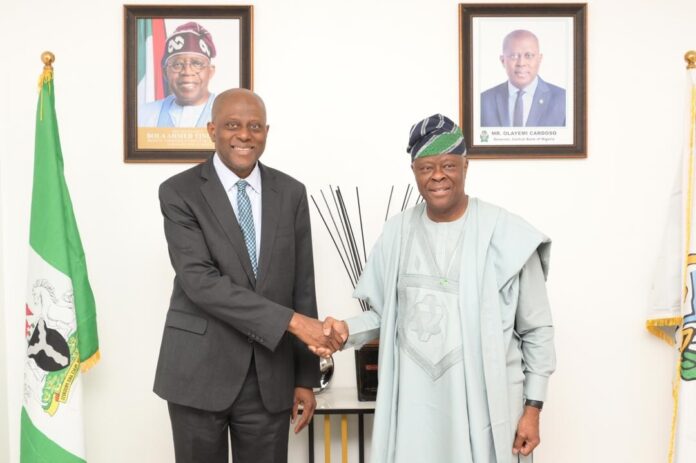
March 13, (THEWILL) — Governor of the Central Bank of Nigeria (CBN), Mr. Olayemi Cardoso, on Thursday said the macroeconomic reforms and policy buffers built over the past two years have placed Nigeria in a stronger position to withstand emerging global economic shocks, including those arising from geopolitical tensions involving the United States, Israel, and Iran.
Cardoso stated this in Lagos while delivering the annual Distinguished Alumni Lecture of the St. Gregory’s College Old Boys Association in celebration of the college’s Founders Day.
The lecture was titled “Strong Foundations: From the Classroom to the Capital Base.”

He noted that the global economy was currently facing renewed uncertainties triggered by geopolitical tensions and conflicts that could disrupt global markets.
“Today, the global economy is facing renewed shocks, including continued geopolitical tensions and the latest developments in the US–Israel–Iran conflict,” Cardoso said.
“These events have the potential to push energy prices higher, disrupt supply chains, and increase risk aversion among global investors.
“But the macroeconomic reforms and policy buffers we have built over the past two years have placed Nigeria in a far stronger position to navigate these challenges.”
Cardoso also stressed that the CBN was paying close attention to the rapidly expanding financial technology ecosystem by establishing clear regulatory guardrails to ensure stability and trust within the system.
According to him, the apex bank is strengthening frameworks around Know Your Customer (KYC), Anti-Money Laundering (AML), and operational risk management to support sustainable innovation.
“Just as capital buffers protect banks, these regulatory frameworks protect the integrity and credibility of the broader financial ecosystem,” he said.
“By combining innovation with discipline, technology with integrity, and opportunity with responsibility, we can ensure that Nigeria’s financial system not only adapts to the digital age but thrives in it.
“This is the bridge between strong foundations today and sustainable growth tomorrow.”
Meanwhile, stakeholders from the private sector, academia, and civil society have also acknowledged the necessity of the ongoing economic reforms introduced by the federal government.
However, they expressed concern that the speed of implementation, coupled with weak social protection measures and persistent infrastructure gaps, has continued to exert significant pressure on businesses and ordinary Nigerians.
The concerns were raised in Abuja during a stakeholders’ dialogue on “Sustaining and Deepening Economic Reforms in Nigeria,” organised by Agora Policy in collaboration with the Nigerian Economic Summit Group (NESG), with support from Nigeria Economic Stability and Transformation (NEST) and UK International Development.

Ogochukwu Onwaeze is a writer specializing in business and economic journalism. At THEWILL News Media, she translates market trends, financial developments, and policy shifts into clear and engaging stories.
