
-
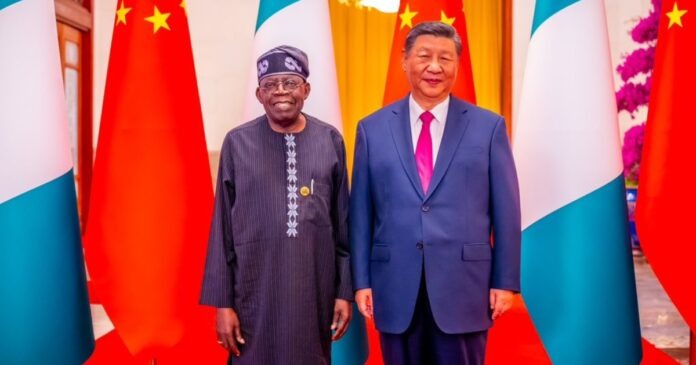
Chinese capital inflows into Nigeria fell 40.9 percent to $5.55 million in the first quarter of 2026, despite the Federal Government’s announcement of more than $20 billion in investment commitments.
-
China’s share of Nigeria’s total capital importation weakened to just 0.05 percent during the quarter, even as overall foreign capital inflows into the country surged 83.8 percent to $10.37 billion.
-
The figures underscore the widening gap between investment announcements and actual capital deployment, suggesting many of the proposed Chinese-backed projects are yet to translate into recorded foreign investments.
July 28, (THEWILL) — China’s capital inflows into Nigeria fell sharply in the first quarter of 2026 despite the Federal Government’s announcement that it had secured more than $20 billion in investment commitments from Chinese investors, highlighting the gap between investment pledges and actual capital entering the economy.
Analysis of the National Bureau of Statistics (NBS) Capital Importation Report for Q1 2026 showed that capital imported from China declined to $5.55 million during the review period from $9.39 million in the corresponding quarter of 2025, representing a 40.89 percent year-on-year decline.
The latest figure also represented a 13.69 percent drop from the $6.43 million recorded in the fourth quarter of 2025, indicating that Chinese capital inflows weakened on both annual and quarterly bases despite expanding economic ties between both countries.

$20bn commitments yet to reflect in inflows
The decline comes months after the Federal Government announced that it had secured over $20 billion in investment commitments from Chinese investors across agriculture, automotive manufacturing, mining, steel production and energy.
In July 2025, the Minister of Power, Joseph Tegbe, who was then Director-General of the Nigeria-China Strategic Partnership, said the commitments followed the elevation of Nigeria-China relations to a Comprehensive Strategic Partnership.
According to him, the projects are expected to boost food security, create jobs, improve power supply and position Nigeria as a manufacturing hub in Africa.
However, the latest capital importation data suggests many of the announced investments have yet to translate into recorded capital inflows, although large investment projects typically take time to move from commitments to actual disbursements.
China’s share declines despite overall surge
China’s contribution to Nigeria’s total capital importation also weakened during the quarter, falling to 0.05 percent from 0.17 percent recorded in the corresponding quarter of 2025. Compared with the previous quarter, its share also slipped from 0.10 percent.
An analysis of the five-quarter trend shows that Chinese investments have remained volatile. Capital inflows fell from $9.39 million in Q1 2025 to $2.69 million in Q2 before rebounding to $20.15 million in Q3, the highest level during the period under review. The recovery was short-lived as inflows dropped to $6.43 million in Q4 and declined further to $5.55 million in Q1 2026.
The slowdown contrasts with Nigeria’s broader capital importation performance. According to the NBS, total capital imported into the country rose to $10.37 billion in Q1 2026 from $5.64 billion in the corresponding period of 2025, representing an 83.83 percent year-on-year increase. Quarter-on-quarter, capital importation also rose by 60.97 percent from $6.44 billion.
Banking sector leads capital inflows
Portfolio investment remained the dominant source of foreign capital, accounting for $9.86 billion or 95.09 percent of total inflows. Other investments stood at $374.48 million, while foreign direct investment contributed just $135.08 million, representing 1.30 percent of total capital imported.
Sectoral analysis showed that the banking sector attracted the largest inflow at $7.55 billion, followed by the financing sector with $2.43 billion. Production and manufacturing received only $152.27 million.
By source country, the United Kingdom remained Nigeria’s largest provider of foreign capital with $5.08 billion, ahead of the United States ($3.18 billion) and South Africa ($983.83 million).
While the latest figures point to weaker Chinese capital inflows, they also underscore the challenge of converting high-profile investment announcements into actual capital deployment, particularly in sectors expected to drive Nigeria’s industrialisation agenda.

Ogochukwu Onwaeze is a writer specializing in business and economic journalism. At THEWILL News Media, she translates market trends, financial developments, and policy shifts into clear and engaging stories.
