
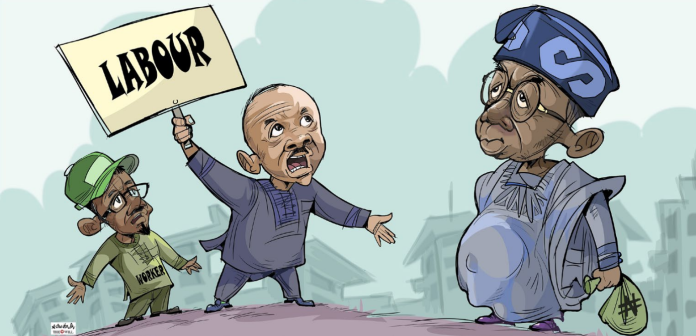
March 17, (THEWILL)- A 37-member Tripartite Committee is currently visiting the six geo-political zones to harmonise minimum wage for millions of Nigerian workers. Inaugurated by Vice President Kashim Shettima late January and comprising representatives from the government (federal and state), labour unions and private sector, it is chaired by Bukar Goni Aji, one-time Head of the Civil Service of the Federation. THEWILL finds conflicting reports from the sittings so far, putting the entire process in a dilemma. MICHAEL JIMOH reports…
For Christopher Osarodion (not his real name) a 43-year-old mid-level staff of the Edo State Ministry of Health in Benin City, last Christmas was one of the best for him and his family in a very long time. He cannot remember the last time he was paid 13th month salary as a civil servant in the ministry he’d worked for more than a decade.
In the heat of the Nigeria Labour Congress, Trade Union Congress face-off with both Federal and state governments to level off minimum wage at a reasonable sum in 2019, he didn’t give the unions any chance of success, any hope that workers like him in ministries would one day go home with a sizeable pay packet. But it worked, at least in his native state, under the administration of Governor Godwin Obaseki. The state not only implemented the minimum wage as stipulated by the union bosses but also paid promptly. And, surprise, surprise, before Christmas last year, Governor Obaseki promised to pay 13th month salary to all workers under the employ of the state government. He did. Instead of the N30k minimum wage, Obaseki paid N40k.

“Unlike past Christmases when my wife had to shop for hand-me-downs for the children in flea markets at Ring Road,” Osarodion recalled, “I sent for the family tailor to come and take their measurements at home.” In the health worker’s words, that was how his own father, who was a school teacher in a popular secondary school in the ancient city, presented his children with new clothes for Christmas. No secondhand wears, no crumbling shoes or even accessories that have seen the worst of times.
“For one brief period in my long working career,” Osarodion happily told friends, “I could do for my children what my father did for me and my siblings when the going was good back in time.”
Ajisafe Ogunshakin (not real name as well) Osarodion’s counterpart in the same ministry in Ogun State would have loved to do the same thing for his children about the same time last year. He is older than Osarodion by two years and has worked in the Ogun State Ministry of Health for more than two decades. But Ogunshakin just could not afford to hire a tailor to sew custom-made Christmas clothes for his children. It is not hard to see why.
Instead of the N30k NLC bargained for workers the union represented everywhere in Nigeria, his state government paid half that sum, that is N15k monthly. Worse still, salaries didn’t come as and when due. Despite being declared one of the solvent states in the country all through last year and thereafter, Ogun owed salaries serially, thereby ruling out 13th month bonus pay to workers in the state’s employ. For the Ogunshakins therefore, it was a bleak Yuletide. “We couldn’t even afford the proverbial Christmas roast. We had fried fish instead with plenty of onions, just to let our neighbours know there was serious action going on in our kitchen.”
Across many states last year, families like the Ogunshakins could not afford to put a delectable roast on the table not for lack of a king-sized appetite for browned chicken breast or wings but because of affordability. After the removal of fuel subsidy on May 29 last year by President Bola Tinubu, life had become increasingly difficult for many of them, resulting in a sharp decrease in their purchasing power.
Transport fare, house rent and sundry services for their daily needs ramped up by nearly 200 percent. Against that ugly scenario and from the get-go, labour locked horns with the relatively young administration of Bola Tinubu (four since swearing-in last May) by our last count.
Even so, that would not be the first time union bosses squared off with the government. There have been threats of embarking on indefinite strike actions on account of poor pay for those they represent against the worsening economic conditions in the past decade. Perhaps in order to find a permanent solution to that perennial problem, in May 2017, the House of Representatives moved to amend the National Minimum Wage Act to be reviewed every five years. Two years later, President Muhammadu Buhari signed the Minimum Wage Act into law pegging it at N30k. Despite this presidential seal of approval, many states refused to comply, with the governors insisting they didn’t have the kind of money or resources required to meet that amount.
According to a recent BudgiT report, 15 states are yet to implement the minimum wage, notwithstanding that all the 36 states “grew their cumulative personnel cost by 13.44 percent to N1.75tn in 2022 from N15tn in 2021.”
In its ‘State of the States’ report 2023, the Civil Service Organisation disclosed that the 36 states of the federation grew their revenue by 28.95 per cent from N5.12tn in 2021 to N6.6tn in 2022. “Put together, the Internally Generated Revenue of the 36 states appreciated by 12.98 per cent from N1.61tn in 2021 to N1.82tn in 2022, denoting a strengthened domestic revenue mobilisation capability. Nonetheless, the IGR to GDP ratio remained very low at 1.01 per cent. The increase in IGR did not reflect across board as 17 states experienced a decline in their IGR from the previous year while 19 states recorded positive growth. Occasioned by a 49.2 per cent increase in global oil prices, growth in federal transfers rose by 35.68 per cent from the previous year to N4.05tn, despite a 12.55 per cent drop in crude oil production.”
Despite this rise in revenue generation and increased Federal Allocation, many of the states have refused to pay the N30k minimum wage. Only a few of them like Edo have begun paying. Surprisingly, oil-rich states like Akwa Ibom, Bayelsa and Delta have defaulted serially.
Following a meeting with the labour unions to avert another imminent strike early this year, President Tinubu approved a provisional wage award of N35, 000 for Federal workers for six months. At that time, some states were unwilling or unable to pay the previous N30k minimum wage approved by Tinubu’s predecessor Buhari. As a result of that and following Tinubu’s provisional wage award, state chapters of the NLC and TUC made sure governors of their respective states got the message.
One of them, Kano State NLC chairman, Kabiru Inuwa, told journalists afterwards, “We have written to the government requesting payment of the wage award to workers in the state and we are still waiting for the government to respond.”
Likewise, his colleagues from Bayelsa, Benue, Delta, Gombe, Katsina, Kebbi, Kwara, Niger, Ondo, Ogun, Osun and Rivers States have written to their respective state governments. No response so far.
It is against this backdrop that the Tripartite Committee on National Minimum Wage set up by the Federal Government is now touring some states in the six geopolitical zones to harmonise minimum wage, to sort of find a solution to what has clearly become a dilemma.
Chaired by Goni Aji, representatives of the Federal Government include Nkeiruka Onyejeocha, Minister of State, Labour and Employment. She is representing the Minister of Labour and Employment. Wale Edun, Minister of Finance & Coordinating Minister of the Economy; Alhaji Atiku Bagudu, Minister of Budget Economic Planning; Dr. (Mrs.) Yemi Esan, Head of the Civil Service of the Federation; Dr Nnamdi Maurice Mbaeri, Permanent Secretary, GSO. OSGF and Ekpo Nta, Esq, Chairman/CEO, NSIWC – Member/Secretary.
State governors are also members of the committee. Thus, Mohammed Umar Bago of Niger sits in for North-Central, Bala Mohammed of Bauchi for North-East and Umar Dikko Radda of Katsina for North-West. From Anambra is Charles Soludo for the South-East, Ademola Adeleke of Osun for the South-West, Otu Bassey Edet of Cross River for the South-South.
Organised labour has president of NLC, Joe Ajaero, fellow comrades Emmanuel Ugboaja, Adeyanju Adewale, Ambali Akeem Olatunji, Benjamin Anthony and Theophilius Ndukuba. President of TUC, Festus Osifo, is a member, so with Tommy Etim Okon, his deputy. Others from TUC are Kayode Surajudeen Alakija, Jimoh Oyibo, Nuhu A. Toro and Hafusatu Shuaib, the chairperson of the Women Committee.
Representatives of Nigeria Employers’ Consultative Association (NECA) are part of the committee. DG of NECA Adewale-Smatt Oyerinde, Chuma Nwankwo and Thompson Akpabio are members of the committee, just as President of Nigeria Association of Chambers of Commerce, Industry, Mines and Agriculture (NACCIMA) Michael Olawale-Cole, Ahmed Rabiu, National Vice President and Chief Humphrey Ngonadi (NPOM), National Life President.
Included in the committee are representatives of the National Association of Small and Medium Enterprise (NASME): Abdulrashid Yerima, President and Chairman, Theophilus Nnorom Okwuchukwu, Private Sector representative. Muhammed Nura Bello, Zonal Vice President, North West. From the Manufacturers Association of Nigeria (MAN) are Mrs. Grace Omo-Lamai, Human Resource Director, Nigerian Breweries, Segun Ajayi-Kadir, Director-General, MAN, Ada Chukwudozie, MD of Dozzy Oil and Gas Limited.
Early in March, the committee had its first meeting in the South-West geopolitical zone. Venue was Lagos with the Lagos State Head of Service, Olabode Agoro, Wale Edun, Minister of Finance and Coordinating Minister of the Economy and Governor Ademola Adeleke of Osun state in attendance. Remarkably, there was no consensus of opinion among the labour officials in attendance. For instance, while NLC rooted for N794k as minimum wage, TUC plumped for N447k, thus bringing a sharp division among them. On their part, the states admitted that the new wage payment would be possible only if they get higher allocation from the central government and control mineral resources.
Representing the workers in Lagos state, Funmi Sessi and Gbenga Ekundayo of NLC and TUC, respectively, said the increment is “required to narrow the widening gap of poverty among the employed and mitigate the erosion of the living standards of Nigerian workers,” adding that “workers in the country deserve a living wage that would be set at a level that is fair and commensurate with economic realities” because “the cost of essential services, such as food, housing, transportation, healthcare and education has risen tremendously and astronomically, making most of these services and goods out of the reach of the workers.”
In his defence of the N447k minimum wage for workers, Ekundayo said that compared to the minimum wage in operation in other African countries, Nigeria’s is one of the lowest. Nigeria has since been left behind in that regard, he noted, declaring, “What Nigeria has as a national minimum wage was nothing but deceit that is borne to keep an average worker perpetually poor.
“Out of the eight countries surveyed, Equatorial Guinea has the least amount as minimum wage, which is $224 per month. This is way off from that of Nigeria, which is $20 per month. The difference in the minimum wage in Equatorial Guinea compared to Nigeria is 1,195 per cent,” Ekundayo told the committee. “The National minimum wage being asked for through this memorandum, i.e. N447,000/month (an equivalent of $298/month) is therefore apt for now.”
Governor Adeleke of Osun state thought, felt and spoke otherwise. Unless the sharing formula of the Federation Account Allocation Committee (FAAC) is reviewed and solid minerals moved from exclusive to concurrent legislative list, paying the minimum wage will remain unfeasible.
Adeleke’s spokesperson Olawale Rasheed admitted that from meetings and various deliberations with stakeholders in Osun, workers in Nigeria “are due for an improved welfare package. There is a consensus for an upward review of the National Minimum Wage because the existing one has become unrealistic,” adding that “while it would be desirable to see that a uniform minimum wage is agreed on a national basis, it would amount to self-deceit to assume that states have equal ability to pay.”
So, going forward on the matter, Adeleke urged the Federal Government and National Assembly to “remove solid minerals from the exclusive legislative list. Every state in Nigeria has been blessed with one form of natural resource or the other. There is a strong appeal to move solid minerals from exclusive to concurrent legislative list.”
Even before the tripartite committee had its maiden meeting in Lagos, organised labour had proposed a different minimum wage. NLC proposed N709, 000 while TUC proposed N447, 000.
Also, for the six geopolitical zones, NLC and TUC have differed widely. TUC roots for N540, 000 per month in the South-East against N794, 000 in the South-West and then N850,000 in the South-South, compared to N560,000 in the North-East, N485, 000 in the North-West and N709, 000 in the North-Central.
Surely, that is the dilemma the Tripartite Committee hopes to resolve by the time it covers the entire six geopolitical zones. They have until the end of this month. Already Vice President Shettima admonished them to “speedily” arrive at a resolution and submit their reports early because “this timely submission is crucial to ensure the emergence of a new minimum wage.”
NEWS
Disregard Calls For Visa Ban on INEC Chairman – Traditional Rulers Tell UK
The Nigerian Traditional Rulers Council (NTRC) has urged the United Kingdom (UK) to discard calls for visa ban on Prof. Mahmood Yakubu, Chairman of the Independent National Electoral Commission (INEC).
In a letter addressed to the British High Commission, and signed on behalf of the Council by HRH Oba Adekunle Adeyemi (Adara of Adara, Ogun State), HRM King Alfred Prince Will (Amanyabo of Bassambiri, Bayelsa State), His Eminence Emir Ahmed Yayale (Charanchi, Katsina State), HRH Alhaji Muhammad Bubu (Lushi Takololo, Bauchi State), HRH Eze Obinna Opoji (Ama of Amajuoyi Kingdom, Imo State) and HRH Alhaji Audu Eleje (Elejuku of Eluku, Kogi State), the traditional rulers described the calls as mischievous and malicious blackmail by a faceless group.
According to the traditional rulers, the attacks and calls by the group, identified as United Nigerians in Diaspora (UND), are engineered by “disgruntled politicians” who lost elections in 2023.
The Letter reads in part: “We, the Nigerian Traditional Rulers Council, write His Excellency to address the malicious attack on Mallam Mahmood Yakubu, the Chairman of the Independent National Electoral Commission (INEC).
“It has come to our attention that a certain faceless group named United Nigerians in Diaspora Group, sponsored by disgruntled politicians who lost elections in 2023, have levelled serious allegations against the INEC Chairman. We are deeply concerned about these accusations by this faceless group and feel compelled to set the record straight.
“The allegations made by these politicians are baseless and unfounded. We believe that they are attempting to tarnish the reputation of Mallam Mahmood Yakubu and, by extension, the INEC. We vehemently reject these accusations and stand firm in our support for the INEC Chairman.”
According to the Council, the Yakubu-led INEC has made significant progress in “conducting free, fair, and credible elections in Nigeria. The electoral process has been streamlined, and voter confidence has been restored.
The INEC has implemented innovative technologies, such as the use of biometric voter registration and electronic transmission of results, to ensure transparency and efficiency.
“Furthermore, the claims made by these disgruntled politicians are clearly politically motivated and aimed to undermine the credibility of the INEC and its Chairman. It is no surprise that these allegations have emerged now, following their losses in the 2023 elections. It is an attempt to shift blame for their defeat onto the INEC and distract from their own shortcomings.”
The traditional rulers also unequivocally expressed their support for the INEC chair, saying: “We, the Nigerian Traditional Rulers Council, stand firmly by Mallam Mahmood Yakubu and express our full confidence in his ability to lead the INEC effectively.
“His tenure has been marked by integrity, professionalism, and commitment to democratic ideals. The INEC, under his stewardship, has become a beacon of hope for the Nigerian electoral system.”
The Council called on the UND to stop its unfounded and spurious allegations forthwith against the INEC boss, and also respect INEC as an independent institution.
They also appealed to Nigerians to work together to strengthen the country’s democracy, despite the challenges which other advanced democracies are also experiencing.
“We urge all United Nigerians in Diaspora (UND), politicians and their supporters to exercise restraint and respect the independence of the INEC. It is essential for the peaceful coexistence of our nation that we uphold the democratic process and refrain from unfounded accusations and attacks.
“We call upon all Nigerians to respect the rule of law and work together towards a better and stronger democratic Nigeria.
“In conclusion, we wish to inform His Excellency that we reiterate our unwavering support for Prof. Mahmood Yakubu and the INEC. We reject the malicious allegations made by UND and disgruntled politicians and call on all Nigerians to unite behind the INEC in its efforts to strengthen our democratic process. Let us remember that peaceful, free, and fair elections are the bedrock of our nation’s progress and prosperity.”
Michael Jimoh is a Nigerian journalist with many years experience in print media. He is currently a Special Correspondent with THEWILL.
