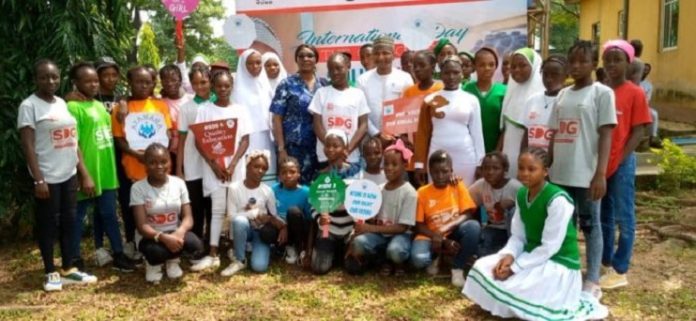
Connected Development (CODE), in collaboration with Ayamara Foundation on Friday called for abolition of harmful practices against girls as they empowered the girls with digital skills and other skills.
The civil society organisations, at a two-day capacity building for 50 girls in the Federal Capital Territory, said the move was to promote the inclusion of girls in the Science, Technology, Engineering and Mathematics (STEM) academic discipline in Nigeria.
This, according to them, is to ensure that the girl-child is not left behind in fulfilling sustainable development goal (SDG) 4 – Education.

Mr Hamzat Lawal, A Malala Fund Global Education Champion and the Chief Executive Officer of Connected Development (CODE) said it was important to continue to engage girls to transfer knowledge and equip girls to become advocates.
Lawal said beyond that, there was need to give the girls knowledge around STEM, where we can have the next astronauts, the scientist, the next innovative ideas come from the girl –child.
“Education is a right and I want to hope that this kind of engagement will inspire the governments to one, increase budget allocation to the education sector, but also release these resources and use it judiciously.
“Today we have over 20 million out of school children, which over 50 per cent are girls, particularly in northern Nigeria, Nigeria cannot attain her full potentials if girls do not go to school and roam around the streets.
“It takes a minute to inspire a generation; I hope that this will inspire them and this memory and the moment we spent today will continue to push them to remain resilient, go to school, but most importantly, become a shining light of our country.
“Let girls be girls, let them not be housewives, my biggest challenge and the threat to our society is the fact that we are giving girls out in marriage; this is wrong.”
Lawal said although the country was faced with challenges of poverty, girls were not meant to be brides and citizens should desist from such acts.
“The fabric of society is demeaning, if girls continue to be brides ,then it means our children would end up in the streets, so let us allow girls to be girls so they can flourish and grow and in meet their full potential,” he said.
Lawal said that his work with Malala was focused on the grassroots, adding that the work started in the Northeast to end early child marriage, accelerate girl-child education and ensure that no girl was on the streets in the zone.
He expressed hope that this would be scaled up across the country though collaboration with other stakeholders especially the private sector because they have the immediate resources.
He said the group would also work with government to review existing laws and policies and advocate for the UBEC law which says compulsory nine years education to be changed to compulsory 12 years.
He said this was because most times girls in their senior secondary school dropout, but if a girl can attain senior secondary school, she would ensure that all her children would get to tertiary level.
Dr Stella Dorgu, the Chairman and Founder Ayamara Foundation, said the event was aimed at celebrating the girl-child in accordance to the UN’s directive.
Dorgu said this was because UN felt that the girl child needed to be buoyed in order for her to attain her full potential.