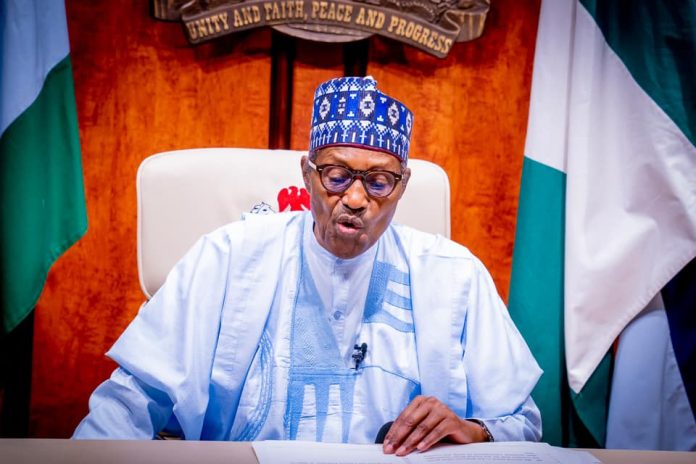
March 06, (THEWILL) – President Muhammadu Buhari finally signed the Electoral Act Amendment Bill 2021 into law on Friday, February 25, 2022 after much hesitation and this action got him accolades from many Nigerians, especially politicians and watchers of political developments in the country who believe that the new Act will enhance Nigeria’s democracy.
Reacting, a member of the Board of Trustees of the Peoples Democratic Party, Chief Olabode George, described the President’s signing of the Electoral Act as a right step in the right direction.
He said, “The much debated, much discussed and much delayed Electoral Bill has finally been signed into law by President Muhammadu Buhari.. This is a triumph for all Nigerians and for all advocates of genuine representative governance. I congratulate President Buhari for being courageous and forward looking enough to append his signature to this very significant Bill which has now become part of our law.

“This Electoral law is quite significant in many ways. It will forever remove the democratic process from the shackles of godfatherism and money bags who continue to sabotage the will of the people. It will equally reduce a great deal of electoral malpractices through the brazen forging of figures and other manipulative processes that hinder the growth of democracy.
“The Nigerian democracy is now on the path of liberation and emancipatory importance. The will of the people will now triumph over the shenanigans of a dirty few. This, no doubt, will deepen our democratic values and ensure the endurance of freedom and liberty. It is indeed a right step in the right direction.
“Nigerians have suffered a lot for this dawn of democratic. We must all applaud every opportunity that enhances our collective freedom. The next agenda that needs the attention of President Buhari is the devolution of powers, where all sections of our nation will be empowered to develop at its own pace without the overbearing intervention of the centre”.
The question one needs to ask is how will the new Electoral Law affect or shape the much-awaited 2023 general election.
One contentious provision in the new law is the one that disallows ministers, commissioners and political appointees from participating as delegates in the primaries of political parties, which also requires them to resign their appointments three months before the primaries take place, if they want to be delegates or contest the elections.
Clause 84 of the Act states, “No political appointee at any level shall be a voting delegate or be voted for at the convention or congress of any political party for the purpose of the nomination of candidates for any election.
“Where a political party fails to comply with the provisions of this Act in the conduct of its primaries, its candidate for election shall not be included in the election for the particular position in issue.”
What this connotes is that some key ministers in President Muhammadu Buhari’s cabinet believed to be nursing political ambitions will be barred from seeking the nominations of their parties, just as it means that ministers, commissioners and other political appointees must resign ahead of their parties ‘primaries in order to be eligible to contest in the primaries.
President Buhari alluded to the contentious clause while signing the bill into law when he said, “The practical application of section 84(12) of the Electoral Bill, 2022 will, if assented to, by operation of law, subject serving political office holders to inhibitions and restrictions referred to under section 40 and 42 of the 1999 Constitution (as amended).
“It is imperative to note that the only constitutional expectation placed on serving political office holders that qualify, by extension, as public officers within the context of the constitution is resignation, withdrawal or retirement, at least 30 days before the date of the election.
“Hence, it will be stretching things beyond the constitutional limit to import extraneous restrictions into the constitution on account of practical application of section 84(12) of the bill where political parties’ conventions and congresses were to hold earlier than 30 days to the election.
“Arising from the foregoing, with particular regards to the benefits of the Bill, industry, time, resources and energy committed in its passage, I hereby assent to the Bill and request the National Assembly to consider immediate amendments that will bring the Bill in tune with constitutionality by way of deleting section 84(12) accordingly.”
Also, the Inter-Party Advisory Council (IPAC) called on lawmakers to initiate the process of expunging the contentious clause 84 (12).
IPAC National Chairman, Engr. Yabagi Yusuf, insisted that Clause 84 (12) was contrary to the provisions of Sections 40 and 42 of the Constitution.
He said, “We share the views of the President on the clause, which makes it mandatory for political appointees to resign from their positions before participating as delegates at political party congresses and conventions or, as aspirants to elective offices.
“To us in IPAC, this clause runs contrary to the provisions of Sections 40 and 42 of the Constitution on the inalienable fundamental rights of every eligible citizen to participate in the electoral processes.”
IPAC also said that expunging the contentious clause would also bring the Act in tune with the Constitution, which categorically stipulates that political office holders are only to vacate their positions or appointments 30 days before the elections.
But a Constitutional Lawyer based in Abuja, Dr Kayode Ajulo, differed with Buhari and IPAC, when he said that literal interpretation of the provision of Section 84 (12) is that an appointee of the Executive should not and must not, be a delegate in primary elections while still in office, just as an appointee must not contest as a delegate while still in office at the convention or congress of any political party.
While looking as to whether the provision of Section 84(12) is in contravention with the provisions of the Constitution of the Federal Republic of Nigeria, 1999 (as amended)., Ajulo said, “First, it must be noted that the provision of Section 84(12) of the Electoral Act derives its validity from the Constitution and same does not contravene the provision of the Constitution. By the provision of *Section 228 of the Constitution of the Federal Republic of Nigeria, 1999 (as amended) the National Assembly has the power to provide guidelines and rules to ensure internal democracy within political parties, including making laws for the conduct of the party primaries, party congresses and party convention.
“Suffice it to note that varying provisions of the Constitution provide for the disqualification of persons from vying for the post of the senate or House of Representatives if he is a person employed in the public service of the federation or of any State and has not resigned, withdrawn or retired from such employment, thirty days before the date of election.
“It is also instructive to note that a public servant is also disqualified from contesting the position of President, Vice President, Governor and Deputy Governor respectively if same has not resigned from that position within a period of 30 days before the date of election.
“Having stated the above, the perdurable question to ask is whether a political office holder is a public servant under the provisions of the Constitution.
“By virtue of Section 318(1) of the 1999 Constitution, public service of the federation means the service of the federation in any capacity in respect of the Government of the Federation and includes: the Clerk of other staff of the National Assembly or of each House of the National Assembly; member of staff of the Supreme Court, the Court of Appeal, the Federal High Court, the High Court of the Federal Capital Territory, Abuja, the Sharia Court of Appeal of the Federal Capital Territory, Abuja, the Customary Court of Appeal of the Federal Capital Territory, Abuja or other courts established for the Federation by this Constitution and by an Act of the National Assembly; a member of staff of any commission or authority established for the Federation by this Constitution or by an Act of the National Assembly; the staff of any area Council; the staff of any statutory corporation established by an Act of the National Assembly; the staff of any educational institution established or financed principally by the Government of the Federation; the staff of any company or enterprise in which the Government of the Federation or its agency owns controlling shares or interest; and members or officers of the Armed forces of the Federation or the Nigeria Police Force or other government security agencies established by law. The section also makes similar provisions for public service of the State.
“One can argue that the reason for the requirement of resignation of a public servant before election is to ensure neutrality of persons in the Executive Administration of the Government at all levels and to prevent partisan politics in the civil service. Notably the Public Service Rules prohibits a Civil Servant from being involved in partisan politics. So if you want to be involved in partisan politics, you must resign.
“Section 4 article 030402(g) of the Public Service Rules categorically states that “engaging in partisan political activities” is one of the significant examples of serious misconduct.
“It is quite succinct to state that by the dint of the provisions of Section 318(1) of the Constitution of the Federal Republic of Nigeria as highlighted above, a political office holder is not a public servant or in the public service.
“It is apposite to note that the position of the law is that the express mention of one thing in a statutory provision or schedule, excludes the other. Since the Constitution expressly states that a public servant must resign within a period of 30 days before the conduct of the election, the said section does not include political office holders. Hence, political office holders cannot take coverage under these provisions of the Constitution.
As to whether Section 84(12) of the Electoral Act, 2022 disenfranchises political office holders as guaranteed under the provision of Section 40 of the Constitution of the Federal Republic of Nigeria, 1999 (as amended), Ajulo said :
“It must be stated pronto and very clearly too that the right to assemble freely and associate with other persons as provided in Section 40 and the right to form a political party as provided for under Section 221 of the Constitution has not been derogated from by the provision of Section 84(12) of the Electoral Act.
“The said provision has not precluded political appointees from becoming a member of a political party or to vote at general elections. It only precludes them from voting as a delegate at the party’s convention and congresses. This regulation only deals with the internal affairs of political parties. More so, a political appointee does not hold the office as of right but at the pleasure of the Chief Executive.
“Having established the legality of the provision of Section 84(12) of the Electoral Act, 2022, it is pertinent to state that most of these political appointees have ended up using their offices to intimidate political opponents of their principals during party primaries in a bid to retain their jobs.
“More so, the section of the Act was designed to create a level playing ground for all aspirants during congresses and conventions. It is instructive to note that the Section does not in any way undermine the rights of political appointees to hold office or participate in primaries or main elections.”
Another issue in the new Electoral Act is the provision that has to do with the registration of new political parties.
The Electoral Act states that “Any political association that complies with the provisions of the Constitution and this Act for the purposes of registration shall be registered as a political party: PROVIDED however, that such application for registration as a political party shall be duly submitted to the Commission not later than 12 months before a general election.”.
The INEC recently announced that Presidential and National Assembly elections have been slated for February 25, 2023, while the governorship and state assembly elections will now be held on March 11, 2023.
The implication of this is that it is too late to register new political parties before the next election. Those who are creating different political movements in order to turn them into political parties that will participate in the 2023 elections will not fulfill their ambitions. The Act has put a stop to their ambition.
Another provision of the Act is the one that creates room for the use of technological devices to accredit and transmit election results.
Many believe that the electronic transmission of results will ensure credible elections as they believe that manipulations between the polling units and the collation centres will be eliminated.
The Act makes the use of card readers or any other technological devices adopted by INEC as mandatory for accreditation before voting.
The Act states, “To vote, the presiding officer shall use a smart card reader or any other technological device that may be prescribed by the Commission, for the accreditation of voters, to verify, confirm or authenticate the particulars of the intending voter in the manner prescribed by the Commission
“Where a smart card reader or any other technological device deployed for accreditation of voters fails to function in any unit and a fresh card reader or technological device is not deployed, the election in that unit shall be cancelled and another election shall be scheduled within 24 hours if the Commission is satisfied that the result of the election in that polling unit will substantially affect the final result of the whole election and declaration of a winner in the constituency concerned.”

AYO ESAN, has been actively reporting and analyzing political events for different newspapers for over 18 years. He has also successfully covered national and state elections in Nigeria since the inception of this democracy in 1999.