December 01, (THEWILL) – Lagos State Government has rejected the report of the Judicial Panel of Inquiry that there was a massacre in Lekki Toll Gate during the 2020 #EndSARS protest.
According to the White paper released on Tuesday night, of the 32 recommendations made by the panel on the Lekki toll gate shooting, the state government only accepted 11, rejected one outright, agreed to six, albeit with modifications, while 14, which fell outside its powers would be forwarded to the federal government for consideration.
It said some recommendations cannot be accepted because of obvious inconsistencies and distortions.

However, the White Paper emphatically rejected claims that nine people died at the Lekki toll plaza.
To the government, the Justice Doris Okuwobi-led Lagos State ‘Judicial Panel of Inquiry (JPI) on Restitution of Victims of SARS-Related Abuses and Other Related Matters’ failed to establish arbitrary and indiscriminate killing of protesters at the toll gate.
It said the panel’s findings “are clearly and manifestly not supported by the evidence before the JPI as attested to by the JPI itself, when it said there was no contrary evidence to that of Prof. Obafunwa that only one person died at Lekki Toll Gate (LTG) of gunshot wounds on 21st October 2020”.
Rejecting the recommendation, it said: “The state government is, therefore, unable to accept the finding that nine (9) people died of gunshot wounds at LTG on 20th October 2020.
“It also follows that the irresistible conclusion to be drawn from the JPI’s acceptance of Prof. Obafunwa’s testimony that only one (1) person died of gunshot wounds at LTG on 21st October 2020 is that there was no massacre at LTG, contextual or otherwise.
“The findings of JPI that nine (9) people died at the LTG on 20th October 2020 from gunshots fired by the military are based on assumptions and speculations.
“The inconsistencies and contradictions in the entire JPI Report concerning the number of persons who died at LTG on 20th October 2020 and their cause of death rendered the JPI’s findings and conclusions there upon totally unreliable and therefore, unacceptable.
“The evidence of Pathologist Prof. Obafunwa, that only three of the bodies that post-mortem examination was conducted on, were from Lekki, and only one had gunshot injury, and this was not debunked. We deemed it credible as the contrary was not presented before the panel.
“This finding of nine deaths at LTG on 20 October is even more baffling because apart from listing out their names in that form on pages 297-298, the panel offered no explanation regarding circumstances of their death. The names simply sprang up on pages 297-298 of the report without any justification.
“It is quite astonishing that in the list of 11 deaths set on pages 297-298, two of the names appeared twice (Kolade Salam, Folorunsho Olabisi). Furthermore, the person listed as No. 46 Nathaniel Solomon, who testified as a witness and petitioned the panel in respect of his brother who he alleged died at LTG, himself listed as having died at LTG on October 20, 2020. Remarkably, Nathaniel Solomon’s deceased brother (Abata Solomon was then also listed as No. 2 on the list of persons who died at Lekki Tollgate).
“The only victim of gunshot injury from LTG was picked up at 7:43, on October 21, 2020, after the curfew started (see page 99). Furthermore, there was no shred of evidence regarding who shot him.”
According to the White Paper, the award of compensation to only one of the alleged nine listed as ‘deceased’ showed that the JPI itself had doubts as to the alleged death of eight other deceased persons on its list.
It added: “The JPI also surprisingly awarded the sum of N10 million to one Serah Ibrahim (listed as No. 14 on Page 304 of the report). Serah Ibrahim was neither a petitioner nor a claimant before the JPI. On page 179 of the report, Serah Ibrahim testified on oath that she did not have any petition before the panel; neither did she have any claims for compensation.
“This award to Serah Ibrahim is also contrary to the provisions of Section 13 Tribunal of Inquiry Law 2015 (Cap. T6 Laws of Lagos State) which prescribes that only witnesses summoned by a Tribunal of Inquiry are entitled to witness fees subject to the consent of the Attorney-General. Serah Ibrahim did not testify at the request or summons of the tribunal.
“The government is, therefore, unable to accept the finding that nine people died of gunshot wounds at LTG on October 20, 2020.”
However, the state agreed with the panel’s sixth recommendation that the use of social media played a significant role in escalating the crises and the need for restraint in spreading unverified pieces of information.
It noted that the Lekki Toll Gate incident was exacerbated by indiscriminate dissemination of unverified accounts of the events.
“Lagos State Government will, therefore, launch a campaign to sensitise the public on the use of social media and the inherent dangers in its abuse”, the White Paper stated.
Commenting on the development, a member of the panel, Ebun-Olu Adegboruwa (SAN), said the chairman of the #EndSARS panel, Justice Okwuwobi (rtd), would provide further guidance to the members on the White Paper when they receive it.
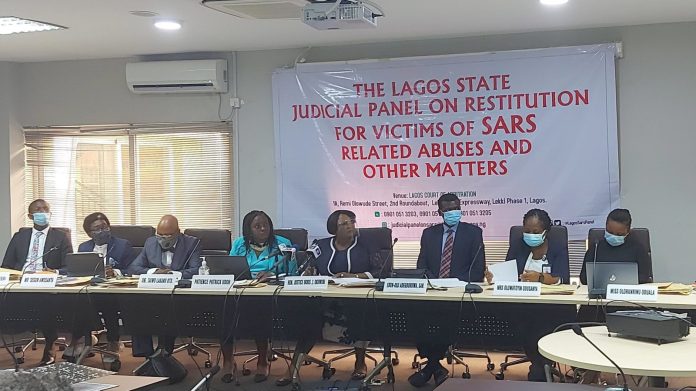
The panel, which sat for one year, had on November 15 submitted two documents, a consolidated report on cases of police brutality and another on the Lekki shooting investigation to Governor Babajide Sanwo-Olu.
The governor consequently set up a four-man committee to examine the documents within two weeks and “bring forward the White Paper” that would be considered by the State Executive Council.
The four-member review panel was chaired by Lagos State Attorney-General and Commissioner for Justice, Mr Moyosore Onigbanjo (SAN).
The other members are Youths and Social Development Commissioner, Segun Dawodu; Special Adviser to the Governor on Works & Infrastructure, Mrs. Aramide Adeyoye and Permanent Secretary in the Cabinet Office, Mrs. Tolani Oshodi.