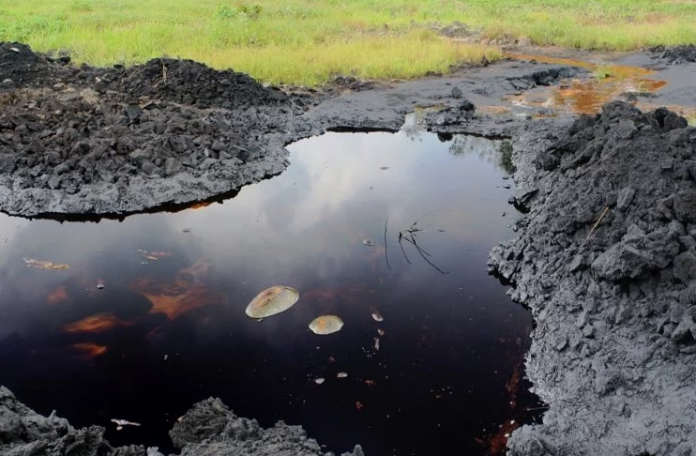
November 27, (THEWILL) – Some environmentalists have expressed concerns about the biosafety and toxicity of dispersants, used to mop up oil spills from offshore waters which support fishes and marine creatures.
The concerns are coming as International Oil Companies (IOCs), divest from onshore assets for offshore fields.
Dispersants are chemicals applied to oil spills to break down the oil molecules.

The environmentalists spoke against the backdrop of the Nov 15 leak from Egina Floating Production Storage and Offloading (FPSO), a vessel operated by TotalEnergies on November 15.
They spoke in separate interviews on Monday in Yenagoa.
TotalEnergies had in a confirmatory statement issued one week after the November 15 incident, described the oil leak as minor with no adverse impact on shoreline settlements.
However, Mr Idris Musa, Director-General of the National Oil Spills Detection and Response Agency (NOSDRA), said that 3,000 barrels of crude were discharged into the Atlantic waters in the incident caused by an export hose failure.
Musa disagreed with the operator that the spill was a minor one.
He said that NOSDRA’s response efforts made the difference as an aircraft and five vessels were used to apply 15,000 litres of dispersants to mop up the leaked crude.
Dr Nnimmo Bassey, a renowned environmentalist, reacted to the incident, noting that IOCs seem to prefer the ‘remote’ location of offshore oil fields.
He said that offshore oil fields shield them from the scrutiny of regulators and communities.
He said it was regrettable that after several decades of polluting their onshore fields, the IOCs are going offshore without clean-up
Bassey, who holds a National Honours of Member of the Order of Federal Republic (MFR), for Environmental Activism noted that dispersants were toxic and not safe for aquatic life.
According to him, dispersants are known to be toxic to aquatic life that form part of the food chain.
“The use of dispersants is mainly to hide the impact of oil spills from view.
“As the name says, they disperse but do not eliminate or remove the spills. It is known that chemicals remain in the aquatic ecosystem with some staying on the seabed.
“These dispersants have an impact on the aquatic species and by extension, they also cause injury to human health.
“Considering the lax regulation of the oil field environment, this is another example of expanding the sacrifice zone the Niger Delta has been turned into.
“We cannot continue to sacrifice our people and environment on the altar of cash,” Bassey said.
Bassey wondered why it took TotalEnergies over one week to confirm the operational mishap if not a failed attempt to cover up and called for transparency and more stringent regulation at offshore fields.
For Chief Alagoa Morris, Head of Field Operations at Environmental Rights Action (ERA), in Bayelsa, dispersants are not conducive to life.
“The thing is that these chemicals called dispersants used by the oil companies to reduce the quantity of spilled crude oil or sink the crude oil are not properly identified by stakeholders or experts to enable informed conclusions.
“It is one of the ‘smart ways’ deployed by the polluters to be evasive, taking advantage of not having regulators or environmental NGOs within the particular location at that point in time.
“We in ERA have received several such complaints of inappropriate use of dispersants from community folks in Ogboinbiri, Odioama, Ikarama, etc.
“The use of dispersants is not an alternative for cleanup or remediation.
“We have had instances where cleanup contractors apply detergents as dispersants at Okpotuwari and Ikebiri environment in Olodiama Clan of Southern Ijaw Local Government Area of Bayelsa state.
“In most cases, dispersants either cause the crude oil to coagulate and sink or break down the molecules, leaving it still in the environment leading to environmental degradation,” Morris said.
Also, Rev Samuel Ayadi, Niger Delta Coordinator of Artisanal Fishermen Association, said that chemical dispersants used to tackle spills are poisonous to fish and wipe out generations of fish species.
“The chemicals they call dispersant are poisonous. They not only kill fishes, but when the coagulated crude sinks to the seabed where fish breeds, it wipes out the eggs as well and that is like an epidemic.
“The dispersants they used on the spill at Egina will cause hardship to fish and fishing activities in the Niger Delta for a long time starting with prolonged fish scarcity.
“Any fish that encounters the dispersant is poisoned and contaminated and poses danger to public health.
“The ones that survive will migrate deeper out of Nigerian territorial waters where artisan fishermen cannot reach,” Ayadi said.
Ayadi urged the regulators to compel TotalEnergies to conduct toxicological tests to ascertain the biosafety levels in the Atlantic waters around the Niger Delta region.