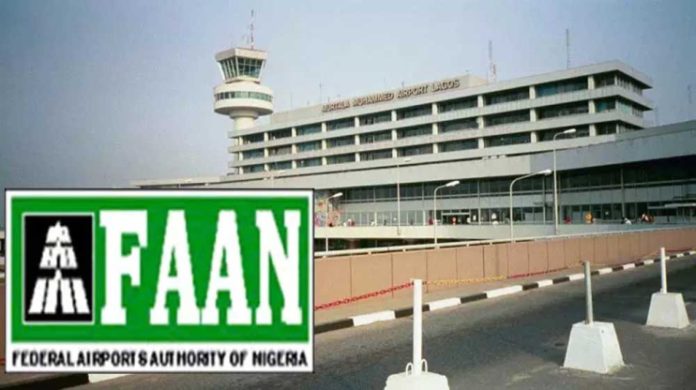
June 21, (THEWILL)- The Federal Airports Authority of Nigeria (FAAN) is strategising to increase its revenue base through its aeronautical and non-aeronuatical sources.
To achieve its plan, the authority is partnering with state governments to promote investments in airport infrastructure, including cargo terminals and facilities to enhance air cargo operations.
The partnership is geared towards improving on its revenue generation in all fronts and some of the airports involved in the deal include: Ibom Airport, Owerri Cargo Terminal and the newly commissioned Anambra Cargo Terminal.

Director, Commercial and Business Development, FAAN, Mr. Sadiku Rafindadi, who disclosed the plan recently, said many successful airports in the world depend more on non-aeronautical revenue sources arising from modern facilities and the provision of services that draw both passengers and non-passengers to the airports
Delivering a paper with the theme: “Improving Airport Non-Aeronautical Revenue Stream” at the opening of the Business Summit on Cargo and Aero Logistics and Drone Expo in Lagos, Mr. Rafindadi said that, the new international airport terminals when completed, apart from Abuja and Port-Harcourt already commissioned, would bring in 15 million more passengers and thus increase revenue for the airports.
He said “the new terminals shall open up potentials for tourism, businesses and effective use of Bilateral Air Service Agreement (BASA) within partnering countries”.
“The terminals provide more space to cater to passengers’ preferences, exciting retail facilities, duty free shops, food and beverage outlets, advertising, car parks etc”.
Among the 22 airports in the country, Rafindadi said that, in terms of revenue generation, Murtala Mohammed Airport (MMA) generated 58%, NAIA, 21%, PHC 4%, Kano 4%, other airports 13% from January to December 2020.
“Nigerian airports have enormous potential for high gross earnings if well harnessed; each airport has their peculiarity in terms of tourism, agriculture, mining and aerotropolis to better improve their viability”.
To shore up its revenue generation, Rafindadi said FAAN was looking at increasing the share of non-aeronautical activities from below 30% to 40%, adding that this would be achieved “by focusing on investments in airport infrastructure and technology solutions to drive cost optimisation, creating enabling environment and improving none aeronautical revenue streams”.
The FAAN Business Director also disclosed that, due to the fact that about N576 billion ($1.2b) is lost to medical tourism yearly in Nigeria, in addition to its airport clinics being commercialised, FAAN is designating some land area at the airport to harness non- aeronautical opportunity.
Among the top potential contributors to non-aeronautical revenues he listed include car parks, access gates, advertising among others.
Explaining further, Rafindadi said that “Nigerian airports have the ability to grow their non – aeronautical revenue, considering the geographical location of the country as a hub, the available land, climate, competition, consumer demand, etc”.
“With the vast land available at our airports for business, FAAN is open to Foreign Direct Investment (FDI) and partnership with corporate organisations on different Public Private Partnerships (PPP) business models through Build Operate and Transfer (BOT), Joint Ventures (JV’s) and concessions to explore opportunities for improved non- aeronautical revenue streams”.