
September 08, (THEWILL) – Nothing hurts more than losing a fight or a cause you’ve devoted much time and effort to. It is even worse if you have to pay for losing that particular fight. In other words, after being defeated, you are also compelled to lay down some money for your own defeat.
That precisely is the sorry situation three political parties are currently facing and there seems to be no way out for them.
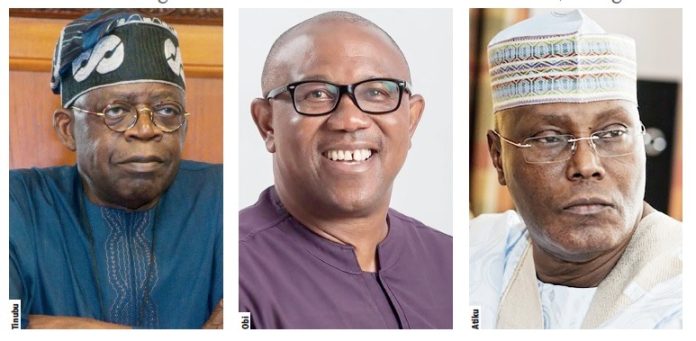
On March 1, 2023, Professor Mahmoud Yakubu, Chairman of INEC, declared President Bola Ahmed Tinubu of the All Progressives Congress winner of the presidential election held on February 25 across Nigeria. Tinubu polled 8,794,726 to Atiku Abubakar’s 6,984,520 of the Peoples Democratic Party. Peter Obi of the Labour Party, who came third, polled 6,101,533, while Rabiu Kwankwaso of the New Nigeria Peoples Party had 1,496,687 votes.

Almost immediately after Yakubu’s announcement, Peter Obi and Atiku Abubakar, presidential candidates of the LP and PDP, went to court to challenge both INEC and Tinubu whom the electoral body announced as the winner. Also, Chichi Ojei of the Allied Peoples Movement went to court concerning the APC victory at the polls. The party in question challenged Tinubu’s running mate, Kashim Shettima’s unsuitability to contest since he was already running as a senator in Bornu State – for double nomination sort of.
The Presidential Election Petition Tribunal set up, thereafter, was no surprise because, from living memory, such tribunals have been part and parcel of elections in Nigeria where politicians almost always challenge the outcome of elections. To that end, Justice Monica Dongban-Mensem, president of the Court of Appeal, set up a five-member panel of the court. Their job? To hear all petitions from all the candidates and parties. Headed by Justice Haruna Simon Tsamani, other members of the PEPT include Stephen Jonah Adah, Misitura Bolaji-Yusuf, Boloukuoromo Ugoh and Abba Mohammed. The panel began hearings on May 8 at the Court of Appeal Complex Abuja.
From then till last Wednesday, the victorious party and challengers in the February presidential polls have waited with feverish anticipation for the judgment of the PEPT. The five judges have unanimously upheld PBAT’s election while also dismissing the suits of APM, LP and PDP.
From all indications, the ruling by the judges seems to follow a previous one in 2008 between Atiku Abubakar versus Musa Yar’Adua (2008) NWLR. In the case presided over by Supreme Court Justice Niki Tobi, the eminent jurist famously observed that “Courts of law do not give judgment according to public opinion or to reflect public opinion unless such opinion represents or presents the state of the law. This is because the judge’s clientele is the law and the law only. Public opinion is, in most instances, built on sentiments and emotions. Both have no company with the law. They are kilometres and kilometres away from the law. The pulse of Nigeria’s public opinion, if I can feel it, is to allow the appeal on the speculation or should I say belief that the election was irregularly conducted in violation of the Electoral Act. The concern of the court is whether the appellants proved their case.”
The challengers did not only lose their case against PBAT, they were also made to pay for the cost of the proceedings from start to finish “for filing frivolous elections.” Thus APM was fined N13, 675, 890.00, LP N47, 910, 431.87 and PDP N23, 391.001.45. If there’s any truth to the fines, the parties would have paid or are in the process of paying since they were given a 48-hour ultimatum.
The presidential candidates of LP and PDP, Peter Obi and Atiku Abubakar, have said they will appeal the ruling of the PEPT and proceed to the Supreme Court.

Michael Jimoh is a Nigerian journalist with many years experience in print media. He is currently a Special Correspondent with THEWILL.
