
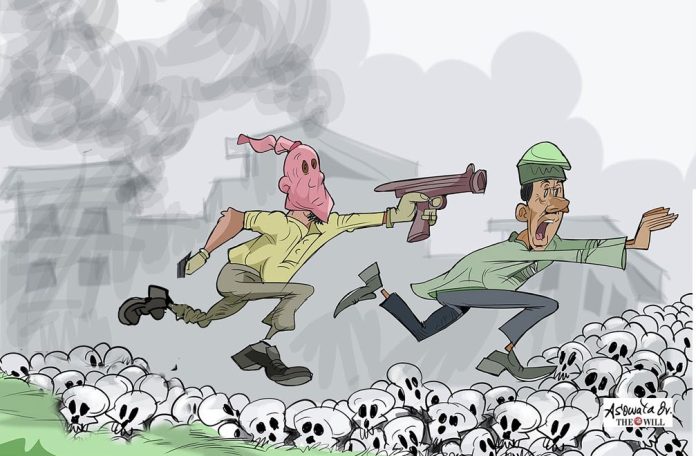
January 07, (THEWILL) – Until 2001, Plateau state lived up to its inspiring and comforting motto “Home of Peace and Tourism.” From September 7 to 13 that year, a major inter-communal violence exploded the peaceful ambience resulting in needless death of a thousand people in just six days, displaced thousands more, destroyed households and farmlands. Since then, the state has been pretty much in the news not for the potato fields it was once famous for but the killing fields it has become. THEWILL considers a crisis threatening the very existence of a state home to dozens of ethnicities who once co-existed in harmony but are now torn apart by mutual hatred. Michael Jimoh reports…
Those with a calendric turn of mind say with confidence the first recorded major inter-communal crisis in Plateau state began with an appointment in 2001. It was the appointment by Olusegun Obasanjo who was president of Nigeria then of Alhaji Mukhtar Muhammed a Hausa/ Fulani Muslim as Coordinator of National Agency for Poverty Eradication Programme.
Plateau state had been on a low boil years before starting from 1994 when the indigenes (Birom, the Afizere and the Anaguta) versus settlers (Hausa-Fulani) struggle for political posts aroused ancient animosities. It continued in 1996 and then 1998 after Mukhtar was appointed chairman of Jos North Local Government Area to the dismay of the indigenes. With a predominance of Christian indigenes in the Middle Belt state, the appointment of a Hausa Fulani Muslim settler was provocative enough.

Hate speech and even threatening mail soon followed the job offer to Muhammed accused of falsifying his credentials. “Trace your roots before it is too late,” one such mail purportedly written by a Christian was posted right on Mukhtar’s office door at JNLGA. Another urged the appointee to “Run for your life,” while yet another said: “You are warned once again not to step in.” The messages were unambiguous: “This office is not meant for Hausa-Fulani or any non-indigene,” and “Mukhtar Muhammed is a wanderer. If you want to stay alive don’t step in.”
Mukhtar got the hint and so stepped down as chairman. But a group called Hausa-Fulani Youths did not take the threat lightly. They took up the bait by the indigenes and responded in kind, leaving behind banners and leaflets threatening reprisal actions. “Yes, the loss of a few families wouldn’t bother us,” one proclaimed. “After all for every single Anaguta’s [indigene] life and their allies; there are thousands of other Hausa-Fulanis. Let’s see who blinks first.” Another was even more menacing: “Death is the best friend of Hamas. Be rest assured that we will do it even better.” “The seat is dearer to us than our lives. In that case, do you have the monopoly of violence?” As for the imminent violence by the indigenes, the group proclaimed their readiness, vowing “Blood for blood. We are ready.”
While this iciness hung over Plateau state like ominous clouds, ethno-religious crisis in neighbouring states like Bauchi, Kaduna, Nasarawa and Taraba brought an influx of refugees to Jos, the capital, thus straining an already tense situation.
According to a report by Human Rights Watch in 2001, “many people fleeing conflicts in their own areas had sought protection and safety in Jos; some had even settled there. Some observers believe that this regular influx of populations from neighboring states may have ended up destabilizing the tranquility of Jos. People fleeing in 2000 and 2001 from clashes in Kaduna, Bauchi, Taraba, and Nasarawa states may have inadvertently contributed to creating an atmosphere of fear among inhabitants of Plateau state by testifying to the atrocities they had left behind, some of which were still continuing. The increase in the population in Jos, in particular, also created an increase in economic pressures leading, in turn, to the scarcity of some goods and increase in prices. Resources became stretched, and tensions began to rise.”
It was against this background that OBJ appointed Mukhtar as Coordinator of NAPEP. It was simply too much for the indigenous people of Plateau state. As if willed by fate, a Christian woman tried to breach a cordoned street during Jumaat service in Jos. The worshippers prevailed on her to find an alternative route or wait after prayers. She refused. This incident would become the match sparking the simmering discontent and rivalry between the indigenes and Hausa-Fulani into a raging conflict from the first through the second week of September.
An argument, it was said, developed between the worshippers and Christians who soon joined in at the mosque, resulting in “a violent battle between groups of Christians who appeared at the scene and Muslims who had been praying at the mosque or who happened to be in the neighborhood.”
The ensuing confrontation spread to other parts of the state, provoking more and more atrocities from both sides. At the end of the bloody confrontation, about a thousand people were killed, many more displaced adding to the internally displaced persons from Bauchi, Kaduna, Nasarawa and Taraba. Homes and farmlands lay wasted in the aftermath.
At about the same time as the Jos killings, another attack was taking place thousands of miles away in the heart of New York by Al Qaeda terrorists on September 11. While the World Trade Center attacks by Osama bin Laden’s terror squad captured much of the world’s attention, the killings in Plateau state was more of a local affair. But it has continued through successive administrations in Nigeria, from OBJ’s up to now thus bringing the tragic consequences of the grab for land and territory to world attention.
In a Features article for Al Jazeera headlined “Horrors on the Plateau: Inside Nigeria’s farmer-herder conflict” published on 28 November 2021, Alfred Olufemi detailed how another tragic conflict broke out months before.
“The violence in central Nigeria is now one of the country’s deadliest security threats after Boko Haram in the north east and banditry in the northwest,” Olufemi wrote presciently. One of the survivors of the attack at the time 29-year-old Mary Hommes recounted to the journalist how they “heard about an attack around 5am (on August 21.) Before we knew what was happening, everywhere was in disarray.”
By the time the attackers who claimed they were herders were done, more than four dozen residents had been killed, some more on the run for their lives from Maiyanga village in Bassa Local Government Area of the state. The surprise dawn raid was, as usual, a farmer-herder clash which Olufemi put in its right perspective contrary to the religious colouration many thought it was.
“The clashes, mostly between Muslim Fulani herders and Christian farmers from the Berom and Irigwe ethnic groups, is often painted as ethno-religious,” Olufemi wrote. “But analysts have said climate change and scarcity of pastoral land is pitting the farmers and herders against each other, irrespective of faith. The Fulani, meanwhile, are nomadic pastoralists, often of northern extraction, who have travelled to central and southern parts of the country in search of greener pastures for their livestock. In some cases, the pastoralists permanently settle in their host communities.
“However, across the years, pastoral land scarcity compounded by increasing urbanisation has forced herders onto farmlands and restricted areas, such as national parks and conserved forests. This often results in the destruction of crops and ends up snowballing into a conflict between the herders and local farmers.”
Speaking with both sides in the raging conflict, Olufemi was told how, in retaliation for the attacks, “aggrieved farmers and members of farming communities sometimes attack the herders and their livestock.”
A Fulani pastoralist, 39-year-old Abdullahi Abubakar, told the reporter how his son was killed while grazing cattle. His forebears have been in Plateau for more than a century, Abubakar told Olufemi, asking rhetorically: “If someone destroys your farm, is it justice to kill the cow and the owner?” Continuing, he disclosed that “they (the farmers) kill our cows one after the other. When they kill our boys, they cut their heads. They shoot them to death or slaughter them,” insisting that “the killing of herders and their livestock is not proportional to the destruction of farmers’ crops.”
From what respondents told Olufemi, both the herders and farmers are to blame for the crisis in Plateau state, stating in the report that “while suspected Muslim herders have attacked Christian farming communities, gangs of armed Christian youth have also attacked Muslims.”
That much was confirmed by Plateau state secretary of Miyetti Allah Cattle Breeders Association of Nigeria Abdullahi Ardo. In his words, “both sides are at fault” and are “to blame for not abiding by past peace deals,” insisting that the media had not been fair to the herders. “When the Fulani are killed, they will be buried but no media will broadcast.”
Despite the little or no report by the media of burial of Muslim Fulani herders killed in reprisal attacks, the earth mounds are proliferating in Plateau state nonetheless. Unlike the physical structures (mighty rocks and boulders) carved by nature into breathtaking scenic vistas and lying in their immense indifference, the latest ones are manmade, ugly reminders of the killing fields the state has gradually become.
More than 150 were added to those mini mounds after the Christmas eve attack by nighttime bandits in their motorbikes. Reports say they were mostly strangers, guided into several communities by locals. They were also said not to bear arms in their convoy but had them stashed somewhere near or in the affected communities. So, like in a never-ending horror show, the world watched in helpless disbelief once again as those communities were set upon by the nighttime bandits, killed in their slumber, chased from their homes which were subsequently razed.
The reports this time were as grim as in previous surprise raids. No fewer than 20 communities were targeted in Bokkos and Barkin Ladi LGA. Early casualties was estimated at 113, according to Monday Kassah, head of Bokkos LGA. “Military gangs, locally called bandits launched well-coordinated attacks in not fewer than 20 different communities and torched houses,” Kassah said of the surprise raid. “We found more than 300 wounded people who were transferred to hospitals in Bokkos, Jos and Barkin Ladi.”
By 27 December, the number of the dead in the attack had risen to 150. So far, no group has claimed responsibility. On that same day, Vice President Kashim Shettima visited the affected parts of the state where he donated relief materials to victims at IDP camps. Members of the Upper House of the Legislative arm of government also pledged their salaries to the victims of the attack.
Of the attack itself, Amnesty International’s country director for Nigeria, Isa Sanusi called for investigation. “It is really sad and unfortunate that these kinds of things continue to happen, and the authorities cannot do anything apart from sympathizing with the victims, which shows helplessness on their side. Rural communities have been allowed to live in the last 10 years or so at the mercy of gunmen,” Sanusi lamented.
Equally critical of the authorities is Chukwudi Victor Odoeme, a security analyst. “I think the government is not doing enough. There’s still the absence of political will. It’s an indictment on our government and security forces.”
But speaking on behalf of Governor Caleb Muftwang of the state, Gyang Bere his spokesperson promised that “proactive measures will be taken by the government to curb ongoing attacks against innocent civilians.”
Following the Christmas eve attack, the Senate summoned the defence chiefs over what it said was intelligence failure of the security agencies. Under the leadership of Senate President Godswill Akpabio, the senate grumbled that “the massacre of scores of Nigerians in Plateau on the eve of Christmas was due to failure of intelligence.”
Two senators representing Plateau state Diiket Plang (APC, Plateau Central) Abdul Ningi (PDP, Plateau State) were particularly miffed that the security agencies could not prevent an attack that was “strategically planned with collaboration from locals.”
Ningi said inter alia: “I was in Bauchi for the Christmas holiday when the news broke out and instantly in behalf of the Northern Senators Forum I moved into Plateau, had two sessions with the Governor of Plateau state before paying a courtesy call on some members of the forum as to the gravity of what happened in Bokkos. What happened in Bokkos is unprecedented, when you have a catchment of bandits over 400 of them moving at a go and when I sat with the governor the stories I heard were mind-boggling.
“First there was a rumor of this attack, secondly the governor tried to make this information available but they did not take him seriously.” The attack, Ningi said, “is unprecedented. Until we see the importance of security in this country we will never move forward. We need to urgently call the security agents because there is no synergy among them. The entire security architecture of the state failed. What we have discovered is that these marauding bandits did not come with weapons, those weapons were actually domiciled in certain locations, all they do is to come and pick them.
“That means there is something behind what is happening in Plateau. Who are these people and where are they doing it because if you go there from the outside you will think it is a religious war, no. There is something behind it that this Senate must need to unravel. What I have also discovered after spending 72hours, the little information about those bandits, they are not living around the communities. Somebody imported them. Somebody escorted them. They don’t even know the terrain, they were led by some people who knows the terrain.”
The inference is that those who know the terrain are right there in those communities to guide the bandits like scouts in future sneak attacks, the quislings of the Middle Belt, if you like. For now, military check points are within a respectable radius of one another in Jos hoping to bring peace and sanity to a much troubled land. Now, also, there is a lull, a calm characteristic of the home of peace the state once was – until the fire next time.
Michael Jimoh is a Nigerian journalist with many years experience in print media. He is currently a Special Correspondent with THEWILL.
