
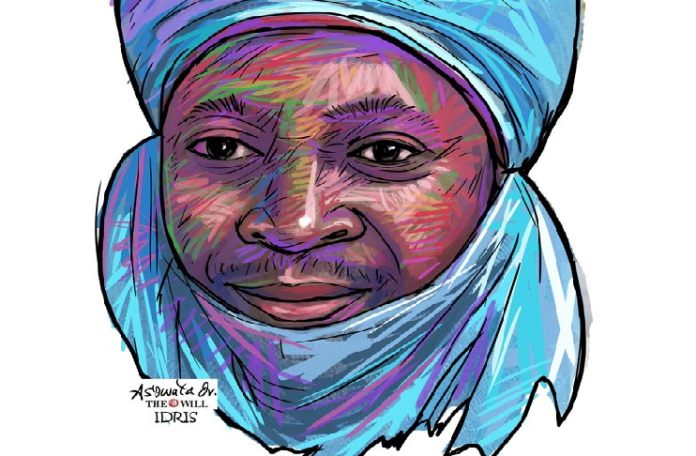
December 03, (THEWILL) – It is one of the ironies of life that a confirmed villain yesterday can quickly become a model today. From May through July to December 2022, former Accountant-General of the Federation Ahmed Idris was pretty much in the news for the wrong reasons. After failing to honour invitations by the Economic and Financial Crimes Commission on fraud charges, Idris was arrested in May, docked in July in a court in the Federal Capital Territory up until last December. The same Idris was recently turbaned Ajiyan Hausa by the Emir of Kano sparking outrage from Nigerians, as THEWILL found out. Michael Jimoh reports…
Though a fictional character in Chinua Achebe’s A Man of the People, shop owner Josiah darkly brings to mind circumstances surrounding a real life person in Nigeria today. As the eponymous author of Things Fall Apart tells us in his fourth novel, Josiah stole a blind man’s walking stick in the erroneous belief it has magical powers that will attract customers by the dozen to his dry goods shop.
The villagers of Anata community are repulsed by the trader’s egregious act. As punishment, they boycott his shop and then ostracise him. But things change in no time for the disgraced shop owner-turned-thief. Josiah the villain of yesterday soon becomes a very important person in Anata, wooed and courted by supposedly prominent individuals in the same community. The next time readers encounter the thief, he has morphed into a very important campaign manager overseeing a rally for one of the contestants in a forthcoming election.

Published in early 1966, critics and literary historians have not glossed over the fact of Achebe’s fourth novel presaging the first military coup in Nigeria because A Man ends with a coup overthrowing a corrupt civilian government in which Chief MA Nanga was Minister of Culture – the main subject of Achebe’s satirical portrait. The author’s uncanny ability to foresee that the villain of yesterday can become the hero or model of today is equally telling.
Though not of equal standing, there’s a parallel to Josiah in the person of erstwhile Accountant-General of the Federation Mr. Ahmed Idris. It is true the bespoke suit-wearing civil servant is on a higher realm than the penurious, superstitious trader. Idris is in the business of keeping records all the same, of presiding over the incomes earned, revenues generated and expenditure of his country.
Appointed by former President Muhammadu Buhari in 2015, he was reappointed for a second tenure four years later. Buhari sacked Idris’s predecessor Mr. Jonah Otunla for misappropriating N2.5 billion of security agencies funds and then appointed Mr. Mohammed Dikwa a director in the office of the AGF in acting capacity. But by midyear 2015, Idris assumed duties fully as the AGF, allowing him a complete run of the nation’s finances.
It was during his tenure as AGF, for instance, that monies stolen by onetime governor of Delta state James Onanefe Ibori was repatriated to the Nigerian government with the intention of transferring same to the state where they were purloined. It never got to be. Investigations soon showed that much of that loot was re-looted by the AGF himself leading to his suspension by Buhari.
Of course, the anti-graft agency stepped in discovering, in the process, that like the bent Otunla, Idris was no less crooked. He had been siphoning monies all along. But where Otunla stole N2.5 billion, Idris had outdone him by more than 500 percent, embezzling N109 billion, according to findings by EFCC.
For a government with a fabled boots-on the ground approach to fighting corruption, the scandal was too juicy for editors of both mainstream and online publications to pass by. So, a common headline in national newspapers at the time ran something like this: “How suspended Accountant-General swindled FG, EFCC reveals” (The Guardian) “EFCC set to arraign former accountant-general, Ahmed Idris, over N109bn fraud charges” (Premium Times) “Court orders forfeiture of former accountant-general Ahmed Idris’ $900,000, 15 houses” (Premium Times) “Alleged N109bn Fraud: EFCC To Arraign Ex-Accountant General Idris On July 22” (Vanguard.) Foreign media such as BBC, Bloomberg, CNN and Al Jazeerah made their splashes as well, disclosing detail by grinding detail how a supposedly trusted civil servant from Kano state practically turned the national treasury into an ATM machine.
In his report of 30 July 2022 for The Guardian, Sodiq Omolaoye stated how the former Accountant-General of the Federation (AGF), Ahmed Idris, “compromised the Treasury Single Account (TSA), Government Integrated Financial Management Information System (GIFMIS) and Integrated Payroll and Personnel Information System (IPPIS) and carted away billions of naira belonging to the Federal Government.”
Quoting sources from EFCC, Omolaoye stated that Idris used the stolen money “in constructing properties like the Gezawa Exchange Limited, Gezawa Integrated Farms and Kano City Mall.” On the strength of their investigations, EFCC invited more people involved in the numerous dubious transactions with companies traced to the suspended AGF. One of them, a Bureau de change operator Baita Ibrahim Kura of B I Kura Ibrahim admitted paying “N208 million into Gezawa Commodity Market with Jaiz bank.”
The BDC operator also admitted paying N866 million to one Architect Mustapha Mukhtar of March Construction Limited for the construction of Gezawa Commodity Market and Exchange Limited.”
Through his position as disburser of funds to the nine oil-producing states concerning 13 percent derivation from Excess Crude Account, Idris and some of his accomplices who were also his subordinates made some bricks of cash amounting to millions of dollars. A Federation Account Allocation Committee (FAAC) had considered the complaints of the nine oil producing states and then approved $2.2 billion for them to be deducted over a 60 months period on a quarterly basis.
According to one witness in the ensuing court proceedings in Abuja, “11.5 per cent of this figure amounting to N44.7 billion was put aside as payments to some public officials to facilitate payments to the oil-producing states.
“After the determination of this committee, some companies, Akindele and Co, a company owned by the second defendant, Godfrey Olusegun Akindele a staff under Idris, was presented under the guise of consultancy….Investigation revealed that N84.39 billion was paid into Akindele’s bank accounts…another transaction occurred on February 12, 2021, with N21 billion paid into his account.”
The witness named Ahmed (not a relation of the former AGF) said inter alia: “Funds were shared with some groups, including the Revenue Mobilisation Allocation and Fiscal Commission (RMAFC), represented by one of its Commissioners, Peace Akomas, former Deputy Governor of Abia State, who allegedly collected N18.8 billion. He said the money was withdrawn by Akindele and converted to U.S. dollars and handed over to Akomas.”
The second group of beneficiaries represented by the AGF was generously compensated with N18.01 billion while the third group, comprising Commissioners of Finance in the nine oil producing states, received N21.4 billion, the witness said in court, insisting that “the money was withdrawn by Akindele, converted to U.S. dollars and handed over to Akomas on behalf of the group.”
Two other groups were similarly paid, according to Ahmed, totaling four and all the defendants confirmed in writing to having received the monies.
On that premise, EFCC instituted an eight count charge against the former AGF stating in count one that “you, Ahmed Idris between February and December, 2021 at Abuja in the Abuja Judicial Division of the High Court of the Federal Capital Territory, being a public servant by virtue of your position as the Accountant General of the Federation accepted from Olusegun Akindele, a gratification in the aggregate sum of N15,136,221,921.46 (Fifteen Billion, One Hundred and Thirty Six Million, Two Hundred and Twenty One Thousand, Nine Hundred and Twenty One Naira and Forty Six Kobo) which sum was converted to the United States Dollars by the said Olusegun Akindele and which sum did not form part of your lawful remuneration but as a motive for accelerating the payment of 13% derivation to the nine (9) oil producing States in the Federation, through the office of the Accountant General of the Federation, and you thereby committed an offence contrary to Section 155 of the Penal Code Act Cap 532 Laws of the Federation of Nigeria 1990 and punishable under the same section.”
Count eight rehashed Idris’s criminal conspiracy with his technical assistant Olusegun Akindele: “That you, Ahmed Idris while being the Accountant General of the Federation and Godfrey Olusegun Akindele while being the Technical Assistant to the Accountant General of the Federation between February and November 2021, at Abuja in the Abuja Judicial Division of the High Court of the Federal Capital Territory, in such capacity, entrusted with a certain property, to wit: N84,390,000,000(Eighty-Four Billion, Three Hundred and Ninety Million Naira) committed criminal breach of trust in respect of the said property when you dishonestly received the said sum from the Federal Government of Nigeria through Godfrey Olusegun Akindele trading under the name and style of Olusegun Akindele & Co., and you thereby committed an offence punishable under Section 315 of the Penal Code Act Cap 532 Laws of the Federation of Nigeria 1990.”
Following these damning indictments, some of the properties and assets illegally acquired by Idris have been forfeited to the Federal Government. At the last count a year ago Premium Times listed some of the properties as Kano City Mall/Al Ikhlas Shopping Mall at Mandwawarti, one-storey Shopping Complex at Ladanai, Corner Shops at Ladanai all in Kano and some in Abuja.
With this high-profile scandal swirling around the former AGF and pending cases in court, Nigerians were rather surprised sometime in October when the same disgraced public official was honoured with a traditional title of Ajiyan Hausa by the Emir of Kano.
Till date palace officials have not stated clearly why the title itself was bestowed on the beleaguered former AGF except that it is to strengthen the ancient ties between Daura and Kano. Still, observers are worried about the Daura connection. Idris himself is Kano-born so how does the Daura connection come in?
Worse still, analysts are left wondering how it could ever be. What, some people pointedly asked soon after the conferment of the title, is one to make of a public official on trial for corruption having this title bestowed on him by no less a revered first class traditional ruler than the Emir of Kano?
Reacting to that, Professor Abdulrahman Bello Bada of Usmanu Danfodiyo University Sokoto last November lamented the negative effect of corruption on countries in general and Nigeria in particular. Fresh from a meeting with some like-minded progressives in Sokoto apparently on and about corruption, the lecturer said the topic discussed at the meeting was “corruption as far as leadership in Nigeria is concerned.”
“I expressed my own understanding that corruption does not spare any country that as a human being if you don’t implement the rules and regulations of that country, I don’t think you can stop it,” Bada declared, alluding to a corrupt individual as desperate enough to kill. “Sometimes he can turn into something else. Sometimes he can even become animalistic, he even kills in pursuit of his own interest.”
Zeroing in on Nigeria, the professor went on cite to examples of someone whose salary is not up to N300 but own houses everywhere. For the discerning, it was Bada’s way of coming around to the real reason for meeting with the press.
“Nobody can believe what happened recently,” he continued. “A former Accountant-General of the Federation who is accused in a court of law for stealing over N109b was last week turbaned by the Emir of Kano in Kano celebrating what actually is not in our character. This is something entirely new to us. You can’t believe it.”
The professor of Sociology couldn’t have been more correct: how did an indicted man under trial who has already forfeited some of his illegally acquired wealth and assets to the Federal Government be made a titled man in the society?
Bada himself provided some answers: “As long as we don’t use our laws, we don’t punish those who are offenders, then only God knows where Nigeria is moving to…But what of people protected living in government houses and looting the treasury every day? We almost worship them, we praise them, we sing about them, we dance for them. This was not the culture of Sokoto Caliphate…Something is really wrong. We have to think.”

Michael Jimoh is a Nigerian journalist with many years experience in print media. He is currently a Special Correspondent with THEWILL.
