
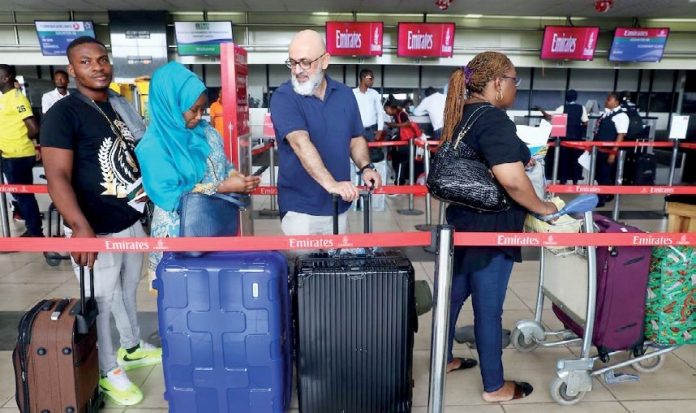
As funds estimated at $743 million belonging to foreign airlines remain blocked in Nigeria, stakeholders are worried that the situation, which is already affecting the flow of Foreign Direct Investments (FDI) into the country, may have far reaching consequences for the aviation sector.
For example, two United Arab Emirates (UAE) carriers: Emirates and Etihad Airways, have pulled out of Nigeria because they do not want their funds to be trapped further.
Apart from charging Nigerian air travellers’ exorbitant fares, these stakeholders have also expressed concern over the inability of foreign airlines to repatriate their trapped funds in the country, insisting that Nigeria has become a country with the highest amount of foreign airlines’ trapped funds while highlighting its implications.

The implications, according to them, include the designation of Nigeria as a high-risk country in doing business related to aviation; the increase in insurance premium due to country risk and also the reluctance of lessors to lease aircraft to Nigerian carriers or to do so at very high cost.
They equally believe Nigeria has the highest amount of the trapped airlines’ funds which, to them, is not good for the country because of the perception of Nigeria in the global aviation industry.
In October last year, Emirates Airlines suspended flight operations to Nigeria over its inability to repatriate blocked funds.
As of December 2022, the trapped funds belonging to foreign airlines rose to $550 million, despite the recent intervention of the Central Bank of Nigeria (CBN) to clear part of the funds.
According to reports, the trapped funds belonging to international carriers operating in Nigeria are estimated to be up to a whopping sum of $743,721,097 from $662m in January 2023.
However, many stakeholders feel that the issue of trapped funds rests with the Federal Ministry of Aviation, but the Hon. Minister of Aviation, Senator Hadi Sirika disclosed recently, that the issue of blocked funds sits with the CBN and it is not what the ministry can handle alone else it would have been resolved immediately.
In his reaction, the Area Manager West & Central Africa International Air Transport Association (IATA), Dr. Samson Fatokun said that for over a year, Nigeria has been the country with the highest amount of airline blocked funds in the world and this will affect Foreign Direct Investment (FDI) in Nigeria, the image of a country that does respect contractual obligations as well as reduced connectivity to and from Nigeria and high-ticket prices among others.
According to Fatokun, the increasing backlog of international airlines blocked funds in Nigeria sends a strong message against foreign direct investment (FDI) in Nigeria.
He said, “Potential investors are reading from the plight of the airlines that they would not be able to repatriate their funds from Nigeria, even at this moment when Nigeria is expecting investments in the concession of some of its prominent airports”.
Dr Fatokun went on stressing that the trapped funds give Nigeria the image of a country that does not respect contractual obligations.
Noting that foreign airlines fly into Nigeria within the legal framework of the Bilateral Air Service Agreement (BASA) signed between their countries and the Federal Republic of Nigeria, he added that the agreements in those BASAs indicating that Nigeria will facilitate the repatriation of the funds of the other party’s airline did not hold.
“Nigeria flaunts this contractual obligation by not facilitating enough the repatriation of airlines’ funds”, Fatokun emphasised.
Speaking in the same vein, Mr Bankole Bernard, Group Managing Director, Finchglow Travels regretted that, it is very unfortunate Nigeria cannot simply comply with the rules of the Bilateral Air Service Agreement (BASA).
Condemning the situation, Bankole who described trapped funds in Nigeria as fraudulent said “If you say that you do not have funds for them at an official rate as it were, if you are going to make them pay for a premium, they will sell the tickets at a premium and they will be able to repatriate their funds, but you don’t give them at the official rate and they are unable to repatriate their money”.
“Today, the rate at which we are issuing tickets is N551 to a dollar. Is that the official rate? No, but that is the rate we are issuing tickets, which is moving closer to the black market. This means the issue of trapped funds would not have been if it had been properly managed”.
Bankole pointed out that the funds became trapped because Nigeria was not ready to give the foreign airlines at the official rate.
Explaining further the GMD queried, “Why didn’t you come out all these while and tell them the rate you would give the airlines so that they can sell their tickets at particular rates as long as it is official. After all, we have multiple exchange rates. So, what will make this one different? Then, there will not be an issue of trapped funds and people will be able to do their business and the agony that you are putting a lot of travellers to will not be there’.
“Now that we have started to sell tickets at N551 to a dollar, I can tell you that the issue of trapped funds will move as fast as possible and it will come to zero. To fly to London now, it’s about a million naira and that is the cheapest,” Bankole added.

Anthony Awunor, is a business correspondent who holds a Bachelor of Arts Degree in Linguistics (UNILAG). He is also an alumnus of the Nigerian College of Aviation Technology (NCAT), Zaria Kaduna State. He lives in Lagos.
