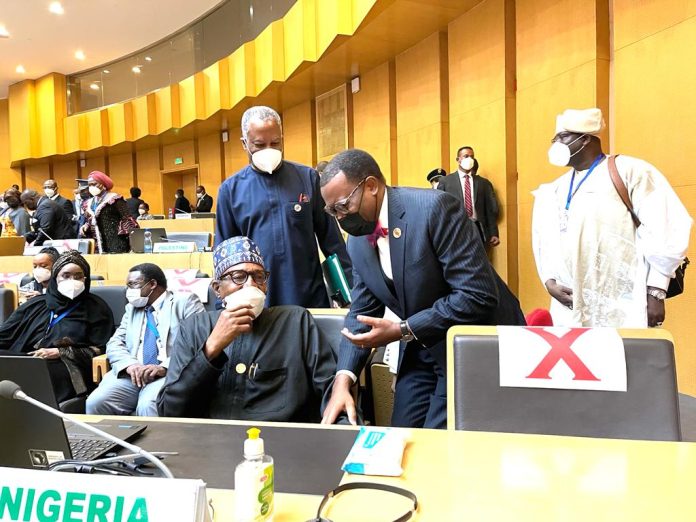
February 09, (THEWILL) – The African Development Bank (AfDB) has called for renewed commitment from African leaders to prioritise the health and nutrition of the continent.
President of the Bank, Akinwumi Adesina, particularly urged African leaders to invest in health, saying it is akin to investing in national security..
Dr Adesina made the call in his speech at the weekend, titled, ‘Mobilising Financing for Africa’s Accelerated Economic Recovery, Development and Integration’, at the 35th Ordinary Session of the Assembly of the African Union in Addis Ababa.


He outlined three strategic priorities for building the continent’s healthcare defence system: “First, building Africa’s quality healthcare infrastructure; second, building Africa’s pharmaceutical industry; and third, building Africa’s vaccine manufacturing capacity.”
Adesina revealed that Africa needs $600 million to $1.3 billion to meet its goal of attaining 60 percent vaccine production by 2040, stressing that investing in health is investing in national security.
He also said AfDB plans to invest $3 billion to support pharmaceutical and vaccines manufacturing capacity in Africa.
The eventual rollout of vaccines by so-called developed nations following the outbreak of COVID-19 has prompted debates around vaccine nationalism.
Vaccine nationalism is a phenomenon the World Trade Organisation’s (WTO) President, Ngozi Okonjo Iweala, described as an economic strategy “where rich countries are vaccinating their populations, and poor countries have to wait.”
He regretted that, while developed countries have moved to booster shots in the fight against COVID-19, Africa is still struggling with basic shots.
Adesina called on leaders to learn from the COVID-19 experience to improve the continent’s health sector and general welfare.
“Africa can no longer outsource the security of the lives of its 1.4 billion people to the benevolence of others. We must secure African lives! It is time, Your Excellencies, to build Africa’s healthcare defence system.
“This must be based on three strategic priorities. First, building Africa’s quality healthcare infrastructure. Second, building Africa’s pharmaceutical industry and third, building Africa’s vaccine manufacturing capacity. Africa needs $600 million to $1.3 billion to meet its goal of attaining 60% vaccine production by 2040. Investing in health is investing in national security.”
Urging African leaders to “drastically mobilise more resources”, Adesina said: “To address the socio-economic impacts of the pandemic and support economic recovery, Africa will need some $484 billion over the next three years.
“To eliminate extreme poverty by 2030, the continent will need $414 – $784 billion per year. Africa will need $7-$15 billion a year to deal with climate change. The continent will also need between $68 – $108 billion per year to fix the infrastructure financing gap.”
The AFDB boss said that the bank has plans to invest $3 billion to support pharmaceutical and vaccines manufacturing capacity for Africa and made a clarion call on leaders to support efforts at vaccine production to serve the continent’s vulnerable population.
Adesina said as Africa’s premier development financing institution, AFDB has been mobilising resources to meet the challenges of “strengthening resilience in nutrition and food security…, strengthening agro-food systems, health and social protection systems for the acceleration of human, social and economic capital development.”
He said the bank’s general capital increased in 2019 by 125%, rising from $93 billion to $208 billion, the highest since its establishment in 1964.
“These resources have allowed the African Development Bank to scale up support to African economies to tackle the pandemic. The Board of Directors of the Bank approved a Crisis Response Facility of up to $10 Billion.
“The bank also launched a $3 Billion Fight COVID-19 Social Bond on the international capital markets, which was the largest ever US dollar-denominated social bond in world history. The bank provided $27 million as grants to the African Centres for Disease Control”, Adesina explained.