
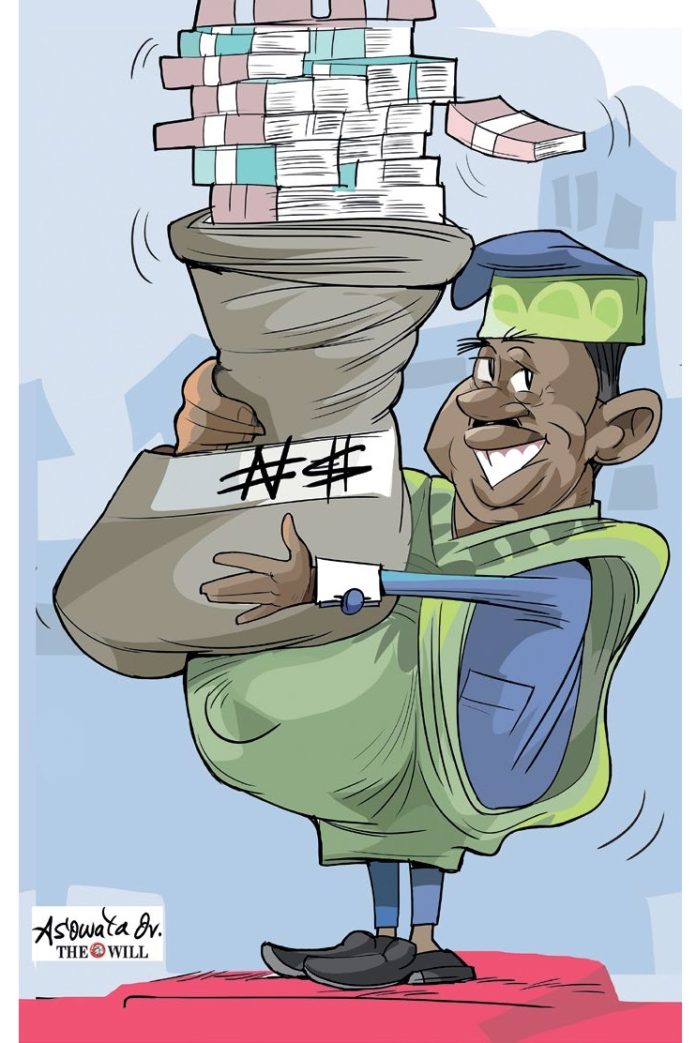
In or out of office, Nigerian politicians seem to always be in clover, getting the best of both worlds. From the president and his vice down to governors and their deputies, federal and state legislators, ministers, commissioners and even special advisers, the treatment is the same – they are pampered like royalty. Now on their way out, nothing suggests the royal treat will discontinue. If anything, it has been ramped up, considering the jumbo severance package for the departing public office holders. Michael Jimoh reports.
Nigerian politicians are one of the most coddled lot in the world. In office they earn far higher than their counterparts in other democracies. Out of it (as many of them will be from tomorrow May 29) their severance packages will be paid as and when due, to borrow a phrase common with civil servants. And that includes I00 percent basic salaries for governors and their deputies for life, marques of their choice to be changed every three years, mansions in choice locations anywhere in Nigeria, a retinue of domestic staff and several other perks – all of that for doing nothing!
And now, Nigerians are wondering if the politicians deserve such humongous severance pay at all, especially in the face of crippling economic conditions they are burdened with. For others, it shows that democracy can be quite an expensive business.

A summary of the severance packages for the political office holders, according to a Punch report, may cost “the country about N63.45bn.” The list includes President Muhammadu Buhari, Vice President Yemi Osinbajo, governors and their deputies, ministers, commissioners, national, state assembly members and special advisers. Special assistants, the newspaper stated, are not included.
Sourced from the website of the Revenue Mobilisation and Fiscal Allocation Commission, Punch gave a blow-by-blow account of the exact sum due to each of the office holders. Of the total amount, the Federal Government will pay N3.39bn while the states will pay about 20 times that amount: N60.06bn.
Continuing, the newspaper reported that the severance package is “separate from other financial packages which may be in place as retirement benefits or pensions for some of the political office holders.”
The departing politicians will not be the only beneficiaries of the bumper package. Even past rulers are not left out. Among those that will be paid are “former Presidents, Vice-Presidents, Heads of State, Chiefs of General Staff, retired heads of service, permanent secretaries, as well as retired heads of government agencies and parastatals in the 2023 fiscal year.”
The estimated total is N13.81bn and former Presidents Olusegun Obasanjo, Goodluck Jonathan, Atiku Abubakar and Namadi Sambo will benefit from the largesse.
“Also expected to benefit from the windfall are ex-military Heads of State, General Yakubu Gowon and General Abdusalami Abubakar, as well as a former dictator and self-styled military President, General Ibrahim Babangida and a former Chief of General Staff, Commodore Ebitu Ukiwe (retd.).
“As stipulated by RMAFAC, the President will get a severance pay of N10.54m, which is 300 per cent of his annual basic salary, while Vice-President Osinbajo will receive N9.09m. The eight special advisers in the Presidency are expected to get N5.83m each, totalling N46.64m. There are 44 ministers under Buhari, consisting of 27 federal ministers and 17 ministers of state.
“While each minister is entitled to N6.08m, each minister of state is entitled to N5.87m. In total, they would get N258.08m, with ministers getting N164.16m and ministers of states receiving N93.92m.”
With these various payments to past Nigerian rulers and political office holders, one is forcibly reminded of the famous quip by H. L. Mencken on democracy. “Democracy,” the inimitable American scholar once mused, “is the theory that the common people know what they want and they deserve to get it good and hard.”
Nigerian politicians, it now seems, have never had it so good at the expense of the “common people” who are on the receiving end of democracy, getting it “hard.”
Of course, the humongous severance pay has raised concern from Nigerians. Among these lot is Joel Akinola. He is chairman Nigeria Union of Pensioners, Ekiti State Branch. In his view, it is wrong to pay such outrageous sums to the departing politicians and political office holders. “It is unfair,” Akinola is quoted as saying. “I see that kind of a move as selfish, inconsiderate and inhuman if people who had worked meritoriously for 35 years are being owed pensions and gratuities of less than N3m for over 10 years whereas people who served in a political appointment for just four or eight years are being paid humongous amounts.”
Akinola pointedly noted that the beneficiaries “have not come to serve us but to rip us off of our benefits. When they are in power, they are heavily paid; they have access to all the benefits – free feeding, free transport, free medicare, free everything, and when they are leaving, they are going with humongous amount as severance allowance.
“I think it is very unfair to leave the poor ones who really did the job unpaid. God does not support this kind of treatment. It is ungodly and should be condemned. I want to appeal to them that they should do the needful concerning pensioners and pay them their dues so that they can put their body and soul together.”
For him, such payments to politicians are illegal because is not in the Nigerian Constitution therefore amounting to “double pay,” insisting that it is “an abuse of power, abuse of privilege.”
For Akinola’s counterpart in Benue state, Mike Vembe, it smacks of selfishness on the politician’s part, “selfish people who do not consider the welfare of their citizens, especially senior citizens…It is a terrible matter if such a huge amount of money is proposed, not to talk of paying it. It is like looking at some people as if they are nothing, you cannot pay them, let them go and die but to themselves, there is no problem.’’
Renowned economist and CEO of Financial Derivatives, Bismarck Rewane thinks that the government should show as much concern for the lawmakers as well as for pensioners. “You know the price of democracy; the government should spend more money on both the pensioners and also the lawmakers. They should pay everybody both the lawmakers and pensioners, not paying one and leaving the other.”
Dr. Muda Yusuf CEO Centre for the Promotion of the Private Sector and onetime DG Lagos State Chamber of Commerce and Industry agrees with Rewane for equitable payment of severance packages to the pols and pensioners.
“I think whatever proposal on pension should be sensitive to the prevailing economic conditions. It should be sensitive to the sensibility of Nigerians, particularly the pensioners because this service is less than 10 years. Some of them have served 10 years while some have a maximum of eight years. Whether that one now qualifies for such a severance package, I think, is something that we can interrogate. This is because the whole essence of pension, even in public service, one must have served for a reasonable length of time such as pensioners who have spent 20-35 years for you to be entitled to pension and, in any case, most of the pensions we have these days are contributory.’’
Pampering those in leadership positions is hardly a novel phenom in the world. Far back in time, long before Christ, the scripture tells us of the Israelites’ distrust of the priestly class. A heady and murmurous race, as Dryden described them, the Israelites approached Prophet Samuel to appoint a king for them. The prophet himself was becoming senile and his children were becoming unruly and laws unto themselves.
After consulting God, Samuel grudgingly acquiesced, reminding the Israelites that they will become more or less serfs under the new monarch. “This is what the king who will reign over you will claim as his rights: He will take your sons and make them serve with his chariots and horses, and they will run in front of his chariots. Some he will assign to be commanders of thousands and commanders of fifties, and others to plow his ground and reap his harvest, and still others to make weapons of war and equipment for his chariots. He will take your daughters to be perfumers and cooks and bakers. He will take the best of your fields and vineyards and olive groves and give them to his attendants.
“He will take a tenth of your grain and of your vintage and give it to his officials and attendants. Your male and female servants and the best of your cattle and donkeys he will take for his own use. He will take a tenth of your flocks, and you yourselves will become his slaves. When that day comes, you will cry out for relief from the king you have chosen, but the Lord will not answer you in that day.”
Of course, the Israelites got their wish and, as the prophet presciently predicted, their punishment too.
Like the Israelites of old though under different circumstances and after suffering for so long under military dictatorships, Nigerians insisted they had had enough. “Never again,” they chorused from the rooftops. “We want democracy.”
True to their wish, General Abdusalami Abubakar obliged them and so blew the whistle for the current dispensation to begin in earnest in 1998. It has turned out to be quite an expensive experiment, as narrated by Karl Maier in his book This House Has Fallen: Midnight in Nigeria.
In the very first chapter, the British journalist elaborated on the cost of the democratic process put in place by the departing military brass, starting from the handover day at Eagle Square Abuja in 1999. “The outgoing information minister, John Nwodo, resorted to the role of traditional praise singer in a speech on Abubakar’s career, describing him as “a soldier’s soldier,” a man of vision. Nwodo neglected to mention that Abubakar had held the third most powerful position in the Abacha regime when all the nastiness occurred. Missing too was any allusion to the unexplained decrease, of at least $3 billion in less than six months, in foreign exchange reserves.
“Given the short time frame, that drop would have made even the notoriously larcenous Abacha catch his breath. Nothing was said about the disastrous state of the economy that Abubakar was handing over to the civilians, a fact that led the more cynical observers to suggest that the military was deliberately attempting to undermine the new civilian order before it even started: coup by bankruptcy, so to speak.
“For the moment, all that was forgiven for the simple fact that Abubakar was about to leave office peacefully, and in Nigeria, and sadly much of the rest of Africa, such a thing was cause for jubilation. To honor his departure, the military was determined to put on quite a show, and a very high-priced one at that. Estimates of the construction cost of Eagle Square ran at about $30 million, and the bill for the fireworks display the night before was believed to be close to $5 million. In the distance sat the green domed building of the new bicameral National Assembly, built by a company owned by Abacha’s Lebanese business partners, the Chagoury brothers, at a cost of some $65 million. Nigerian democracy can be an expensive business.”
Almost a quarter century after, it is hard to prove the journalist wrong.
Michael Jimoh is a Nigerian journalist with many years experience in print media. He is currently a Special Correspondent with THEWILL.
