
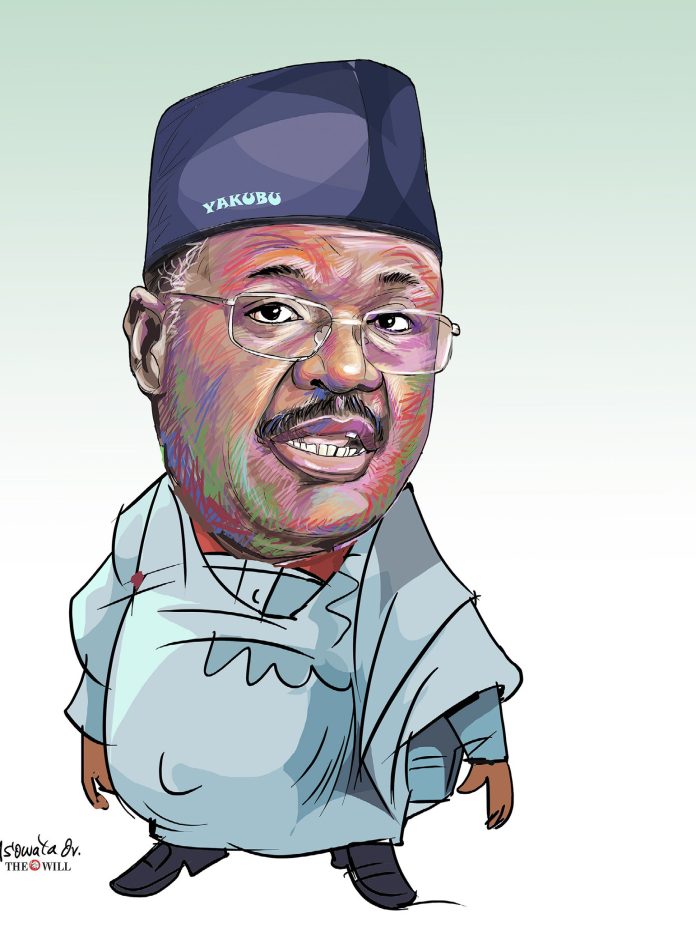
Prof. Mahmood Yakubu was born on May 1962 in Bauchi, Bauchi State. He is a Nigerian academic and current Chairman of the Independent National Electoral Commission (INEC). Definitely, all eyes are now on him both within the country and the outside world as the nation gets set for a general election in a few weeks’ time. He had his first degree at the University of Sokoto now Usmanu Danfodiyo University (UDU), Sokoto. He is also an alumnus of the prestigious Oxford and Cambridge universities. Yakubu was a lecturer, guerrilla warfare expert, and Professor of Political History and International Studies at the Nigerian Defence Academy (NDA).
He was however pulled out of the classroom to answer the national call, first as the Executive Secretary of the Tertiary Education Trust Fund, (TETFUND) after being appointed to office in 2007 by then-President, Umaru Musa Yar’Adua and later as the Chairman of the INEC by President Muahammadu Buhari on October 21, 2015. During his tenure as TETFUND Secretary, a National Book Development Fund was established, supporting 102 journals of professional associations.
Also, while on this job, he worked as a member of the Federal Government team on the Renegotiation of the Federal Government Agreement with the Academic Staff Union of Universities (ASUU) under the leadership of Deacon Gamaliel Onosode. He was on the Presidential Task Team on Education, the Committee on Presidential Scholarship for Innovation and Development (PRESID), the Implementation Committee on the Presidential Fund for the Revitalisation of Nigerian Public Universities, the Ministerial Implementation Committee on the Establishment of Nine New Federal Universities, the Almajiri Education System, and was the Chairman of the Presidential Committee on Needs Assessment of Nigerian Public Universities.

By the time he finished his five-year tenure in 2012, Yakubu was credited for not only improving but also bringing innovations to the country’s higher education system. These innovations include the Academic Staff Training and Development programme, which paid for over 6,000 lecturers from different Higher Education Institutions to get postgraduate degrees at Nigerian universities and over 2,000 lecturers to get postgraduate degrees at universities outside of Nigeria. He also served as a technical member of the Implementation Monitoring Committee (IMC) for the Presidential Special Intervention Fund for the Revitalization of Nigerian Public Universities in 2013.
Yakubu was the Assistant Secretary of Finance and Administration at the 2014 National Conference organised by the then President, Goodluck Jonathan and in 2013, he was awarded an honorary fellowship to the Nigerian Institute of Public Relations (NIPR).
Yakubu achieved a new national record when he received President Muhammadu Buhari’s endorsement for a second term as Chairman of the INEC in 2020. With the extension of his tenure as INEC boss for a second term of five years, Yakubu becomes the first head of an electoral agency to achieve tenure elongation in post-Independence Nigeria.
All his 11 predecessors served just one term. Thus, of all the country’s 12 electoral chairmen since independence, Yakubu becomes the first to serve two terms, having been appointed by Buhari in 2015 to succeed Professor Attahiru Jega. But to keen followers of this illustrious Bauchi indigene, this would not be the first time Yakubu would be cracking records. In the University of Sokoto (now Usmanu Danfodiyo University) where he obtained his first degree, this academic-technocrat owns the exclusive glory of being the first Northerner to obtain a First-Class in History in the school. His tenure as INEC boss was a call to glory but like all good things; it wasn’t all rosy at the beginning. He started slowly and received a lot of criticisms. He was however resilient and showed doggedness and determination to succeed.
In August 2016, INEC was accused of conducting too many inconclusive elections within a short period of Yakubu’s appointment. In fact at some point, critics dubbed Yakubu “Mr. Inconclusive,” an annotation to the spate of hung elections that INEC under him conducted with results delayed beyond the electoral cycle.But in defending this accusation, Yakubu said that the accusation was “ill informed”, “misplaced and undeserved.”
He explained that “inconclusive elections are caused by violence and over-voting and that the notion of inconclusive election is not strange to our law (see Section 26 and 53 of Electoral Act 2010 as amended).”
In October 2019, shortly after the general election, Yakubu dismissed insinuations that all elections conducted since he assumed office had been inconclusive.
He said the commission can only resort to declaring elections inconclusive whenever the circumstances warrant it. He said, “First, what is an inconclusive election? It’s an election in which a winner has not emerged on the first ballot, which is essentially what it is. So now you mobilise and remedy the problem and make a declaration. Is it strange in Nigeria? It’s not strange. In 2013, was the Anambra governorship election concluded on the first ballot? In 2015, the governorship election in Taraba state was declared inconclusive; the commission remobilized and concluded the election two weeks later. In 2011 and 2015, the Imo governorship election was inconclusive, the commission remobilised. In 2015, Abia election was inconclusive, the commission remobilised.
“There are two sections of the Electoral Act that we need to focus on. The first one is Section 26, which says “in the event of violence or natural disaster, INEC should not proceed with an election and if the total number of registered persons in the place affected is more than the margin of lead where you have conducted the election, then don’t make a declaration until you go back and complete the election.”
Despite this criticism, Yakubu may have found the saving grace for his career in the two governorship elections INEC conducted in 2020. In Edo, the commission conducted what was adjudged a free and fair election, reflective of the true wishes of the electorate. Governor Godwin Obaseki, who had left the governing party at the Centre, All Progressives Congress (APC), for the opposition Peoples Democratic Party (PDP) won the September 29, 2020 election. INEC repeated the feat in the Ondo governorship election of October 10, the same year that saw the incumbent Governor Rotimi Akeredolu winning the poll. Those two elections certainly upped Yakubu’s reputation. Why change a winning team? So it was not a surprise when President Buhari granted him a second term in office. On the road towards this year’s election, INEC had also received kudos for the successful conduct of two elections in 2022. The governorship election in Ekiti last June and that of Osun State in July 2022 had brought hope to many Nigerians who hitherto were skeptical of INEC’s capability to conduct a free, fair and credible election. The result was evident in the thunderous crowd of youths that came out to obtain permanent voter cards for the coming election.
One thing that has kept Yakubu and the INEC under him going is his determination to succeed where others had failed. The number of litigations against INEC or in which INEC were joined is enough to send a lily-livered person out of office, but not Yakubu, as he vowed to always stand on the side of the law no matter what it takes. Many watchers of political developments have also commended INEC under Yakubu for its insistence on the use of modern technology, particularly the Bimodal Voter Registration System (BVAS) and the Election Result Viewing Portal (IReV). The technology is important to bequeath transparency and by extension, credibility to the crucial presidential election in February 2023. It is instructive that Yakubu has maintained that there is no going back on the use of the technology notwithstanding the call by some persons for his resignation or removal over his position on the matter.
The BVAS is a technological device used to identify and accredit voters’ fingerprints and facial recognition before voting, while the IReV is an online portal where polling unit level results are uploaded directly from the polling unit, transmitted and published for the public. At the front end of the online portal, members of the public can create personal accounts with which they can gain access to all uploaded results stored as PDF files. This accessibility of polling unit level results increases transparency and public trust in the process. The success of some off-cycle elections, especially in Ekiti and Osun, have been attributed to the use of BVAS. The 2023 Election is Yakubu’s date with history, will he succeed? Nigerians and all lovers of democracy all over the world are waiting as they wish him success.
AYO ESAN, has been actively reporting and analyzing political events for different newspapers for over 18 years. He has also successfully covered national and state elections in Nigeria since the inception of this democracy in 1999.
