May 10, (THEWILL) – Nigerian Maritime Administration and Safety Agency (NIMASA) on Tuesday pledged to provide logistics and formulate policies that would sustain piracy decline in the Gulf of Guinea (GoG).
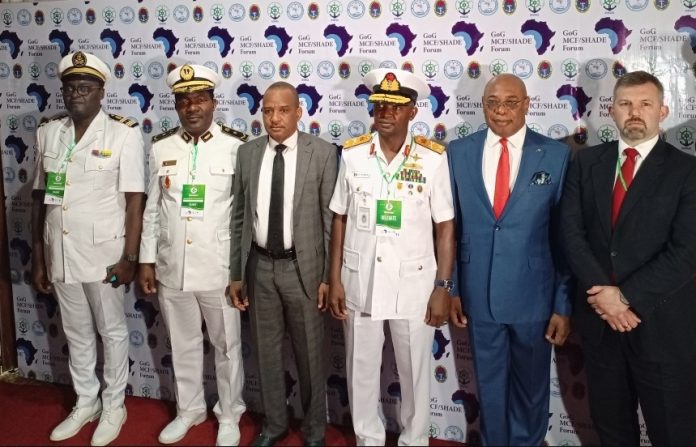
Director-General of NIMASA, Dr Bashir Jamoh, made the pledge in Abuja, at the Fifth Plenary of the Gulf of Guinea Maritime Collaboration Forum/Shared Awareness and Deconfliction (GoG-MCF/SHADE).
Speaking on the theme: ”Enduring and Sustainable Security”, Jamoh said that, in sustaining piracy decline, collaboration was of essence among member-countries so that each country’s boundaries and limitations would be considered, to prevent any form of conflict.

According to Jamoh, the regional forum provided an opportunity to share mutual maritime concerns, jointly face threats and create mitigations, adding that Nigeria, through NIMASA and the Nigerian Navy, stands ready as co-chair of the SHADE to continue to provide every necessary support in collaboration with the ICC.
He said that SHADE would be nurtured to maturity and give laudable results.
“Two years ago, we connected virtually with a dark, sad and persistent cloud of blue crimes enveloping the region, but today we gathered with the cloud opening and we are seeing the sun gradually shining through.
“No one can easily forget the frequent reports of attacks on ships and kidnapping of seafarers in the GoG in 2019 and 2020 when they reached their peak”, he said.
Jamoh noted that the attacks had negative economic effects on seaborne trade in the region.
“While it is important to recognise success so far made, the future must, however, be the focus. Our deliberation over the next two days must be forward-looking even as it seeks to provide specific ways to maintain the current momentum, offer concrete solutions to ensure sustainability and build on success”, he said.
He said that more remained to be done in terms of the legal framework to enable SHADE’s existence.
“SHADE must be nurtured to remain a force for good. As members, we owe a collective duty to this forum to keep its dialogue robust and guard it from slipping into complacency as to become a toothless bulldog.
“Our SHADE must be strengthened through cooperation, coordination, collaboration and communication. Security success can never be solitary achievements”, he said.
Nigeria’s Chief of Naval Staff, Vice-Admiral Awwal Gambo, said that SHADE would offer a veritable platform for GoG nations and other partner-nations to congregate and cooperate to address piracy challenge facing the region.
Vice Admiral Gambo, who was represented at the occasion by Rear Admiral Saidu Suleiman Garba, Chief of Policy and Plans, however regretted that the comparative advantage of the GoG has been threatened by the activities of criminal elements perpetrating piracy and armed robbery at sea.
According to him, the activities of these criminal elements have continued to undermine the economic lifeline of nations within the region in particular and global trade in general, hence, the need for a sustained collective collaborative effort by relevant stakeholders.
“I am pleased to announce that our collective efforts have resulted in a steep decline in the reported cases of piracy within the GoG, especially in the last three quarters of 2021.
“Also, it Is gladdening to note that in 2022 only one case of pirate attack has been recorded till now. I want to appreciate all coastal nations within the region as well as international partners and relevant stakeholders that have made positive strides in the area of multinational and interagency cooperation and response to piracy incidents in the GoG.
“On the part Of the Nigerian Navy, the successes recorded were largely due to its ongoing efforts towards building institutional capacity in reinforcing capabilities for maritime governance.
“This has been deeply supported by the Government of Nigeria, through the Office of the National Security Adviser, Ministry of Defence, Ministry of Transportation and Defence Headquarters amongst others. On Maritime Domain Awareness capability, the NN is utilising its Falcon Eye Maritime Intelligence Facility, Regional Maritime Awareness Capability as well as recent acquisition of Unmanned Aerial Vehicles (UAVs) to enhance and extend the reach of the NN surveillance architecture.
“Also, Nigeria’s Deep Blue Project is an integrated National Surveillance and Waterways protection infrastructure, though still evolving. The Nigerian Navy forms an integral part and currently manning some’ assets to support the project towards ensuring the nation’s waterways are safe.
“Similarly, on the response capability of the NN, we are deeply committed to a sustainable fleet renewal programme. Recently, the NN took delivery of some naval assets among which are survey ship (NNS LANA), an AW 139 maritime helicopter and a Landing Ship Tank (NNS KADA). These acquisitions are pointers to Government’s commitment to building institutional capacity toward improving maritime security.
“We are encouraged that our investments in maritime governance are bearing some positive results with the recent International Maritime Bureau’s report indicating a decline in piracy incidents in our waters. Equally, the Federal Government of Nigeria is working assiduously with different stakeholders and tiers of government to ensure that root causes of piracy and other Maritime crimes are mitigated through other non-kinetic programmes and community engagements”, he said.
Other stakeholders present at the plenary include Dr Paul Adalikwu, Secretary-General, Maritime Organisation of West and Central Africa; Admiral Narciso Fastudo, Director, Interregional Coordination Centre (ICC-Yaounde); and Rear Admiral Solomon Agada, Co-Chair, SHADE-GoG/Maritime Collaboration Forum.