The lovefest between Africa and China is heating up —trade volume is expected to hit $200 billion this year, and the “West” —Africa’s traditional trade partner, is out in the cold, helplessly engrossed in economic turbulence. A huge chunk of this affection, mostly in form of soft loans for infrastructural projects, is meticulously teleguided and showered on select African markets —with Nigeria at the top of the list.
This year alone, Nigeria has inked agreements with China for loans valued at over $3 billion —with even more pending, targeted at Power, Light rails, Airports, Telecommunication and other infrastructure projects. There’s little reason to doubt the good intentions of Pres. Jonathan administration’s lust for infrastructure soft loans. Yet, just like the road to hell is paved with good intentions, these loans can easily become poisoned chalices!
China’s domineer practice of providing fishy loans that are tied to its own contractors, materials and consultants is a vile habit, often targeted at ultra high-risk nations —a club, thankfully, that excludes Nigeria, at least for now. According to the economist; “Most loans and payments are “tied”—ie, the recipient must spend the money with Chinese companies….But tied aid leads to shoddy work”. Anyone with first-hand experience in construction projects, appreciate the fact that interplay of labor, materials and contractors during construction can easily throw up a vista for insidious fraud that require more that a passing glance to curtail.

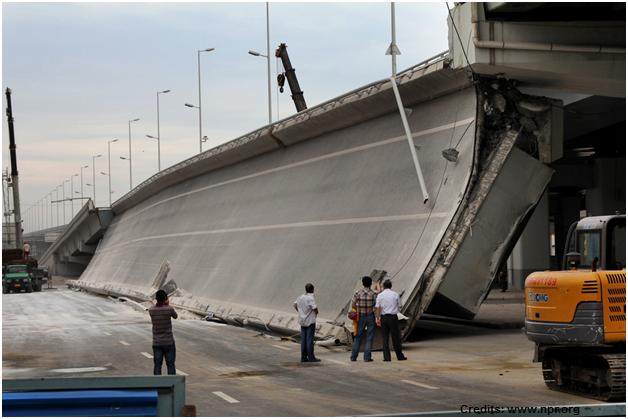
Curiously, recent infrastructure failures inside China has failed to raise concerns in relevant quarters about the wisdom in the wholesale surrender of Nigeria’s infrastructure projects to Chinese construction firms, executing contracts funded with Chinese loans, and built with materials, labor and consultants of Chinese origin. Collapsed infrastructure (eight bridges since 2011 alone) is relatively common in China, as “construction firms and other companies often cut corners in China”, often with fatal consequences and reportedly, due to poor construction practices and corruption.
To be sure, these unwholesome practices have since been exported to Africa, as many Chinese construction firms engaged in many infrastructure projects across the continent. Incidents of shoddy Chinese construction work dot the Africa landscape like a bad case of chicken pox. In one report, in Lusaka, Zambia’s capital, whole road section was simply washed away by rains!
Pres. Jonathan’s hurried pace to transform Nigeria, whether for electoral approval, God and country, can easily boomerang when poorly articulated, and implemented policies become manifest in feebly executed infrastructure —a danger, rather than benefit, to all. For one thing, our national building codes are outdated, unenforced and plainly inadequate in penalties for violations. There exist little or no guidelines for foreign contractors to adhere to or draw focus. This scantiness is akin to a declaration of open season for all manner of construction malfeasance.
Far more worrisome is the lack of engagement of local industry professionals to collaborate with their Chinese counterparts in the execution of these projects. Such collaboration will enhance local content enrichment, technology transfer and capacity development, which are invaluable down the road for repairs and maintenance of these projects.
Clearly, with loans and construction contracts already signed and sealed, there exists an urgency of now to set up incorruptible technical committees that will oversee the rigorous quality management of every aspect of these outsourced infrastructural projects —from design to commissioning. Government can do no less. The turbulent political landscape —not to mention corrupt politicians, makes it doubtful that the oversight committees of the national assembly can be dispassionate and altruistic enough to perform this function, sterlingly.
Without a doubt, what Nigerians have done to Nigeria is far worse that what the Chinese can do to her. Yet, unless government act with timely sagacity, in the fullness of time —when the luster of cheap loans, and sparkle of glass and glimmer of steel have worn out, broken dreams and deficient structures may be a painful experience for many generations.
Pres. Jonathan’s administration must go the extra mile to ensure the qualitative and quantitative components of these critical infrastructural projects meet international best practices. Such efforts will guarantee the projects to come to viable fruition —stand the test of time and serve generations of Nigerians that will bear the pains and sacrifice of repayments of these project loans.
A selfless vigilance over the execution of the nation’s outsourced infrastructure projects is imperative, lest the endeavor becomes the epic joke of the century.
Written By Emma Adoghe