
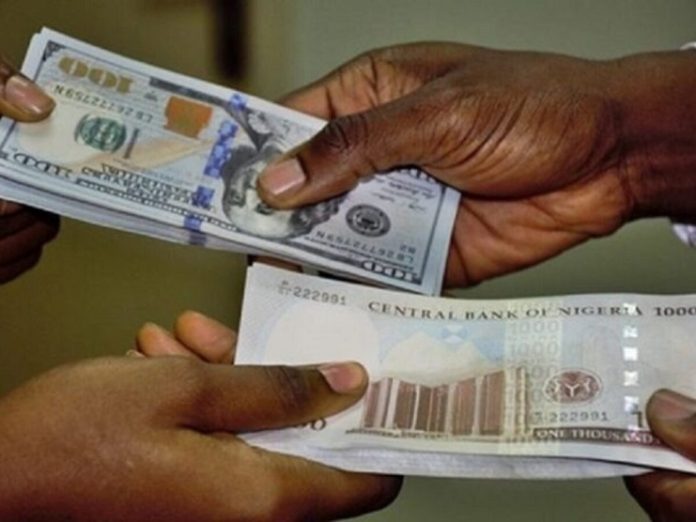
March 20, (THEWILL) — The Nigerian naira weakened at the official market as Nigeria’s external reserves slipped below the $50 billion threshold, raising concerns over the sustainability of recent foreign exchange stability despite rising global oil prices.
Data from the Central Bank of Nigeria showed the naira depreciated by N9.48 to N1,353.90 per dollar on Wednesday the last trading session of the week due to the public holiday compared to N1,344.42 recorded on Tuesday at the Nigerian Foreign Exchange Market.
This represents a 0.7 percent decline.

At the parallel market, however, the currency remained unchanged at N1,400 per dollar.
The spread between the official and parallel market rates narrowed to N47 from N56 recorded a day earlier, indicating improved convergence across the two segments.
Meanwhile, Nigeria’s external reserves have continued their downward trend, declining for five consecutive sessions. Figures from the CBN show reserves fell to $49.83 billion as of March 17, 2026, down from $50.02 billion recorded on March 11. Analysts attribute the decline to sustained outflows amid heightened geopolitical tensions in the Middle East.
The drop in reserves comes despite a rally in global crude oil prices.
According to a report by Coronation Merchant Bank Research, Brent crude rose by 11.16 percent week-on-week, climbing from $91.00 per barrel to close at $101.16 per barrel, driven by escalating tensions in the Middle East.
While higher oil prices typically support Nigeria’s reserves, the impact appears to have been offset by persistent external pressures and foreign exchange interventions.
Despite current headwinds, the CBN maintains an optimistic outlook. In its 2026 macroeconomic projections, the apex bank expects reserves to rise to $51.04 billion, supported by stronger oil earnings, ongoing foreign exchange reforms, and improved capital inflows.
Governor of the CBN, Olayemi Cardoso, said recent policy measures have enhanced transparency and liquidity in the FX market.
He noted that reforms including the unification of exchange rate windows and the removal of legacy capital controls have simplified trade and investment processes.
Analysts say the trajectory of the naira in the coming weeks will depend largely on the pace of inflows, oil production levels, and the effectiveness of ongoing reforms in stabilizing the foreign exchange market.

Ogochukwu Onwaeze is a writer specializing in business and economic journalism. At THEWILL News Media, she translates market trends, financial developments, and policy shifts into clear and engaging stories.
