November 05, (THEWILL) – The Nigerian Communications Commission (NCC) has fixed the reserve price (RP) for the auction of the fifth generation (5G) spectrum at N75 billion ($197.4 million).
The Commission made this known during a stakeholders’ engagement forum on draft information memorandum for the 3.5 Ghz Spectrum auction, held at Marriott Hotel, Ikeja Lagos.
In spectrum auctioning, reserved price means the starting point at which those interested in acquiring the slots could bid.

Meanwhile, NCC has scheduled December 10 for the mock auction, while the actual auction is fixed for December 13, 2021.
Interested operators are expected to pay 10 per cent of the reserved price of $197.4 million to qualify to participate in the auction.
The commission plans to conduct the 5G spectrum auction with a reserve price starting at $197,400,000 for two lots of 100 MHz on offer in the first phase of the auction in the 3.5GHz band while an Initial Bid Deposit (IBD) equal to 10 percent of the reserve price will be adopted in line with the previous auction.
It sought the active participation of stakeholders in the deliberations that would follow towards the licensing of the 3.5GHz mid band for the deployment of 5G services amongst others in Nigeria.
The director, spectrum administration, NCC, Olutoyin Asaju while presenting highlights of the 5G information memorandum, disclosed that new entrants are allowed to participate in the auction in addition to existing licensees; and that only licencees with 100 percent regulatory compliance would be allowed to participate in the auction.
He noted that licencees with outstanding debts that have secured NCC’s approval for a payment plan will be allowed to participate.
“The auction comes with a 10-year Spectrum Licence and a minimum requirement of a UASL operational licence. New entrants or licencees without a UASL will be required to additionally obtain a UASL (Universal Access Service Licence) operational licence”, he said.
Asaju further disclosed that rollout obligations for winners will be in three phases. In the first phase, starting from the effective date of the licence, rollout service in at least one state in each geo-political zone: Southwest, South-south, Southeast, North central (including FCT), Northwest and Northeast zones within one to two years.
In the second phase which is within three to five years, rollout should take place in additional six states other than those in the first phase across the six geo-political zones. In the third phase which is within six to 10 years, operators are encouraged to roll out across all other states.
“Service roll out in each state would mean a minimum of five sites in a state. Minimum download speed of 100 Mbps is to be achieved by the operators and shall be measured using applicable measurement tools. A Risk Management Framework for 5G shall be developed in due course”, he added.
Earlier in his welcome address, the executive vice chairman, NCC professor Umar said through the collaborative efforts of the National Frequency Management Council (NFMC) and Nigerian Communication Satellite Limited (NigComSat), the Commission was able to secure the necessary 3.4 – 3.9GHz C-band for deployment of 5G services in Nigeria.
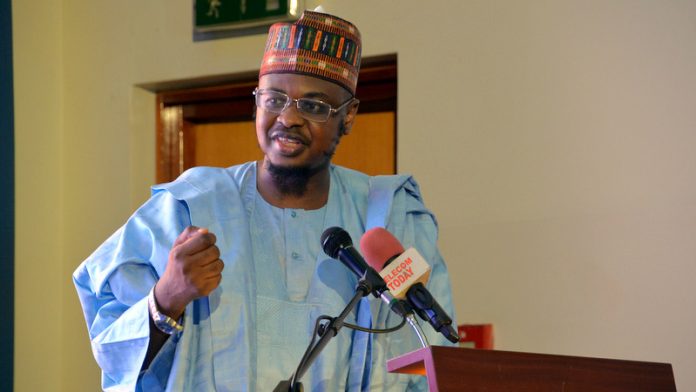
In his keynote address, minister of communication and digital economy, Prof. Isa Ali Ibrahim (Pantami), said the 3.5GHz spectrum band (the lower C-band), which is not effective in satellite operations, has been recovered from NIGCOMSAT and reallocated to the NCC in the first instance, for deployment of 5G technology based on terms and conditions agreed by both parties.
“The next step is auctioning of the spectrum which is under the purview of the regulator of the industry. However, for transparency and accountability in the sale of this common national heritage, the federal government thought it wise to involve relevant stakeholders in the process so that the general public is carried along “, he said.
He further disclosed that the federal executive council (FEC) approved a National 5G Policy for Nigeria’s Digital Economy on September 8, 2021, a 43-page document containing all the necessary information guiding the processes and procedures for the deployment of 5G technology in Nigeria.
The policy is designed and formulated to achieve many other goals, a few amongst which are: to ensure effective deployment of 5G to cover major urban areas by 2025; to ensure security of the 5G ecosystem and the protection of data.
It will also ensure that international best practices and globally accepted standards and specifications are entrenched in Nigeria’s 5G ecosystem; and to ensure that the required infrastructure needed for successful deployment of 5G networks such as data centres, power, etc, are catered for in deployment strategies of 5G networks.
Meanwhile, mobile operators including MTN, Airtel, as well as the GSM Association (GSMA) have called on the regulator to lower the reserve price for the 5G spectrum.
Chairman, Association of Licensed Telecom Operators of Nigeria, Alton, Engineer Gbenga Adebayo, expressed concern that the price came a bit high for the operators, considering the huge investments they needed to make to ensure a robust 5G roll out in the country.
Adebayo believed that the best government should have done was to make the spectrum license as affordable as possible, so the country could maximize all the potentialities of 5G technology when rolled out.
He said: ” Let me say that the telcos will do everything possible to support the government to see out a successful auctioning and a smooth 5G roll out in the country.
” However, our concern is on the reserved price for the auction. That is where the issue is and that is where all the stakeholders should look into.”