
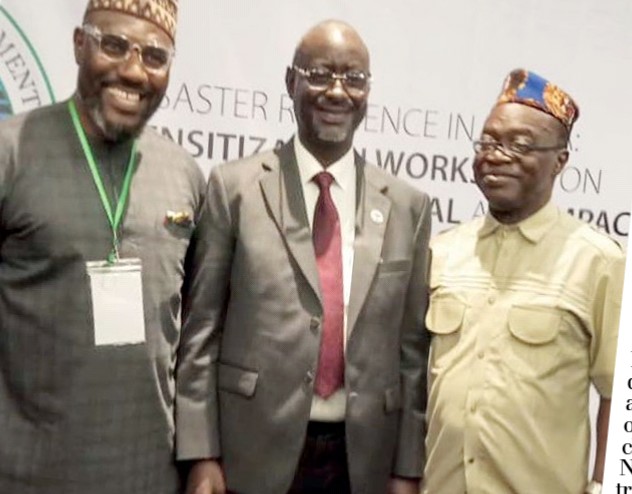
As anyone would imagine, the media and National Emergency Management Agency (NEMA) have little or nothing in common. But that isn’t quite correct because, in reality, both institutions have a lot in common. For one, both address large audiences. Both respond to unfolding events as they happen – the media being the first to report them and, in the case of unexpected disasters, NEMA is sure to be there to save lives. More than anything else, both of them are deeply involved in fieldwork and having to deal with people.
Last week at a fashionable hotel in Lagos, this synergy between the media and NEMA was the subject of discourse at a one-day interaction with the theme “NEMA’s Workshop for Media Practitioners on Disaster Reporting.”
By mid-morning of Saturday July 15, Hall 1 and 2 of Radisson Hotel on Isaac John Street GRA Ikeja, a good number of senior journalists and editors from the print, broadcast and online media were stepping into the icy interior of the hotel, having registered as participants at the foyer. Led by Toni Kan, PR and Development Expert and facilitator of one of the sessions, the synergy between the media and NEMA began on a good note.

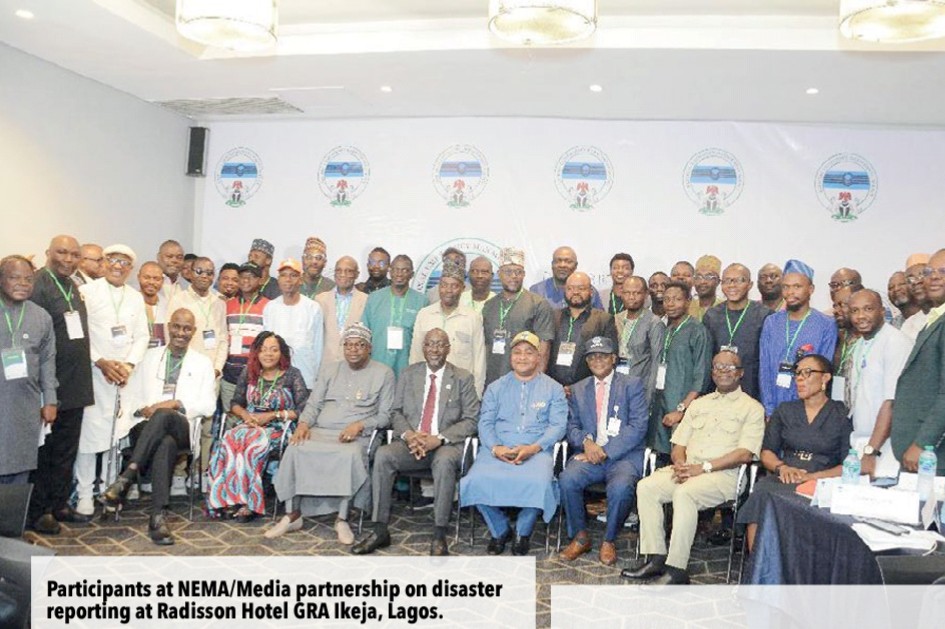
The DG of NEMA himself, Mustapha Habib Ahmed, led a high-profile delegation that included NEMA’s Director Special Duties, Dr. Onimode Bandele Abdullahi, NEMA’s Director of Risk Reduction, Dr. Daniel Obot and Head of Lagos NEMA Technical Office, Ibrahim Farinloye.
Among the media team was Hamzat Idris and Dotun Oladipo, Managing Editor of Daily Trust and Publisher of Eagle Online respectively who were also panelists in one of the presentations “Navigating Challenges in Disaster Reporting: Insights from Media Practitioners.”
Communications Management Expert Chido Nwakanma, took charge of the technical presentation at the workshop titled “Collaborative Approaches in Disaster Reporting: Strengthening Partnerships for Effective Communication.” Toni Kan himself facilitated the third technical session with the theme “Ethics in Disaster Reporting: Balancing Sensationalism and Responsible Journalism.”
Outside the venue as time wore on, it rained ceaselessly with security staff proffering umbrellas to guests arriving at the hotel. Inside Hall 1 and 2, it was a rain of ideas for the NEMA team and media, particularly the panel of discussants.
The workshop was necessary, Ahmed declared, because “we intend to foster a collaboration between media practitioners and NEMA. Our shared goal is to facilitate effective information dissemination during emergencies. By working together, we can ensure that timely and accurate information reaches the public, creating much needed awareness and enabling them to make informed decisions and take necessary precaution where available.”
Part of the reason for the workshop is the proclivity of some media organisations – online publications especially – to embellish and sensationalise disasters where they occur. It is even worse now with citizen journalism whereby anyone with a smart phone can upload fake stories and photographs of disasters that never happened.
Therefore, the DG insisted the workshop was necessary “to enable media practitioners to report on disasters and NEMA as the apex disaster management agency in Nigeria. The objective is to provide a clear understanding of NEMA’s remit, Nigeria’s triple response structure, and NEMA’s relationship with subnational actors” and the media’s role “as gatekeepers in this era of disinformation. We trust you to act as a bulwark against misinformation and fake news and the shenanigans of citizen journalism and fifth columnists.”
The DG’s fears about fake news is not without reason. Bloggers are only too eager to exploit disasters for selfish reasons. So, they inundate sites with fake news of disasters, possibly culled from other countries and posted as recent occurrences in Nigeria just for mischief. Toni Kan pointedly recalled one such incident that happened in faraway Kenya but which a Nigerian blogger reposted as taking place somewhere in the north. To prevent all that, the media must not “rush to publish,” a participant urged, but get “your sources right.”
In as much as disasters and calamities are ‘good news’ for journalists, another opined that they should “rise above personal biases” in reporting them.
Becoming ever more frequent especially now in the rainy season, the images of flood victims are all too familiar. An untamed, relentless rush of coffee-brown water inundating homes, highways, farmlands and bloating canals after a torrential downpour, insultingly sweeping away everything in its path: man and beast, furniture, beddings, pots, pans, cooking gas, stoves and a few driverless vehicles.
During and after rains, mud buildings dissolve into silts leaving behind thatched roofs floating downstream with the unstoppable flood. Otherwise sturdy brick buildings are submerged to their eaves and beams, with the occasional survivor pet squatting despondently on the roof.
Disasters of this type are common features across the tropics, especially after torrential rainfall rivalling or even surpassing that of Noah. While the hirsute patriarch had the privilege of providential early warning the better to prepare for the impending disaster, modern man is often caught unawares thus exposing him to the elements. And humans nearly always come off worsted in all of those unexpected and unequal contests with nature.
The records are grim enough: In Katsina a mother had a baby strapped to her back when a sudden deluge surprised her neighbourhood after an unceasing downpour weeks ago. She lost grip of the boy in tow because of the rapid onrush rising steadily until it reached her waist. While the rain poured around her, she could feel her daughter’s weight and wetness on her back. But one time her son was gone, gone with the flow as if he was never there with her at all.
A two-year-old girl was similarly lost to over-flooding in Bayelsa last October. More than half a dozen communities Amarata, Edepie, Akenfa, Tombia, Akenpai, Agudama-Epie were surprised by the heavy downpour which rendered hundreds of families homeless. While asleep, a middle-aged woman was swept away along with her house.
In big cities and out of the way communities across Nigeria, it is an unending tale of lamentation like the rain itself falling without let, ravaging and levelling everything in its way. According to NEMA, more than 600 people were killed last year as a result of flooding.
Disasters, NEMA DG said at the workshop, “are local and to enhance our disaster management capabilities, it is imperative that State Emergency Management Agency (SEMA) are fully operationalized and Local Management Committees (LMCs) are activated. These bodies will play a crucial role in ensuring effective disaster response at the state and local level.”
Four days before the workshop, Ahmed met and sp
oke with Nigeria’s Governors Forum in Abuja seeking their cooperation for preparedness of the 2023 flooding season. “We seek to collaborate with NGF to establish a robust monitoring and evaluation framework which will enable NEMA and NGF to track progress, assess the effectiveness of flood preparedness initiatives, and identify areas of improvement. Regular feedback and joint evaluation exercises will support evidence-based decision-making and promote accountability in disaster management efforts.”
Furthermore, the meeting/ partnership with the governors “will provide a platform for facilitating the sharing of best practices and lessons learnt among the states. We can facilitate discussions, workshops, and peer-to-peer learning sessions where states can share their successful initiatives in disaster risk reduction and resilience. This knowledge exchange will help expedite the adoption of effective strategies across the country.”
In that regard, the DG went on, NEMA “has taken steps to align its national policies and strategies with the Sendal Framework by developing the National Disaster Risk Reduction Policy and National Disaster Risk Management which provide guidance for implementing risk reduction measures at national, state and local levels. These initiatives emphasise and highlight the importance of multi-stakeholder collaborations and community participation in disaster risk management.”
NEMA was established via Act 12 as amended by Act 50 of 1999 specifically “to manage disasters, coordinate resources towards efficient and effective disaster prevention, preparation, mitigation and response in Nigeria.” Added to this is NEMA’s vision “to build a culture of preparedness, prevention, responses and community resilience to disaster in Nigeria.”
According to Ahmed, Nigeria was hit in 2022 with the worst possible flood in history, affecting 29 of the 36 states. Records from the Red Cross in that year showed that at least 2.8million people were affected with 603 fatalities and more than 2, 500 injured.
The NEMA DG gave the vote of thanks while president of the Guild of Corporate Online Publishers (GOCOP) and publisher of Realnewsmagazine.net Maureen Chigbo spoke on behalf of the participants, all of whom were presented with certificates of attendance.
“The workshop was insightful and timely and would help enhance reportage of disasters and emergencies from the perspective of well-informed media practitioners,” she said.
The NEMA/ media workshop was facilitated and moderated by Dayo Alao of Impact Pointe Consultancy Limited, Vista and The Media Training Room and Radi8.

Michael Jimoh is a Nigerian journalist with many years experience in print media. He is currently a Special Correspondent with THEWILL.
