…Experts Express Doubts On Feasibility
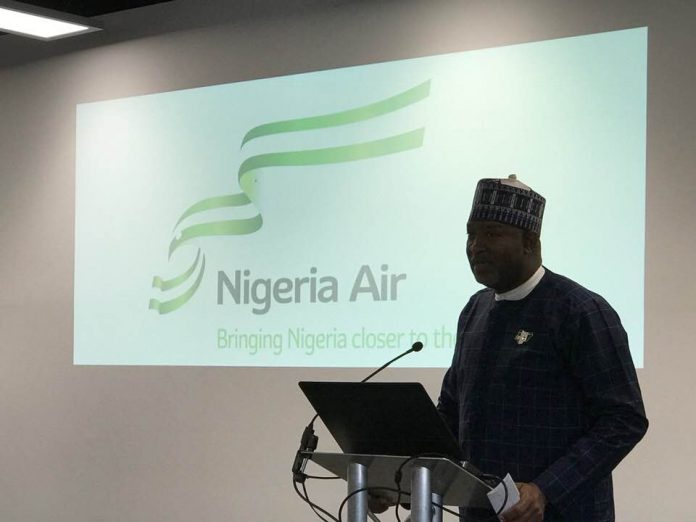
BEVERLY HILLS, March 08, (THEWILL) – In search of an indigenous airline that would serve her people, the Federal Government mooted the idea to float a new national carrier already named Nigeria Air. As part of the planning process, the present administration unveiled the name and logo elaborately at the Farnborough Air Show in the United Kingdom in July, 2018. Two years after, Nigerians are still waiting anxiously to see the realisation of the airline project.
In 2003, the Olusegun Obasanjo administration liquidated Nigeria Airways, the government-owned national carrier, because it had failed as a business. Twelve years later, President Muhammadu Buhari prior to 2015 election promised Nigerians that he would deliver a new national carrier in the status of the defunct Nigeria Airways.

Following the slow pace the project was going amid its suspension, Vice President Yemi Osinbajo had in January 2019, while defending the project, offered an insight into why the much-celebrated Nigeria Air project was suspended by the Federal Government.
According to him, the decision was to allow for private-sector management of the proposed national carrier. Since then, nothing much has been done by the government, concerning the airline project.
Although, the Federal Government has appointed transaction advisers, as early as March 2018, comprising many firms, for the establishment of the national carrier, the Minister of Aviation, Senator Hadi Sirika had continuously assured that the project is on course.
According to Sirika, the project which gulped about N100 million between July and November 2018 (spent for Transaction Advisers and branding purposes alone), is in the pipeline and also designed to drive the Nigerian aviation sector roadmap.
However, the sluggishness employed in driving the plan has elicited comments from aviation stakeholders who feel that continuing allocation of public funds by the Federal Government for the Nigerian Air project is wasteful and insensitive to the preponderance of public opinion against that project
From records, previous attempts to float both a national carrier and even private airlines had always suffered. Since the demise of Nigerian Airways Limited, no local airline had survived continuously for 10 years in a stretch.
Over the next two decades, air traffic in Africa is forecast to increase rapidly; even at that, most state-owned flag carriers on the continent are losing money, with the exception of Ethiopian Airlines, and few others which analysts say have avoided the mistakes of other regional carriers.
ALSO READ: Proposed Nigeria Air To Gulp ₦1 billion In 2021
However, some African countries are making headway. Uganda for example, has within a short period relaunched its national carrier. The Uganda Airlines was liquidated in 2001, some three years before Nigeria Airways closed shop. Today, Uganda has been able to establish a full-fledged national carrier. The East African carrier has bounced back though slowly; however, with clear focus on the regional market that is currently dominated by Ethiopian Airlines.
Beyond Africa, many foreign countries are doing well with their national carriers, raking in money, attracting tourists, investors and foreign exchange into their treasury.
EgyptAir, the national airline for Egypt, for example, is using its airline to make money, and also promote domestic tourism.
A good case in point is the recent effort by the airline to bridge the gap created by the flight restrictions by the government of United Arab Emirates (UAE).
According to the General Manager, EgyptAir Airlines (Lagos), Muharram Abdel Rahman, the carrier is making frantic efforts to offer Egypt as alternative destination to Dubai. The airline has therefore, rolled out lots of incentives for prospective customers.
“We are offering Egypt as alternative destination to Dubai. We are working to promote Egypt as a destination for Nigerians”, Rahman said.
Other airlines, such as Lufthansa, Emirates, Ethiopia Airlines, British Airways, Kenya Airways, Qatar Airways, Singapore Airlines, Turkish Airlines, have equally shown good example in terms of profitability to their countries.
As in the case of Nigeria Air, aviation experts have faulted the beginning, pointing out that the controversial venture is coming at a time of lean resources, global downturn, and investors’ fatigue, amid an unfriendly local environment for airlines’ survival
In his views, former Commandant of the Murtala Muhammed Airport (MMIA) Lagos, Group Captain John Ojikutu (rtd), told THEWILL that the journey of Nigerian Air started very well but met turbulent wave challenges; unfortunately, lost its way.
According to Capt Ojikutu, setting up a national carrier by a developing country like ours needs a technical partner and investors both foreign and national.
Citing example with that of Emirates, Ojikutu said “Even the Emirates we see as one of the best today has the hands of the British technical partners. Unlike the Emirates with a lot of government investments and control we need a national or flag carrier with no government control, otherwise we would end up with a government airline instead of a national carrier”.
Ojikutu, an Aviation Security Consultant who is also the Secretary-General of the Aviation Safety Round Table Initiative (ASRTI), maintained that a national carrier would have very little government shares, shares of credible Nigerians and the shares of public Nigerians through the Nigerian Stock Exchange (NSE).
“On the other hand, if government is not ready, we could go for flag carriers with or without government shares but the shares of public Nigerians, credible Nigerians and foreign technical partners and investors”, Ojikutu added.
He however, admitted that the only challenge either way, is finance and trust from the investors, adding that, “It is a project that should have come on stream by 2018 but there was no transparency within and trust from outside government”.
In his own submission, Secretary General of Association of Nigerian Aviation Professionals (ANAP), Comrade Abdulrasaq Saidu told THEWILL that there is nothing on ground to show that Nigeria Air project is feasible.
Stating that the project had long been abandoned, Saidu, noted that the whole thing about Nigeria Air are media hype just to make an impression.
He said “I don’t think there is anything on ground to show that the project is on. It has been completely abandoned. Remember the Federal Executive Council (FEC), had asked the minister to stay action on the project. It is only Sirika that is saying it will soon be ready. But how soon?”.
“If he is forming a national carrier, where are the staff members; have they been recruited and what is their fleet size? Another important thing is the technical partners; who are they?”.
Similarly, a major stakeholder who spoke under the condition of anonymity said that, from the beginning government has not shown seriousness concerning the Nigeria Air project.
Supporting the stay action order by FEC on the project, the source said “I knew from the beginning that government is not serious with Nigeria Air. They have not been transparent enough to convince the people that they mean well. Although, the project might have good intentions, I doubt if it will sail through at the end of the day”.