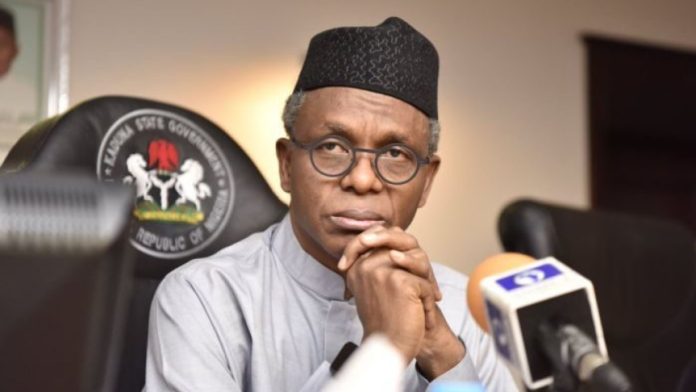
BEVERLY HILLS, November 06, (THEWILL) – Kaduna state governor, Nasir El-Rufai has said that Nigeria is not collecting as much public revenue as it can. He maintained that there is still much potential for growing Value Added Tax (VAT) and independent revenues of the Federal Government than what is being collected presently.
El-Rufai made this known in a keynote address he delivered at the 22nd Annual Tax Conference of the Chartered Institute of Taxation of Nigeria (CITN), held in Lagos on Thursday.
According to the Governor, there is considerable resistance to the hike in VAT from 5% to 7.5%, saying Nigeria’s rates are still much lower than other neighboring countries. “This low rate of internal revenue collection, depresses public finances, hampers the ability to deliver social goods, services and physical infrastructure. He added that the low IGR limits competitiveness, shrinking the ability to promote the sort of enabling environment and economic dynamism that can create jobs, expand public revenues and improve public welfare”, he added.

He stressed that leakages in the tax system constitute a significant drain on government collection and utilization of revenue, adding that leakages may occur at the stage of revenue generation at the stage of assessment, where taxpayers are either not assessed at all or where the assessment is incorrectly done; at the stage of collection, where government revenue is not fully collected or where collection is not fully accounted for. or at the stage of utilization, where revenue collected is not accounted for adequately, or where allocated and disbursed, it is not prudently spent.
“With national tax revenues (oil and non-oil) still less than 7 percent of GDP, Nigeria is way behind the average of comparator nations of about 20% of GDP. As the world goes green, and crude oil loses its primacy as a leading source of energy, Nigeria must look inwards and compel every adult to pay tax as part of our citizenship obligation.
“In light of the situation that we are in, we have very few options other than developing our capacity to broaden the tax net, assess and collect taxes from individuals and companies to levels of our comparator nations – at least 20% of GDP within the shortest possible time frame. As political leaders and tax professionals, we must put our collective heads together to ensure this national objective is achieved as soon as possible”, he noted
The Governor further disclosed that only a minority of Nigerians pay income tax, especially those whose taxes are deducted at source – including the formal sector employees, public servants and the like, lamenting that Voluntary compliance with the obligation to pay income tax remains a major challenge in the country.
He listed Lagos and Edo as having done relatively well in terms of tax revenue mobilization at the sub-national level, stating that the overall picture is even less encouraging than at the national level. “The total internally generated revenues by states are currently less than one percent of GDP, despite the fact that Nigeria’s current fiscal federalism framework allows states (and local governments) to collect many taxes, levies and fees as in the Taxes and Levies (Approved List for Collection) Act, LFN CAP T02. We were determined from 2015 to assess and collect enough tax revenues to cover at least our personnel costs, and in the medium term, our entire recurrent budget such that we don’t need to wait for the monthly FAAC ‘handouts’ to keep our governmental operations running.
“To underscore our commitment to this, the then Deputy Governor and I resolved to donate 50 percent of our salaries and allowances to the state treasury until we are able to achieve the first benchmark. We did so in 2019!”, he added.
El-Rufai, however, stressed the need for tax design in a developing country such as Nigeria to consider supportive strong institutions, particularly by government building fiscal capacity across its economic and political institutions. “The positive effects of tax revenue depend on prudence. For instance, efficient infrastructure enables firms to be competitive, and inefficient infrastructure harms competitiveness. Excessive taxation can be an added business burden that also adversely affects competitiveness. For example, multiple and high levels of taxation affect supply and output prices, firm revenues, and profits.