
BEVERLY HILLS, January 27, (THEWILL) – Nigeria has seized 8,800 kilograms (19,400 pounds) of pangolin scales, elephant tusks and lion bones bound for export to Vietnam, a senior customs official said Wednesday.
Customs operatives intercepted the animal parts hidden in a container as furniture materials at Apapa port in Lagos, the area controller, Mohammed Abba-Kura, told AFP.
“Immediately the container was opened, logs were seen in front, and after physical examination of the container, elephant tusk and the pangolin scales were seen concealed by the logs.

“The items, falsely declared as furniture, comprised 162 sacks of pangolin scale and 57 sacks of mixed endangered species of various sizes such as ivory/animal horns, lion bones and others”, he said.
Abba-Kura said the container load was heading to Haiphong, Vietnam, and that a suspect had been arrested over the shipment.
Nigeria is a major hub for traffickers sending the scales of African pangolins to Asia.
In May 2020, Police authorities in Vietnam found 5.3 tonnes of pangolins scales hidden in a shipment from Nigeria at a port in southern Ba Ria Vung Tau province.
The scales were stuffed into 151 sacks inside a container. Bags of raw cashew nuts were used as a disguise in order to avoid detection from authorities
Pangolin meat is consumed on special occasions and can be bought for a hefty sum on the black market.
Their scales, which are made up of the same material as fingernails, are used in traditional medicine to treat allergies and male impotence.
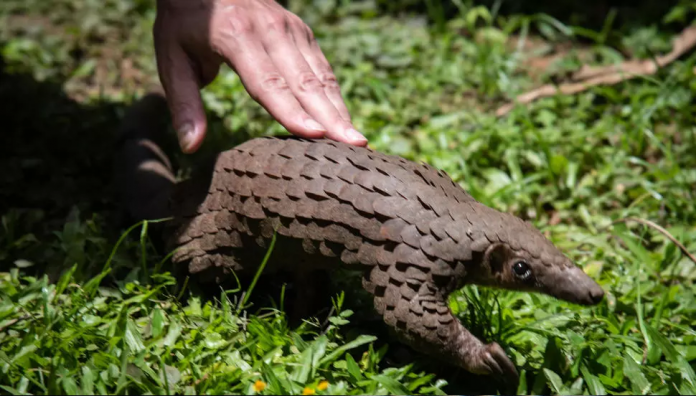
Often called scaly anteaters, pangolins curl up into a ball when they feel threatened and are the most hunted mammal on the planet.
Over one million pangolins have been plucked from Asian and African forests in the past decade, sold and consumed in Vietnam and China where burgeoning middle classes have fuelled appetites for illegal wildlife.
Pangolin scales are traditionally used in China for different illnesses, although there is no scientific evidence the scales have medicinal value.
Studies have also suggested the pangolin may have been the intermediate host that transmitted the coronavirus to humans when it first emerged at a wet market in the Chinese city of Wuhan in late 2019.
Pangolins are believed to be the world’s most trafficked mammals accounting for as much as 20 percent of all illegal wildlife trade.
It is illegal to trade the animals internationally, and their status ranges from vulnerable to critically endangered depending on the species, according to the World Wildlife Fund.

