
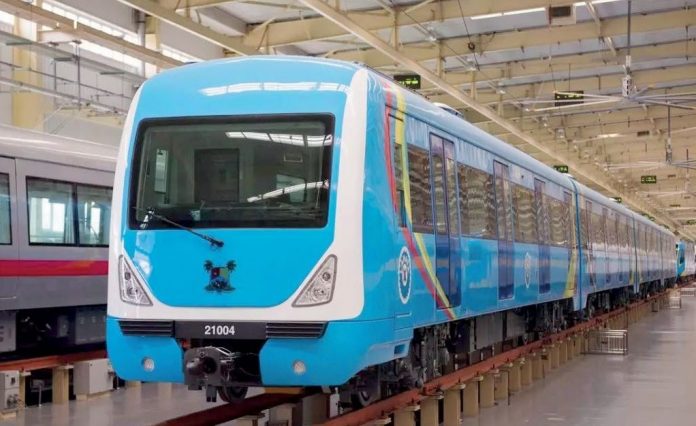
From the moment of conception 40 years ago, the Lagos Metro Line was doomed from the start. Proposed under the civilian administration of Lateef Kayode Jakande, it is one of the oldest projects by any state government in Nigeria, by far older than some that never quite took off or were simply abandoned midway.
At the time, Lagos was not only the seat of government and capital city of Nigeria, it was a fast-growing metropolis with a corresponding population explosion. The Metro Line was meant, therefore, to ease traffic congestion in the littoral state.
But it was fraught with problems from the get-go. No sooner had it landed on the drawing board of Lagos State Government than a military government scrapped it after overthrowing the civvies on December 31 that year. Skeptical of projects with dubious provenance by dishonest politicians they just ousted from power, the new military administration never considered the economic advantages or otherwise of the project itself and so dispensed with it presto.

And so with military fiat, the Muhammadu Buhari-led military junta aborted the project right on, making it seem like an idea whose time had not come, a sort of boondoggle project that wouldn’t amount to much in the end. But as it happens sometimes, the idea behind such projects are hard to extinguish. It proved to be so with the Metro Line and it would take another civilian administration of Governor Bola Ahmed Tinubu in 1999 (now President-elect) to bring it back to life.
Now rechristened Lagos Blue Rail Line, the idea for a mass transit rail service has lurched on from successive governments in the state like a faulty locomotive, prone to derailing along the way but has proceeded doggedly on. And after 30 or so long years, the physical structures of the Blue Rail Line are now visible everywhere in major stopovers in the state with hard-hatted Chinese supervisors bending steel or raising mortar alongside equally hard-hatted Nigerian workers.
On completion, the assumption is that the first and only such transportation system in the country will mass-move 200, 000 – 300, 000 passengers at a go, thus easing the perennial gridlock in the state.
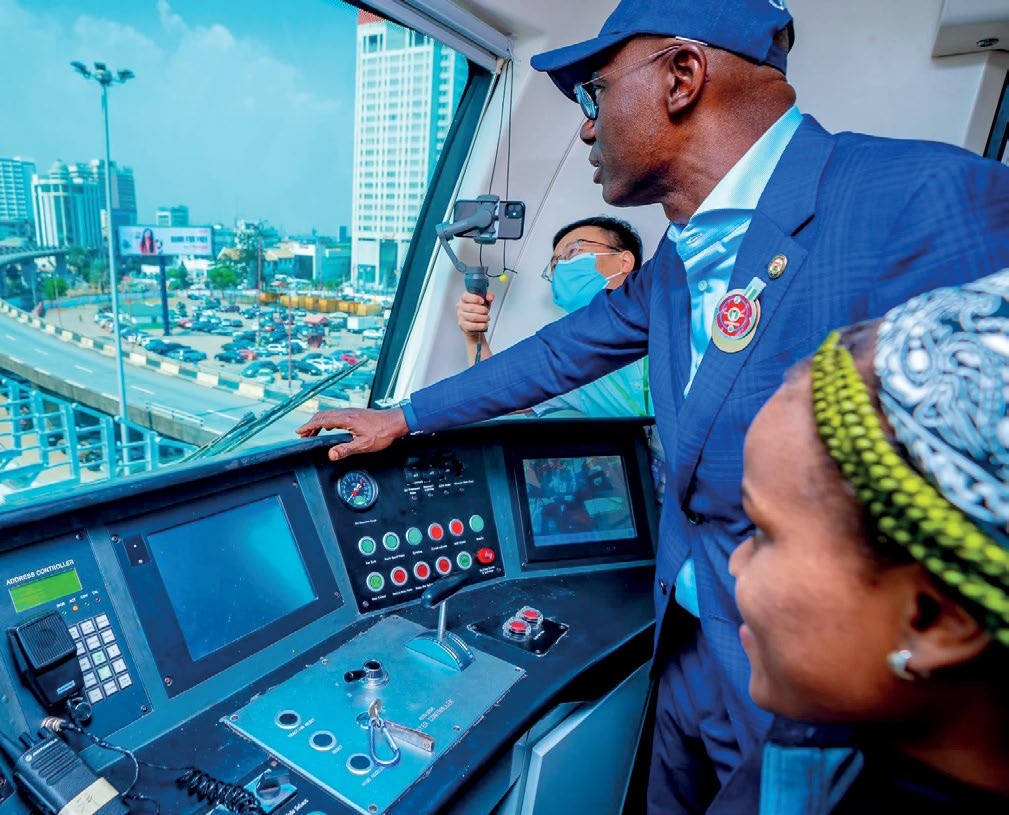
By some twist of fate, and almost 40 years to the day, the very man under whose government the Metro Line was aborted was on hand to commission the first phase of the rail project early this year. On assuming power in 1983, Major General Muhammadu Buhari halted the Metro Line rail. In late January 2023, the same man obliged the Lagos state government’s request to commission the first phase of the project – a 13kilometre stretch of elevated rail from Marina to Mile 2.
On that day too, there was a test-run of the Blue Rail Line for both high-profile government officials from Abuja and LSG, including some traditional rulers in Lagos. Besides, PMB himself, there was Lai Muhammed, Minister of Transportation, Cui Jianchun, Chinese ambassador to Nigeria.
“This milestone in the development of the Lagos rail mass transit is the culmination of several impactful reforms in the transport ecosystem of Lagos State, starting in 1999, the dawn of the fourth republic, Asiwaju Bola Tinubu assumed office as governor,” Sanwo-Olu said.
“Our vision for an integrated transport system is enunciated in the Traffic Management and Transportation pillar of our T.H.E.M.E.S agenda. Our transportation strategy is a multimodal one, bringing together the various elements of the road, rail, and water, and ensuring they are seamlessly integrated.”
Now under construction by China Civil Engineering Construction Company, an arm of China Railway Construction Corporation, some of the proposed terminals in the second phase for LBRL will be located at Agbado, Agege, Ebute Metta, Iddo, Iju, Ikeja, Mushin, Oshodi, Sogunle, Yaba with connections to the domestic wing of Murtala Muhammed International Airport.
The first phase which is now 80 percent complete will transport a quarter million passengers daily when it commences operation later this month – that is from Marina to Mile 2 with stopovers at National Theatre, Iganmu, Alaba and Orile stations up to Mile 2.
On the day of the test-run, spokesperson for the Lagos Metropolitan Transport Agency (LAMATA) Kolawole Ojelabi told journalists the “train is still under trial and will kick-start in late March or early April,” and also insisting the fare has not been decided. But what is clear for now is that passengers will avail themselves of the Cowry Lagos with the touch-and-payment system is already set for use at the station.”
Now sure to ease transportation in the state, the LBRL almost didn’t get to be. For one, the change in government almost hobbled its realization. Second, lack of funds almost crippled the dream project. And just barely a month after the test-run, one of the coaches was engulfed in smoke, causing panic at Marina where the fire broke out.
According to reports during the fire outbreak about three weeks ago, “the newly inaugurated Blue Rail Mass Transit at Marina Lagos Island, yesterday, was gutted by fire, which was said to have started from the generator in the facility. While road users scampered to safety, the fire service, the police, and other emergency responders were said to have arrived to quell the fire.
“Lagos State Police spokesman, SP Benjamin Hundeyin, called for calm. He said: “The fire at Marina started from the generator of the Blue Rail Mass Transit. Police patrol teams and the fire service are already on the ground to control the crowd and put out the fire, respectively. Hundeyin therefore, urged road users to go about their lawful duties and not panic, assuring them that the situation was under control.”
Though the coaches of the LBRL are American-made, some critics of the project contend that the state government may have made wrong choices when they settled for already-made coaches rejected by some other countries. For instance, it is possible, they insist that rather than shop for coaches that fit the topography of the state and climactic conditions in the tropics, the state government hurriedly bought the ready-made ones. That, in their assumption, possibly accounted for the fire outbreak weeks ago.
Baring all that, LSG, analysts now say, has made history with the LBRL. “In Lagos State,” one of them wrote recently after the test-run, “history has been made with the completion of the 13km Lagos Blue Line Rail Phase 1 scheme (Marina-Mile2) infrastructure, with testing scheduled between Wednesday and first quarter of 2023, when the line will be fully operational.
“The first passenger trip on Tuesday by Babajide Sanwo-Olu, the state governor, Mudashiru Obasa, speaker of the House of Assembly; members of the state executive council, among other prominent persons, marked the completion of civil infrastructure work on the Lagos Rail Mass Transit being constructed by the Lagos Metropolitan Area Transport Authority. The Blue Line project is a 27-kilometre rail route designed to run from Okokomaiko eastwards to Mile 2 and then proceed to Marina via Ijora.
“The five stations have been completed, with 13km of the rail tracks laid in the first phase. Phase 1 of the Blue line is 13km long with five stations: Marina-National Theatre- Orile-Suru-Alaba-Mile 2, while Phase 2 will extend the line to 27km.
“The first phase will transport 250,000 passengers daily and, when completed, the entire 27km will transport about 500,000 passengers daily. Each train comprises four coaches and each coach can take up to 180 passengers conveniently.”
The success of the Federal government rail project from Lagos – Ibadan, Abuja – Kano possibly galvanized the LSG to hasten work on the LBRL. “The joy brought about by the Lagos-Ibadan inter-state train rides have put more pressure on the delivery of the Lagos version of the service,” Uche Nnadozie wrote in March. “Nearly every resident who sees the massive work going on and the federal government-backed beautiful standard gauge service feel a sense of pride knowing that in a matter of days and weeks, two separate corridors will open for use by commuters.
“A safe, fast, comfortable train ride is what Lagos residents have dreamt of since the metro service was muted by the Lateef Jakande administration in the early 1980s. The older generation can’t help but feel a sense of accomplishment seeing that the truncated mass transit service will be off the ground in their lifetime.
As we are aware, the colour codes are for brand differentiation. Well, Governor Babajide Sanwo-Olu has equally added that the Blue line, which runs from Okokomaiko (near the Lagos State University) to CMS in Lagos Island is practically run on electric power.
In Lagos, boarding any of the state-run modes of transportation has already been made easy. What experts call the multi-modal integrated transport system is one of a kind in Nigeria. Oh, this is not even the multiple modes of moving around in the state like buses, taxis, ferries and soon trains, it is the mode of payment which has been democratised! Today, with the Cowry card, you pay for your BRT ride, hop on your car hailing LagRide or go on a ferry on our lagoons. And of course from the end of this month, go on a train ride around town. The system is already seamless.”
When the LBRL becomes fully operational, commuting in Lagos will become easier and pleasurable, Nnadozie went on. “This is like buying one and getting two free. It’s only a servant-leader who thinks of people first and ways to ameliorate their daily struggles can deliver on this scale. Lagos public transportation will not be the same again from this year.”
Michael Jimoh is a Nigerian journalist with many years experience in print media. He is currently a Special Correspondent with THEWILL.
