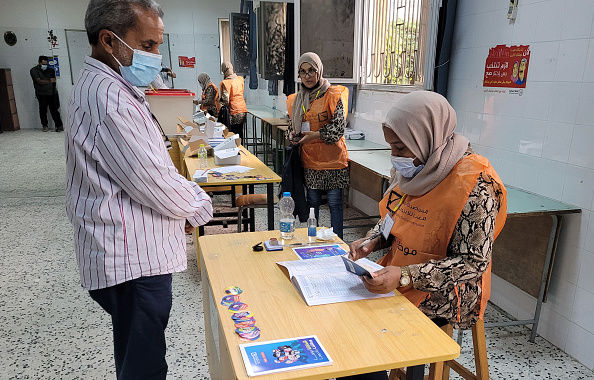
As Libya goes to the polls on December 24, 2021, African countries under the aegis of the African Union (AU) are expected to play a major and important role to ensure a smooth, free and fair first democratic election to hold in the history of that country.
It is very disappointing that while Europe, America, western invaders and other capitalist lobbyists are plotting to rig the forthcoming presidential election in Libya in favour of their puppet, African Union is nowhere to be found.
Africa has been frozen out of the peace and restoration process of Libya, which is pathetic and caused by a mentally-induced fear of the west, of sanction and our own mis-prioritisation. Let us not forget that the late Libyan leader, Muammar Gaddafi, was well respected in AU, which he once chaired and heavily funded.

Gaddafi campaigned for pan-African unity, but after his assassination by NATO backed-rebels, Africa failed to keep his country even under the wing of its military peace mission and send away foreign meddlers and mercenaries.
At the beginning of the Arab uprising, the African Union, having designated the popular uprisings in Tunisia and Egypt as legitimate expressions of democratic will, determined the Libyan crisis to be a civil war demanding a mediated outcome. The AU established an Ad hoc Committee of Heads of State to seek a negotiated settlement which did little to nothing. The committee members were made up of the Presidents of Mauritania, Republic of Congo, Mali, South Africa and Uganda, on the rationale that only African heads of state could speak credibly with Gaddafi and that the arrangement underlined the AU’s seriousness.
At odds with the AU political initiative, the United Nations passed resolution 1973, authorising “all necessary measures” to protect the civilian population of the country as they claim it, unproven to warrant it. This was a rapid and rare invocation of the principle of the responsibility to protect (R2P). United Nations Security Council UNSC resolution 1973 referred to the AU’s peace initiative in its preambular section, but its legal force was the authorisation of “all necessary measures” by UN member states.
Despite this limited mandate, the way the military operations were carried out made it immediately evident that the real goal of the intervention was much wider, namely to provoke the collapse of Gaddafi’s leadership. Coalition forces extensively bombed targets outside of the scope of the mandate with a clear intent to kill Gaddafi, a fact demonstrated by the bombing of a compound of villas near Tripoli where Gaddafi was supposedly hiding that killed his youngest son, Saif al-Arab. However, the coalition failed to set out a plan for the restoration of public order in Libya. It was a series of air campaigns by US-led NATO members with the stated bogus intent of protecting civilians, but the clear objective was of leadership change.
The Libyan Socialist Jamahiriya was so prosperous and generous in terms of security, infrastructure (notably the great man-made river), in health, education, social welfare and a lot of other back bone of an economy, which made the country to be ranked among the happiest.
Philip Gordon, the most senior US official in the Middle East between 2013 and 2015, wrote, “In Iraq, the US intervened and occupied and the result was a costly disaster. In Libya, the US intervened and did not occupy and the result was a costly disaster. This shows how guilty the US was.”
Libya is very important in the peace-making process of Africa as if it is stable, Africa will indeed achieve stability. A clear cut-off of free proliferation and flow of light and small weapons will put an end to illegal migration crisis to unviable Europe, as Libya is the 16th largest country in the world, the second in the Arab world/league and the fourth in Africa with a total of 1,759,541 square kilometres of land with a large proven oil reserve larger than that of any country in the world, making it the 10th in the world.
The western countries should be made to face a difficult choice in Libya by the African Union. The latter should pressure them to leave before the election on December 24. The disorder that enveloped the country, following the 2011 US-led NATO intervention makes any consideration of productive engagement in the country now a child of necessity.
However, it is possible to conceive a good plan that could stabilise the country. In the absence of Africa’s leadership, interventionists and foreign regional actors with their own interests have demonstrated their willingness to step into the fray and manipulate developments on ground. If the member states of the African Union, especially Nigeria, continues to let foreign interventionists and its few African allies fill the void, Libya’s conflict will only continue to escalate.
A clear plan to help stabilise Libya would require targeted assistance from the African Union to bolster the legitimately elected government control over Tripoli and convince the various actors to engage in an inclusive, cohesive process in running the country. Given the critical national security implications of Libya’s chaos for the whole of Africa, especially the Sahel region, the choice is not to step back now. To step back may encourage further escalation that would ultimately drag more of the West into Libya and to remain. A well-planned stabilisation effort now, rather than an unwelcome and compulsory intervention later, will in the long run be in the best interest of the Libyan people, all Africans and those states with an interest in the stability of the region.
•Na’inna wrote in from Ahmadu Bello University, Zaria.