The housing challenge in Nigeria has a very long history and the fact that there is wide housing chasm is not in doubt successive governments over the years have adopted different models and strategies to close the wide gap in the hosing sector to no avail. Nigeria has a low homeownership rate, lower than that of Indonesia (84 percent), Kenya (73 percent), and South Africa (56 percent). According to the Managing Director of Federal Mortgage Bank of Nigeria (FMBN), the housing deficit is estimated at between 17 to 22 million housing units, increasing annually by 900 000 units, with a potential cost of N6 trillion (US$16 billion).
It is instructive to note that the challenge of providing adequate housing accommodation is not just a Nigerian problem. According to the United Nations Habitat, about 30 per cent of the world’s population live in slums, under deplorable conditions or, worse still, in buildings that are structurally unsound and without security of tenure among others. The report also stated that 35 per cent of the world’s rural population live in unacceptable conditions, which means that over two billion people need a better housing. For Nigeria, the government estimates that the housing sector would need about $400 billion investment over the next 25-30 years to resolve this deficit. The World Bank on the other hand said bridging the deficit will cost the country about N59.5 trillion, which further tallies with the estimation of the Federal Mortgage Bank of Nigeria which puts it at about N56 trillion to be able to adequately meet the housing needs of Nigerians.
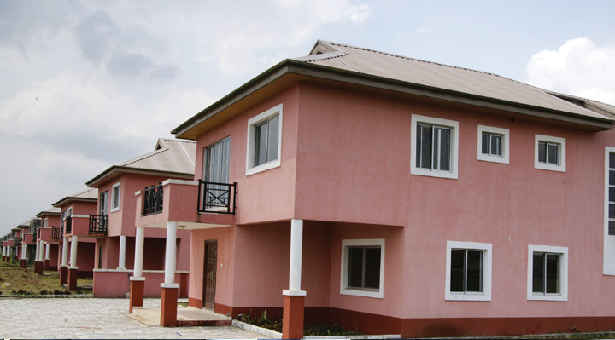
The Federal Government is currently constructing affordable homes in 34 states of the federation, the Minister of Works and Housing, Babatunde Fashola, has said. Fashola, who disclosed this in Abuja recently, also announced that at least one federal road project was being constructed in each of the 36 states of Nigeria. The minister said while many of such roads had been completed, others were under construction and new ones were being planned.

He said, “We are delivering on our agenda for housing provision by aggressively and sustainably pursuing the model National Housing Programme, which will turn out acceptable and affordable houses for Nigerians, and with a lot of associated economic opportunities. “Construction is ongoing in 34 states, most of which are largely completed, and will soon be offered for sale to the public, while also simultaneously planning the second phase in those states that have provided us with land.”
Fashola, who spoke through the Minister of State for Works and Housing, Abubakar Aliyu, noted that in the works sector, the Federal Government had also embarked on rehabilitation of roads across the country. He said, “The effective, efficient and timely movement of people, goods and delivery of services are imperative for socio-economic growth and sustainable development. “I am pleased to report in this regard that there is at least one federal road under construction in each of the 36 states and the FCT. “While many have been completed, others are still under construction and new ones being planned. We are also repairing, building and rehabilitating many other roads under our Federal Road Maintenance Agency.” He said that the government was mindful of the fact that urban settlements offered multiple opportunities and noted that this could not be attained without proper planning.
Recall that in December 2018, Vice President Yemi Osinbajo estimated the country’s present housing deficit at a staggering 20 million houses. The vice president made the disclosure, when as the Special Guest of Honour, he performed the unveiling of the Federal Mortgage Bank of Nigeria (FMBN) Digital Platform at the International Conference Centre, Abuja. Osinbajo, who was represented by the Permanent Secretary, Political and Economic Affairs Office (OSGF) Gabriel Aduda, charged FMBN to rise to the greater responsibility of seeking innovative ways to attract funding for housing provision, through Public Private Partnerships and partnership with relevant government and financial institutions. He noted that raising of long-term housing bonds and other specialised financial instruments will guarantee provision of affordable housing for the public. He requested that these initiatives must be targeted at achieving the aim, which is more affordable houses for greater numbers of Nigerians. He described the digitalisation of the bank as another milestone in the long journey to reducing the country’s humongous housing stock and called for the joining of hands and working in unison for improved mortgage financing and better affordable housing delivery.
The vice president also restated his belief that repositioning of the FMBN is a huge plus that will improve housing provision in the country. “The FMBN is one of the numerous programs of government since the early 70s aimed at housing provision. However, most have not been successful. Repositioning the FMBN we believe is a huge plus and will improve housing provision in Nigeria. “The Economic Recovery and Growth Plan (ERGP) has human capital development as one of its cardinal objectives and housing provision is key in achieving that goal. “May I, however, call on the FMBN not to rest on its oars or get caught up in the success syndrome that says you have arrived but rather arise to a greater responsibility of seeking innovative ways to attract funding for housing provision through private sector funds,” Osinbajo said.
The problem of affordable housing has been a concern for both the government and individuals. Appreciating these problems, both public and private sector developers make effort through various activities to bridge the gap between housing supply and demand, but the cost of building materials, deficiency of housing finance arrangement, rigorous loan conditions from mortgage banks, government policies amongst other problems have affecting housing delivery significantly in Nigeria. Housing delivery in Nigeria is provided by either the Government or Private sector, but despite Federal Government access to factors of housing production, the country could at best expect 4.2% of the annual requirement. Substantial contribution is expected from other public and private sectors. The production of housing in Nigeria is primarily the function of the private market; approximately 90% of urban housing is produced by private developers. Due to housing demand created by rural- urban migration, which account for 65% of urban population growth, the fixed supply of urban land, and inflation of rental and housing ownership cost. Nigeria is perhaps the fastest urbanizing country in the African continent. One of the most important challenges facing the country is the provision of affordable housing. As more and more Nigerians make towns and cities their homes, the resulting social, economic, environmental and political challenges need to be urgently addressed.
However, the importance of housing as a basic need to man, cannot be over emphasised. But to make housing available to people requires an effective mortgage system for funding housing in any country, just as the country’s economy must be sound to support the country’s housing needs. In other words, lack of adequate or poor housing facilities reflect the poor state of any economy. In Nigeria, mortgage system has been grossly ineffective, hence the issue of housing finance has remained a major constraint to housing delivery.
Most governments both in developed and developing countries adopt a system of affordable housing such that the segments of the income strata classified as low-income groups are protected from the vagaries of the housing market, which often preclude these individuals to have decent housing in wholesome environment due to insufficient finance. It is with these people in mind that the concept of social housing interchangeably referred to as public housing in other countries was practicalized through the provision of housing subsidised by government in order to make the dwellings affordable for purchase or rental.
*** Written by Jide Ayobolu.