
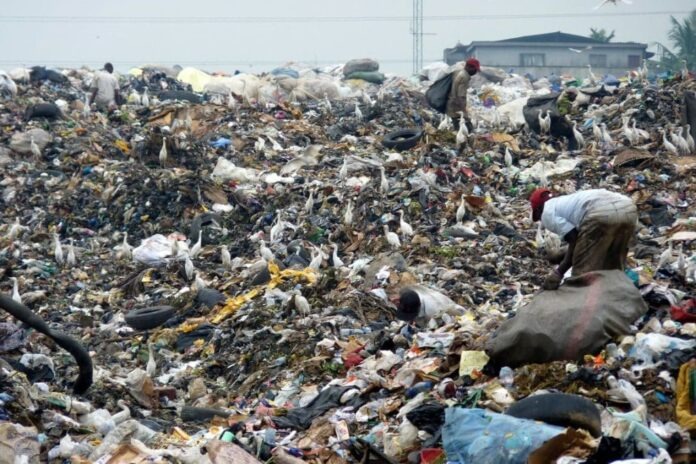
April 15, (THEWILL) — “A clean environment is a human right like any other. It is, therefore, part of our responsibility towards others to ensure that the world we pass on is as healthy, if not healthier, than we found it.” – Dalai Lama.
Nigeria is experiencing a rapid growth in human population and physical development. As industrialisation and urbanisation become evident in shaping lives in municipalities, there have been global calls for the adoption of effective Integrated Municipal Solid Waste Management (ISWM) Programmes. Nigeria, according to sources, generates approximately 85,000-90,000 tonnes of solid waste per day, culminating in 32 million tonnes annually. The level of solid waste being generated daily is increasingly high.
This poses both increasing health and environmental challenges to the people. And residents in their large numbers clearly lack the basic understanding and requisite knowledge of effective solid waste management. Many do not have any idea of independent waste collectors, let alone employing their services. Consequently, they freely dispose of waste at unapproved or illegal dump sites or wherever it is convenient to do so.

This visible lack of understanding of the relevance of a cleaner environment is obvious in the indiscriminate disposal of Solid Waste (SW) very close to residential areas, school compounds, along streets, major roads and drainages. In fact, current solid waste management practice in Nigeria relies predominantly on indiscriminate and open dumping, often accompanied by the burning of waste. These practices generate significant environmental challenges, including the contamination of waterways, soil and the air, as well as the infliction of environmental and health hazards.
ISWM is a deliberate policy of the government aimed at providing a clean, safe, healthy environment and promoting living conditions in a beneficial, technological, economic and sustainable manner. This concept unlocks the hidden treasures which conscious nations have turned into wealth creation: a safe, healthy, and cleaner environment. However, developing nations like Nigeria do not seem to appreciate the hidden treasures of SW as environmental and living conditions continue to deteriorate. This directly contaminates the nexus between having a healthy population and flourishing national development.
Many are not aware that SWM practice is an untapped economic land mine and money-spinning venture, which addresses societal attitudes and behaviour, while creating employment opportunities. The practice in Nigeria almost begins and ends with agency establishments, slow enforcement functions in emergencies or on days set aside for monthly environmental sanitation, uncoordinated waste evacuation mechanisms, and poor public attitude.
Lagos State is a shining example of how cities should address waste concerns despite observed limitations. The Lagos State Waste Management Authority (LAWMA) has set the standards by establishing a mechanism of integrating the law, stakeholders, technology and financing in the management of waste. Cities where successful waste management has been established begin with recognising the roles of the value chain – homes, waste collectors, technology, financing, infrastructure, the law and public attitude, etc.
After the 2011 flooding, which drastically affected over 21 states in Nigeria, both Kaduna and Oyo state governments embarked on the Zaria Solid Waste Management Study/Pilot Scheme and the Ibadan Solid Waste Management Masterplan, respectively. The projects are to address the challenges of municipal solid waste causing flooding, and identify its inherent benefits in a holistic manner for the good of the states and their people. Despite state resources invested in these two projects, the expected outcomes seemed very low. Both projects could not survive political interferences, thus failed to manifest their expected potentials as emphasis was more on political patronage, instead of strengthening the system and bidding for sustainability.
The current waste management practice in most Nigerian cities neglects the great potential of turning waste into viable agricultural resources and other economic prospects. Solid waste must be understood as what it is: having an economic value and not merely unwanted trash. The high percentage of organic matter in waste streams offers a tremendous opportunity to significantly reduce the waste going to landfill sites by converting it into compost for agriculture and electricity.
In Nigeria, the challenges of Solid Waste Management (SWM) are made worse or even more complex by environmental crises arising from the effects of climate change. The general attitude of the public towards solid waste disposal is a source of worry, as exemplified in the Yoruba saying that one cannot buy Èkó (Maize Pudding) with one’s money and pay for disposing of the paper used in wrapping it.
Another major concern is the clear, uncoordinated institutional function among ministries, local government authorities and waste management agencies. Other factors contributing to the challenges are weak laws and a regulatory framework, which have led to low or a lack of interest in private sector financial and infrastructure investment and service delivery. There is also a significant dearth in human capacity for administrative and technical functions, as well as poor data/information for planning. The present poor waste management practices can only translate to more environmental and health challenges as waste generation increases with the rising population and changing consumption patterns in Nigeria.
Emmanuel Unaebgu, a renewable energy and environmental expert, in his article titled ‘Poor Waste Management as Nigeria’s Bane to Achieving Sustainable Development Goals (SDGs), painted a gloomy picture of how waste is unprofessionally handled in the country and its dire consequences on health and environment. According to him, “in Nigeria, over 90% of non-metallic solid waste collected ends up in unsanitary dumpsites. As frequently as possible, these dumpsites are set on fire to reduce the volume of waste, disrupting ambient air quality and releasing dioxins, furan, VOCs, PCBs, etc., heavy metals like mercury and lead.
These pollutants have long-term health consequences, including cancer, liver problems, and impairment of the immune system. In addition, the biodegradable fraction of waste forms leachate, which seeps into and contaminates groundwater. Furthermore, data shows that the disposal of large amounts of waste in landfills and dumpsites accounts for about 5 percent of total global greenhouse gas (GHG) emissions and 12 percent of the world’s methane (CH4) emissions; a GHG that is 23 times more potent than carbon dioxide (CO2).”
However, there is a silver lining on the horizon as he aligned with Waste to Wealth as one key option to resolving the intractable power supply situation in the country. He posits, “recycling, composting and energy recovery are viable options to reducing overall greenhouse emissions in comparison to waste disposal in dumpsites and reduction of frequent release of pollutants to the barest minimum.”
Continuing, he noted: “But thanks to science, there are technological options available to minimise the aftermath release of pollutants and GHG emissions from waste. Energy recovery, otherwise called Energy from-Waste (EfW) or Waste-to-Energy (WtE), involves the combustion of waste in a controlled chamber to produce electricity and/or heat. Energy from waste technology reduces the overall GHG emissions by as much as 80% in comparison to waste disposal in dumpsites and reduces the release of pollutants to the barest minimum. In fact, efficient energy recovery is considered recycling. In 2015, it was estimated that the over 2,200 energy from waste plants across the world processed about 280 million tons of waste, a 45% increase from 2010 estimates of about 192 million tonnes processed.”
“As Nigerians from north to south continue to suffer erratic power supply with a per capita electricity consumption of about 143kWh, there is an urgent need to rethink options. Energy from waste can be that viable option, considering the over 40,000 tonnes of waste generated daily across Nigeria and the billions of naira lost by industry operators as a result of gas supply constraints. Therefore, as a growing technology, Nigeria must position itself to embrace EfW to avoid making the mistake of the early 1900s, missing the economic development that came with coal to power.
But before this can be achieved, the first and top requirement for Nigeria is to put in place regulations to encourage energy production from EfW. The regulation must prohibit the disposal of the non-recyclable fraction of combustible and biodegradable waste in a dumpsite. Another is the availability of waste feedstock. Overall, the profitability and the environmental impact are mostly dependent on plant location, capacity and the conversion technology.”
The federal government should take advantage of the promising potentials for national growth in Integrated Solid Waste Management to promote the much-needed green economy, help Nigeria meet its nationally determined contributions (NDCs) targets (of 20% unconditional emissions reduction), earn money from carbon emission reduction (CER), generate employment, improve health conditions, social security and economic development.
*** written by Sunday Onyemaechi Eze, a lecturer in the Department of Mass Communication and Head, Internationalisation and Partnership, Coal City University, Enugu

