Upon gaining independence in 1960, Nigeria quickly committed itself to improving the lives of the people of the country and harnessing the resources that remain vital to the economy of the country and her neighbours. By observing what benefits and is appropriate for the country, Nigeria became one of the founding members of the Organization for African Unity (OAU), which later became the African Union.
The Organization for African Unity checks political stability of any African countries and encourages them to be holding regional meetings for the union. Nigeria backed the (ANC) by taking a committed tough line with regard to the South African government and their military actions in southern Africa. Nigeria and Organization for African Unity (OAU, now the African Union), has tremendous influence in West Africa nations and Africa on the whole.
Nigeria has additionally founded regional cooperative efforts in West Africa, functioning as standard-bearer for ECOWAS and ECOMOG, economic and military organizations, respectively. Similarly, when civil war broke out in Angola after the country gained independence from Portugal in 1975, Nigeria mobilized its diplomatic influence in Africa in support of the Popular Movement for the Liberation of Angola (MPLA). That support helped tip the balance in their favour, which led to OAU recognition of the MPLA over the National Union for the Total Independence of Angola.

Nigeria extended diplomatic support to another cause, Sam Nujoma’s Southwest Africa People’s Organization in Namibia, to stall the apartheid South African-installed government there. In 1977, the new General Olusegun Obasanjo’s military regime donated $20 million to the Zimbabwean movement against the apartheid government of Rhodesia. Nigeria also sent military equipment to Mozambique to help the newly independent country suppress the South African-backed Mozambican National Resistance guerrillas. Nigeria also provided some military training at the Kaduna first mechanized army division and other material support to Joshua Nkomo and Robert Mugabe’s guerrilla forces during the Zimbabwe War in 1979 against the white minority rule of Prime Minister Ian Douglas Smith, which was backed by the apartheid -government of South Africa. Due to mismanagement of her economy and technology, Nigeria announced that she was launching a nuclear programme of “unlimited scope” of her own but failed. After the Nigerian Independence in 1960, Nigeria demonstrated her seriousness in improving the economy for the people and embarked on nationalizing some multi-national companies that traded with and broke the economic/trade embargo of the apartheid South African regime, the local operations of Barclays Bank was nationalized after that bank ignored the strong protests by the Nigeria populace.
Nigeria also nationalized the British Petroleum (BP) for supplying oil to South Africa. In 1982, the Alhaji Shehu Shagari government urged the visiting Pontiff Pope John Paul II to grant audience to the leaders of Southern Africa guerrilla organizations Oliver Tambo of the ANC and Sam Nujoma of SWAPO. In December 1983, the new Major General Muhammadu Buhari regime announced that Nigeria could no longer afford an apartheid government in Africa.
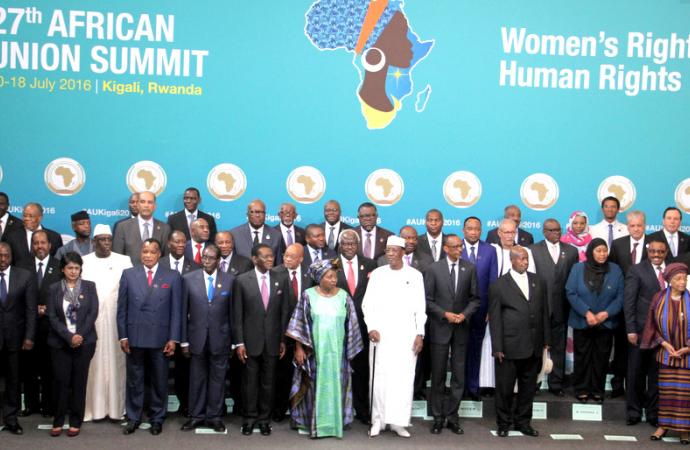
The African Union (AU) is a continental union consisting of 54 countries in Africa. The only African state that is a United Nations member, but is not a member of the African Union is Morocco, who opted to leave due to the African Union’s recognition of the Sahrawi Arab Democratic Republic (Western Sahara) as a member state. However, in July 2016, Morocco sent a special envoy to lobby African leaders to rejoin the African Union 32 years after it left in a row over Western Sahara. The AU was established on 26 May 2001 in Addis Ababa and launched on 9 July 2002 in South Africa, with the aim of replacing the Organization of African Unity (OAU). The most important decisions of the AU are made by the Assembly of the African Union, a semi-annual meeting of the heads of state and government of its member states. The AU’s secretariat, the African Union Commission, is based in Addis Ababa. In the efforts to transform the organization from the OAU to AU, Nigeria’s leading and galvanizing role must be duly acknowledged.
Regrettably, many people erroneously believe that it was Colonel Ghaddafi that played the leading role. There was no doubt that the idea of an African Union was mooted by him at the 4th Extra Ordinary Summit of the OAU in Sirte, Libya on 9 September 1999. However, this idea would have been immediately killed, if not for the convincing and moderating role played by Nigeria’s former President Olusegun Obasanjo. The latter argued and convinced his peers that rather than an outright dismissal of Libya’s proposal, it should be considered as an opportunity to accelerate the implementation of the Abuja Treaty, which was designed for the economic integration of the continent aimed at subsequently leading to Africa’s political integration.
President Obasanjo must therefore be fully credited with the idea of utilizing the opportunity of Libya’s recommendation to advance the implementation of the African Economic Community Treaty, AEC, which was at that time seriously lagging behind in implementation. The attraction of an economic argument promoted by him definitely convinced his peers and has led to the progress made in this direction.
Furthermore, it was Nigeria that provided the leadership that enabled Africa to see clearly the way forward in establishing the African Union. The powerful and sovereign supra-national entity, which Libya proposed and tried to promote, subsequently became tempered and was replaced by the gradualist approach of a European Union model to continental organization, favoured by Nigeria and a majority of member states. A Nigerian, Professor Adele Jinadu, was one of six experts that produced the Draft Constitutive Act of the African Union.
Even at the Experts level, Nigeria’s voice was clear, consistent and equivocal, enabling most countries to support a balanced position put forward by our delegation. During Ministerial debates, Nigeria, along with four others, ensured that Africa was not saddled with an unworkable Union as intended by its initiator. When debates became deadlocked, it was Nigeria that mostly provided the compromise solutions that saved the day. Today, the AU and its institutions are stridently marching forward, thanks to the clear and consistent direction provided by Nigeria in the process leading to the transformation. There was no doubt that in all these, Nigeria’s principled stand was anchored on the importance which the country had always attached to the unity of Africa and the forging of solidarity among its peoples.
Nigeria has a vision of a continent with an effective and robust leadership that will ensure the total unity which the founding fathers of the organization dreamt of and assiduously worked for. In this regard, she looks forward to a leadership that is transparent, duly accountable and which takes into consideration the yearnings of the peoples of Africa for a new image for the African continent. It is a leadership that will be made up of committed officials who will proudly lead Africa to the dream land of economic emancipation and development.
It is the vision of a renewed renaissance for our continent that will lead to greater regional cooperation, deepened economic integration and sustainable development, so that the lives of the average African is better than what obtains at the present. The vision is that the current unenviable statistics of Africa as a continent with the largest poverty rate, one with the highest illiteracy rate in the world, a continent ravaged by preventable diseases, including high maternal and infant mortality, environmental degradation and the like, will become a continent with changed circumstances.
It is the vision of an Africa where democracy and democratic ethos reign supreme in every corner of the continent, complemented by good governance and social justice for every African, young and old and without discrimination on the basis of sex or religion. It is the vision where the leadership of each and every country on our continent will be elected in a transparent, free and fair election; so that such leadership can truly claim that they have the mandate of their peoples to rule.
It is only in such a situation that policies and programmes would be conceived and implemented with due consideration for the views and concerns of the people. It is the vision of a continent free of crises and wars so that the toga of a continent at war with itself will be shed and the various countries can better face the daunting tasks of economic development. It is a vision of every African, young and old, men and women of all ethnic races, living in peace and harmony and in unison, working towards a free and united Africa.
Finally, it is the vision of a united continent, marching forward together, so that Africa can rightly take its place in and assume its responsibilities to the global community, particularly in effectively contributing to world peace and security so that our planet can truly be one for humanity.
It would be recalled that, Nigeria contributed $16.96 million to the $522 million African Union (AU), budget. The contribution of the 54-member AU member states to the 2015 budget is $131 million compared to the $126 million in 2014. Nigeria is thus responsible for about 13 per cent of the members’ contribution to the AU and the 2015 budget. According to the current scale of assessment, 65 per cent of the $131 million contribution would be assessed on the five main contributors including Nigeria, Algeria, Egypt, Libya and South Africa. The international partners would contribute 72 per cent of the budget, $225.5 million, while $10.9 million, $4.7 million and $205,000 would be drawn from the reserve fund, acquisition and property fund, and the women fund respectively.
The 2015 budget framework focused on the five pillars of the AU strategic plan including peace and security, socio-economic development, integration, capacity building and communications. It was as a result of this that President Muhammadu Buhari recently told the AU Envoy on peace fund, Dr. Donald Kaberuka that, Nigeria will continue to fulfil its financial obligations to the continental African body, in its programmes and operations, as it relates to peace, stability and security on the continent. There is no doubt, that this gesture from Nigeria will assist in no small measure to foster closer working ties between Nigeria and the AU.
Written by Jide Ayobolu.