All over the world, social safety nets are tools used by governments to help the vulnerable people in society to tackle hunger and poverty.
In Nigeria, successive governments have expressed concern about the high level of poverty in the country, despite being endowed with enormous resources.
Programmes such as Operation Feed the Nation, Green Revolution otherwise known as “Back to Land”, Directorate for Food, Roads and Infrastructure, Directorate of Employment, Better Life Programme, Peoples Bank Project…

Family Support Programme, National Economic Empowerment and Development Strategy, SURE-P and National Poverty Eradication Programme have been initiated at different times to tackle the high level of poverty in the country.
However, it appears as if safety nets in Nigeria have holes. Many have described them as handouts that cannot scratch the surface of the poverty levels in the country.
In 2016, the Muhammadu Buhari Administration set up the National Social Investment Programme (NSIP) as its measure to combat poverty and hunger across the country.
The components of the administration’s SIP include the N-Power Programme, the National HomeGrown School Feeding Programme (NHGSFP)…
The Conditional Cash Transfer (CCT) Programme and the Government Enterprise and Empowerment Programme (GEEP), which consists of the MarketMoni, FarmerMoni and TraderMoni schemes.
Howbeit, the programmes have been fraught with challenges, such as corruption, shortsightedness, design error, inconsistency, paucity of funds and lack of accountability, to mention a few.
As someone who has benefitted from the N-Power Program, for instance, it will be wrong to say there is no impact altogether, but the impact in the society is not commensurate with the sums of money the government claimed to be spending on the different programmes.
The government claimed to be spending N500 billion yearly on ‘social investment programmes’, yet a 2022 report by the National Bureau of Statistics (NBS) showed that some 133 million Nigerians (62.9 per cent of the population) are poor.
That is so much for a government that claimed to be working towards lifting 100 million people out of poverty. Let me talk about the N-Power Programme a bit.
As plausible as the programme appears, it has a poor design. It was meant to address the issues of youth unemployment and help increase social development.
At its inception in June 2016, graduates who applied and were successful were employed in the different categories of N-teach, N-health, N-agro and N-build.
They were employed for two years and given a monthly stipend of N30,000. One would think the youths would be empowered as the programme is named, but only beneficiaries under the first N-agro batch were trained before they started work.
The beneficiaries would later be rolled back to the streets with nothing to fall back on. How did the government hope to tackle unemployment this way? The result of this shortsightedness is obvious.
Unemployment figures have been on the steady rise. It was 10.4 per cent at the end of 2015 before the ‘life-saving’ programme but today, KPMG has projected that Nigeria’s unemployment rate is expected to rise to 40.6 per cent as compared to 2022’s 37.7 per cent.
The Federal Government was committed to paying the monthly stipends as beneficiaries under the first two batches can testify, but the monthly payment became haphazard the moment the programme was moved in 2019…
From the office of the Vice President to the newly created Ministry of Humanitarian Affairs, Disaster Management and Social Development, stipends could go unpaid for as long as three months, thus demoralising the beneficiaries. There was hardly any form of supervision from government officials.
Independent monitors who supervised the programme under the Vice President were replaced when it was moved to a new ministry.
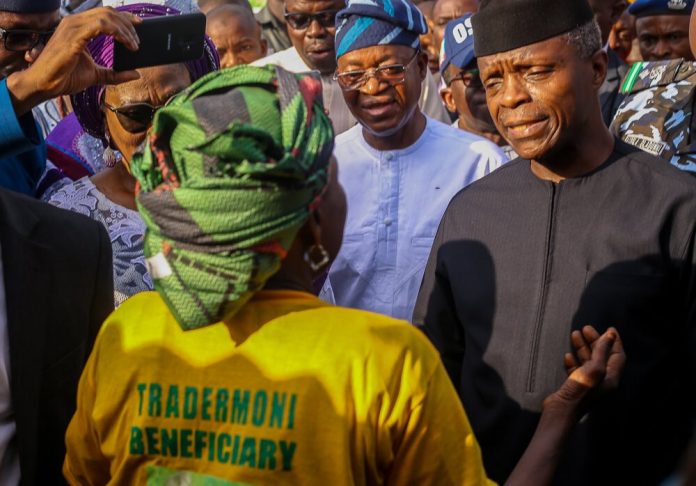
Take a look at the Vice President’s Tradermoni. How much of these interest-free loans were recovered? According to Farouk Sadiya, the Federal Government was yet to recover N10 billion Tradermoni loan three years after.
The programme was introduced with so much fanfare and it looked like an answer to people’s needs. But in reality, how much impact can N10,000 have on a small business with the rising inflation?
Little wonder many of the traders saw the programme as a one-time, cash-out scheme. Well, blame it on the timing of the disbursement of the loans and you may not be wrong.
The programme was initiated in 2018 during the Presidential campaign, and it looked more like an electioneering tool. A similar incident happened during the just concluded election season.
Some of the beneficiaries of the concluded N-Power batch (Batch C stream 1) got stipends for three straight months. For context, this batch had concluded their programme since August 2022.
They had been paid for a year already, but some of them received credit alerts between February and March 2023. It was tagged “an act of minister’s generosity.” Such generosity comes during pelections to a few ‘lucky’ individuals.
Feel free to make your conclusions but it is clear that some of these social investment programs are money-making tools by those who have access to government coffers.
What baffles me most is the lack of accountability that trails these disbursements. On this, Seun Onigbinde of BudgIT said, “I have not seen a coherent evaluation or assessment of those plans” (referring to social investment programmes). It is just typical of Nigeria — spend the money — and nobody is given the rigour on the impact of the money. If you are putting N350 billion in a programme or even up to N500 billion in some instances, by the time you put the recurrent side to it, what is the impact you are getting from it?”
This is the same big question I have about the Homegrown School Feeding Programme. The government said it was feeding 10 million pupils in 66,000 public schools on a daily basis and that the initiative has reduced the number of out-of-school children in the country.
When these statements are placed side by side with the number of out-of-school children in the country, currently at 10.5 million, according to a report by the United Nations Children Fund (UNICEF), what then is the programme’s significant achievement?
Catering for ‘ghosts’ is quite easy in Nigeria, no thanks to poor identity management. Who knows the number of ‘ghosts’ that are among the 1,940,004 vulnerable Nigerians that are receiving N5000 cash transfers on a monthly basis?
In a matter of days, a new government will emerge and it is expedient to examine the impact or otherwise of Nigeria’s social investment programmes.
Experts have said SIPs aren’t tickets out of poverty. Hence, creating an environment that aids productivity in the economy is crucial.
Although all the programmes have been heavily criticised, some things can be done differently in the short run. For instance, the government can introduce a reward system for N-Power beneficiaries.
The programme should serve as a ready pool of recruitment for government at the state and federal level, especially for university graduates. The beneficiaries should be duly trained and the ones going into entrepreneurship can be given grants afterwards while being monitored. Those who are outstanding in their service should be recognised and awarded while those who are negligent should be sanctioned.
Also, there should be moments of unannounced supervisory visits to places of primary assignments. This will convey a sense of seriousness on the beneficiaries.
The government needs to be transparent and accountable with the conditional cash transfers, else the programme should be cancelled.
The metrics used to determine the folks living in extreme poverty needs to be clearly defined and the National Social Register (NSR) needs to be made public.
The incoming government will need to review the execution of these programmes and evaluate the benefits. Ultimately, it will have to look into the future and think of infrastructure, human capital development, and a freer business environment, other than giving people free money that won’t improve their lives.
***Ilerioluwa Oladipupo is an analyst at SBM Intelligence*