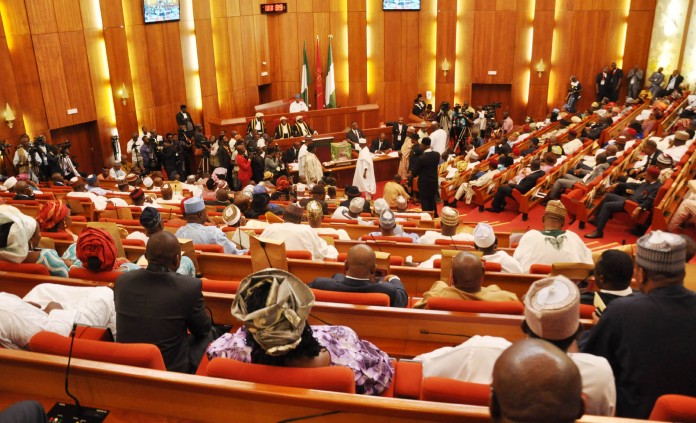
The recently concluded 2-day Stakeholders Interactive Dialogue on the reform of the Nigerian Power Sector organized by the National Assembly has again exposed the rot and the failure of successive government to justify the over N2.7 Trillion spent on the sector since 2001.
Nigeria is in the midst of its worst power crisis occasioned by shortage of gas supply and lack of foreign exchange. Vandalism of power equipment and inability of the Government to offset its over N242,976bn debts to the various electricity generating companies (GENCOs) through the Nigerian Bulk Electricity trader (NBET) are other factors responsible for the collapse of the sector.
The implications of these failures has largely crippled the manufacturing sector of the economy and brought untold hardship to Nigerians as result of a deep in Government revenue, high level of unemployment and increased poverty rate.

In a renewed effort to rewrite the wrong of the past and chart an innovative trajectory to shake up the power sector and attract solution driven ideas, the National Assembly under the leadership of the Senate President, Dr. Abubakar Bukola Saraki brought together stakeholders, traditional rulers, investors, and captains of industry to deliberate on the issues and challenges militating against the success of the Power Sector.
The Chairman Senate Committee on Power, Senator Enyinanya Abaribe, his counterpart in the House of Representative, Hon. Daniel Asuquo led notable dignitaries like the Oba of Lagos HRM, Rilwan Akiolu, Minister of Works, Power and Housing, Mr. Babatunde Fashola, President of Heirs Holding, Tony Elumelu, DG, Bureau of Public Enterprise, Dr. Vincent Akpotaire, MD NEMSA, Prof Peter Ewesor and representatives from the Nigerian Electricity Regulatory Commission (NERC), Dangote Group and Ministry of Petroleum Resource to identify the root cause of the problems facing the Nigerian power sector and a possible way out of the quagmire.
The workshop afforded the officials and participants an opportunity to speak freely and analyze the key issues affecting the generation, distribution and transmission companies as well as the legal, regulatory and commercial/ market issues. Opportunities have been wasted in the past to resolve the power crisis and this reform couldn’t have come at a better time than it did; at the moment an estimated 90 million Nigerians are without access to electricity grid.
The epileptic power situation in the country is having a pervasive effect on the people and every sectors of the economy. Some of the speakers who aired their views at the workshop berated the Federal Government for allocating monies to the ministry of power since the power sector has been privatized. Another key challenge identified is the non-cost reflection tariff; withdrawal of transactional subsidy report and dumping of CBN backed NEMSF.
Lack of consistency and transparency in the review and fixing of power billings was identified as a reason most Nigerians have lost confidence in the distribution companies. Also addressed were the causes of liquidity issue across the entire electricity value chain. Unavailability of funds for emergency projects, outdated, weak legal framework affects the viability of the power sector.
The current shortage of gas supply also implies that government must assist the generating companies repair damaged and vandalized pipeline to block leakages and also ensure enforcement of technical standards and regulations, inspection, testing and certification of employees in the power sector.
One of the key legislative measures to prevent the incessant attacks on gas pipeline is to speed up passage of the consumer protection bill and ensure stiffer penalty for offenders.
In his opening remarks, the Senate President, Bukola Saraki alluded the problem in the power sector to the wasteful spending in the past while expressing his commitment to ensure that things are done differently, henceforth.
“Today, we are on the verge of a total systemic breakdown and I see this (the Power Sector Dialogue) as an opportunity to stop this train from derailing completely. Wherever you go in the country nothing represents the failure of the government and leadership in the mind of Nigerian like the epileptic power situation in the country. Fixing it is at the highest priority list of our people. In other words, our people are demanding that we do all that is in our power to reverse this long and unenviable power sector blight. We must get it right. The first step is this forum” the Senate President said.
Speaking further, Saraki stated that the National Assembly is fully ready to support and drive every actionable initiative that is expected out of this interactive session to boost the power sector significantly while relying heavily on every stakeholders wisdom and input, to craft the right legislative initiatives that will help deliver a new and more reliable Nigerian power sector for the Nigerian economy.
Although, this isn’t the time to point fingers, it is an established fact that the privatization of PHCN has not achieved the much desired results, government on its own part has equally failed to honour its own part of the agreement and Nigerians are forced to pay for darkness and an increased tariffs at the end of the month. At the end of the workshop, it is expected that reports on suggestions and recommendations will be compiled and further deliberated upon by the National Assembly with a view towards establishing a workable, transparent, reliable regulatory framework that will replace the present ineffective outmoded model.
Written by Wale Bakare, Writer at BailiffAfrica & Founder – MediaFactory
(234)-7030052445