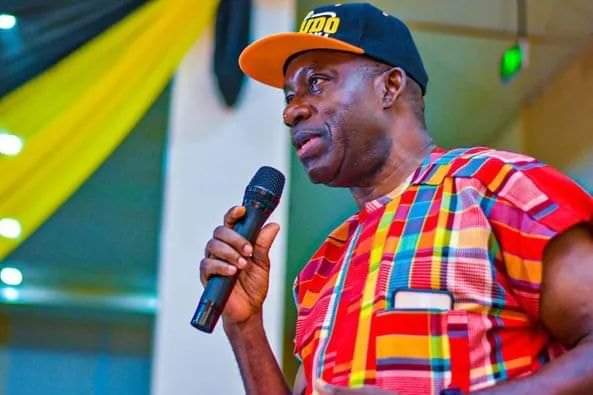
Each time somebody does or says things that amaze me, I shudder. That was my reaction when the governor-elect of Anambra State, Prof Chukwuma Soludo, announced that he would visit Okpoko shortly after his inauguration. I had my reservations about any governor of the state electing to include Okpoko in his agenda.
Anyone that is familiar with Okpoko will share my concerns. It is not that the layout is not worthy of the state government’s attention, but the problem is that the decay in the area has reached such a monumental level that it would be better to steer clear of the community.
For a newly elected governor, going on a visit to Okpoko portends disaster, especially if there is a slip along the line. However, Soludo’s resolute stand has not only received outstanding commendation, even for having such initiative at all in mind, but also drawn the attention of the world to the plight of the people living in the area.

Soludo’s planned visit to Okpoko has several implications. It marks him out as a liberal democrat, someone that is quick to eschewing bitterness and recognising the fact that everyone should be given equal treatment under the law. Elsewhere, the idea would have been cancelled since he did not get a significant number of votes from Ogbaru Local Government Area where Okpoko is located. Therefore, if Okpoko has been chosen for this kind of treatment, one does not need the services of a diviner to tell what awaits Anambra State as a whole.
Apart from its pre-war obscurity, what is today known as Okpoko Layout was a desolate and swampy suburb on the southwest of Onitsha with less than one hundred inhabitants in 1970. That was after the end of the Nigerian Civil War. Strikingly, the early inhabitants were feared in those days for whatever they represented. Popular among them was Isaac Ichu, also known as ‘Commander-in-Chief of Okpoko Jungle’ and the Ede of Obosi. To visit or enter Okpoko at the time, you had to seek his consent. Otherwise, whatever you see, you take.
Nobody ever visited Okpoko in those days without telling one horrifying tale or another. Many people presumably joined their ancestors prematurely by undertaking a visit to Okpoko, an enclave where human beings were reportedly being used for ritual sacrifice. It was the scene of many crimes, such as murder, kidnapping, rape, vandalism, cultism, gangsterism and many others. Once you got lured to the place, you automatically fell victim and may not be lucky enough to live to tell your story. The government of the then East Central State under Ukpabi Asika, turned its eyes the other way.
Of course, the state government had too much on its hands, coming on the heels of a devastating civil war. The three Rs (reconciliation, rehabilitation and reconstruction) policy was implemented in Enugu, Onitsha, Aba and other major towns in the state. Okpoko was non-existent at the time. Even if it were, government officials would not have bothered to enter the community because of its notorious inhabitants. As a young student at Christ the King College, Onitsha in those days, this author had his own personal encounter in Okpoko, but that story will be for another day.
By 1973, the Ede of Obosi had found another lucrative trade in the form of sale of land. Thus, gradually, he started selling parcels of land available in Okpoko to willing buyers. This attracted more people to Okpoko. Being an unplanned layout, it became a slum in no time. Seeing the progress recorded by Ede, Onitsha indigenes invaded the layout towards the end of 1974 and claiming ownership of the same area, they started demanding rent from the settlers. Reluctantly, the latter started making a second payment for the land they had already bought from Ede, this time to Onitsha indigenes. The scramble for Okpoko land later spread to a place called Nkitaku.
Between 1976 and 1980, Okpoko, though still a slum, recorded growth in population. At a point, the military regime that overthrew the civilian government of Shehu Shagari had to declare Okpoko unfit for human habitation and by implication, a slum waiting to be evacuated and demolished. But that was not to be. Although the declaration generated fear and panic among the residents of the layout, it did not stop the settlement from growing in population. What it stopped was the provision of government facilities such as schools, hospitals, power supply, etc.
The above position persisted until the advent of Dr Chukwuemeka Ezeife’s government in 1992. Through subtle manoeuvres by its newly organised leadership, the Okpoko Community Development Union, the community managed to endear itself to the state government, which proceeded to issue Certificates of Occupancy (C of O) to land owners in the area. Very few people benefitted from the exercise as the Ezeife government did not last beyond two years, thereby leaving Okpoko at the mercy of the military once again.
Not much developmental activities occurred in the layout throughout the period that the General Sani Abacha military regime was in power. However, with the return of democratic rule in 1999, Okpoko once again gained the attention of Governor Chinwoke Mbadinuju. This time, government’s interest was largely informed by the revenue potential of the large population of Okpoko, together with the highly promising outlook of Ogbaru Main Market, founded in the early 1980s to give way to reconstruction work at Ochanja Market, which was gutted by fire.
Successive governments in Anambra after Mbadinuju discontinued processing and issuing C of O to Okpoko land owners. The provision of basic amenities by the state government was still slow, until Governor Peter Obi constructed the first set of roads in the area between 2009 and 2012. During Obi’s tenure, government commissioned a study in partnership with the United Nations Settlement Programme, UN-Habitat, to assess the needs of the layout as a precursor to its rehabilitation. Till date, the report of that study has received more of bookshelf attention than actual execution of the recommended rehabilitation schemes.
At the moment, the roads constructed by Obi and his successor, Willie Obiano, have been literally washed away by flood and Okpoko has become increasingly squalid.
A glimpse at the condition of the layout during his electioneering campaign visits to the area, his belief in what he can do to make Okpoko better and a kind of divine push, must have resulted in Prof Soludo’s decision and promise to lift Okpoko out of its current state.
Soludo’s planned visit to the area will most likely signpost the beginning of better things coming to Okpoko. As stated earlier, somebody else would have adopted a retaliatory approach to back out of the promised visit to Okpoko, having failed to win in the local government area where the community is located during the November 6, 2021 governorship election.
The five per cent controversial statement credited to President Muhamadu Buhari in 2015, alluding to the percentage of votes scored by his party, All Progressives Congress (APC) in the South-East, as justification for denying the geopolitical zone the Federal Government’s patronage is still fresh in the minds of many. But Soludo is towing the line of nobility and decency
*** Chike Anyaonu is the Director, International Centre for Human Development and Rule of Law in the FCT, Abuja.