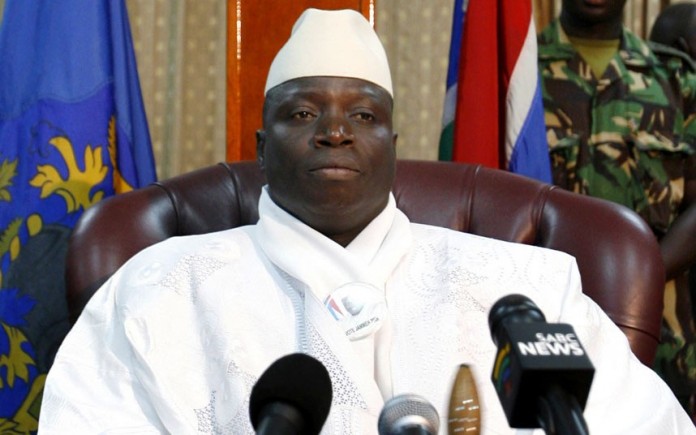
The challenge in the Gambia is a simple one. But it can be made complicated depending on the choices we want to make. It is a straight forward story. On December 1, 2016, elections were held in Gambia in which opposition leader, Adama Barrow defeated incumbent President Yahya Jammeh by 263,515 votes to 212,099. That is a 51,416 vote difference.
The following day even before the final results were announced, Jammeh who had ruled the country for twenty two years publicly conceded defeat saying Gambians and God want him to take the back seat. Four days later, the electoral commission made two shocking announcements. First that the total votes cast were actually 9.1 percent lower than those it had announced. Secondly, that there were errors in its counting as some of the votes counted in Barrow’s favour actually belonged to Jammeh.
Based on these, it released another set of results which showed Barrow with 227,708 votes, that is 35,807 votes lower, and Jammeh with 212,099 or 3,612 more votes. With this, the vote difference narrowed from 51,416 votes, to 19,212 votes. I was not comfortable that a national electoral commission cannot properly tally votes that are less than six hundred thousand. Four days after the reversed results were announced, Jammeh rejected the entire results demanding a rerun of the elections on the basis of what he claims are “… serious and unacceptable abnormalities which have reportedly transpired during the electoral process” He therefore decided to appeal the results to the Gambian Supreme Court in accordance with the country’s laws that allows a candidate dissatisfied with electoral results to appeal same within ten days.

But the world seems to have risen up against Jammeh; they do not want him to avail himself of the electoral rules in his country, they simply want him to give up power. The United States said his decision to seek constitutional legal redress is merely an attempt to hold on to power. The African Union which takes care of the interest of Africans ruled that since President Jammeh had initially accepted the results, his subsequent rejection was “null and void” The Secretary-General [1] of the United Nations, Mr. Ban Ki-moon [2] said Jammeh’s change of mind was an “outrageous act of disrespect of the will of the Gambian people”. The United Nations Special Representative for West Africa [3] and the Sahel [4], Mr. Mohamed Ibn Chambas [5] was more brutal: “For Mr. Jammeh, the end is here and under no circumstances can he continue to be president. By that time (January 18, 2017) his mandate will be up and he will be required to hand over to Mr. Barrow.” Jammeh’s colleagues in the Economic Community of West African States (ECOWAS) initially took mediatory steps, but when they met in Abuja on December 17, the gloves were off. They told him to “ accept the result of the polls and refrain from any action likely to compromise the transition and peaceful transfer of power to the President-elect. ”
In taking a firm stand against Jammeh, they resolved: “ That all Head of States will attend the inauguration of the President-elect Adama Barrow who must be sworn in on 19th January 2017 in conformity with the Gambian constitution. ”
On December 23, the ECOWAS President, Marcel Alain de Souza [6], sent him an ultimatum: “The deadline is January 19 when the mandate of Jammeh ends…If he doesn’t go, we have a force that is already on alert, and this force will intervene to restore the will of the people.”
In the unfolding narration, it is pertinent to ask; was Jammeh sincere when he initially accepted defeat even before the final vote tally? I am inclined to answer in the affirmative. Why he subsequently changed his mind becomes a matter of conjecture. Perhaps, the electoral commission’s review of the votes alerted him to possible electoral fraud. On the other hand, he might just have decided to hang on to power. If the latter were the case, was he reacting to threats by victors including Fatoumata Jallow Tambajang, chair of the victorious opposition to skin him alive or he succumbed to pressure from his inner circle?
Despite the seeming unanimity of the mythical ‘international community’ that Jammeh hands over power, let me ask a question that may sound heretical; supposing Jammeh is right that the votes were rigged in favour of the opposition? Will that be of any consequence, or that fact in itself will not assuage our democratic belief that the opposition won and must be sworn in? There seems to be some unanimity that the Gambian Supreme Court to which Jammeh has appealed, will not deliver justice despite it being headed by a Nigerian, Justice Emmanuel Olusegun Fagbenle with five other Nigerians on the Panel. But supposing it does deliver justice? I assume that is not a risk many want to take.
I am not a fan of Jammeh, but what is clear to me is that he is seen as a bad boy of Africa, and perhaps an embarrassment to some of his colleagues. So they want him out even if it means depriving him of his constitutional right of appeal, or trampling on Gambian laws.
The ECOWAS threat to intervene militarily may not be the best option; what has happened to our legendary African wisdom in resolving disputes? GAMBIA IS A SMALL FINGER PROTRUDING FROM THE ATLANTIC OCEAN INTO THE BELLY OF SENEGAL; IT IS A TINY COUNTRY, BUT AN AFRICAN PROVERB SAYS THAT ALTHOUGH THE NEEDLE IS TINY, IT IS NOT FOR THE HEN TO SWALLOW. It may just find that it is not as easy as eating corn.
Supposing Jammeh refuses to budge and Gambia’s bigger brothers send in troops through the Senegalese border as threatened, do we know what the eventual outcome will be? Can Africa not learn from mighty NATO’s invasion of Iraq and Afghanistan? Supposing Jammeh or his supporters embark on a guerrilla warfare or even a terror campaign? Supposing the rebels in the Casamance Province of Senegal who are close to Jammeh decide to team up with him? President Jammeh is like a man holding a sword, you may be badly cut trying to snatch it from him. It might be better to persuade him to sheath and handover the sword. We may know the beginning of an armed conflict, and even accurately predict its outcome, but we may never know when or how it will end and its implications. Gambia may just well be a banana peel; Africa must tread with caution.
Written by Owei Lakemfa.