
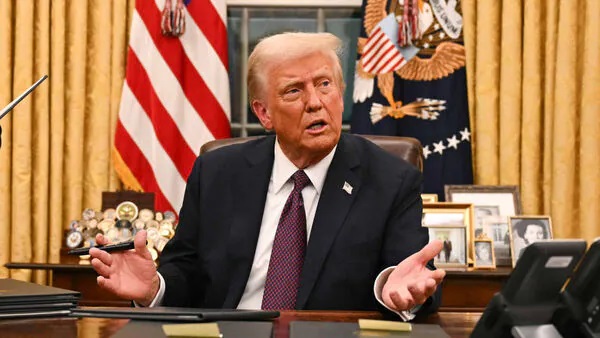
November 06, (THEWILL) — The United States military has reportedly developed a series of contingency plans for possible military action in Nigeria, following a directive from President Donald Trump. According to The New York Times, the U.S. Africa Command (AFRICOM) recently submitted operational options to the Department of War at the request of Secretary Pete Hegseth.
This development comes in the wake of Trump’s inflammatory claim that the Nigerian government is allowing the “mass slaughter” of Christians—an allegation Nigerian authorities have strongly denied as false and politically motivated.
Last week, the U.S. leader escalated his rhetoric, threatening direct military intervention in Nigeria and accusing the Bola Tinubu administration of complicity in religious persecution. In a controversial move, he designated Nigeria as a Country of Particular Concern (CPC), suspended arms sales, and halted technical assistance to the country.

These actions follow months of lobbying by right-wing lawmakers and evangelical pressure groups in the U.S. who have pushed for sanctions on Nigeria. Yet, their narrative ignores the complex realities of Nigeria’s security challenges—rooted not merely in religion, but in poverty, climate stress, inequality, and governance failures.
Western discourse often simplifies Nigeria’s multi-layered problems into crude ethno-religious categories. This reductionist framing invites misunderstanding and opens the door for foreign interference under the guise of “humanitarian concern.”
The irony, however, is glaring. The United States, self-proclaimed custodian of global democracy and human rights, struggles with some of the world’s worst records on gun violence and racial inequality.
Recent figures show that over 117,000 people are shot annually in the U.S., resulting in nearly 43,000 deaths—from homicides, suicides, and accidental shootings. Black children and teenagers are four times more likely to die from gun violence than their white peers. In other words, a person from a minority group is statistically more likely to die violently in the U.S. than in some of the world’s recognized conflict zones.
Yet no country has ever designated America as “unsafe for minorities.” No government has proposed sanctions over the routine killing of unarmed Black citizens by U.S. law enforcement. Are we to pretend the Black Lives Matter movement did not emerge from deep-rooted systemic injustices—nor that these issues still persist?
Then there is the United States’ complicity in international violence. The same weapons America supplies to its allies are used daily in the Middle East—killing innocent civilians, including Christians in Palestine. In fact, there are more Palestinian Christians than Israeli Christians—yet the latter enjoys unwavering American backing.
If Washington were truly invested in protecting oppressed Christians, Haiti—a predominantly Christian nation just 700 miles from Florida—would have been its first point of intervention. Instead, Haiti has descended into lawlessness: no elected government, mass displacement, and widespread gang terror affecting 1.3 million people.
Even after Hurricane Melissa killed 43 people and leveled thousands of homes, the U.S. offered no meaningful rescue effort. The only external help Haiti received came not from America, but from Kenya’s police force. The reason? Haiti has no oil. Unlike Iraq, Libya, or Venezuela, there is nothing to extract. America’s “humanitarian interventions” have always followed the scent of resources, not righteousness.
History is clear: No nation has remained stable after U.S. military intervention. Libya collapsed into militia rule and slave markets after the 2011 NATO invasion. Iraq’s “liberation” birthed ISIS. Syria’s war was prolonged by foreign interference. Congo never recovered from the CIA-backed assassination of Patrice Lumumba and the installation of Mobutu Sese Seko.
Still, while condemning Trump’s reckless threats, Nigeria must confront its own contradictions.
We must ask ourselves whether we are truly a secular nation—or merely pretending to be one. Can a country that sponsors pilgrimages, funds religious institutions, and entangles faith with governance credibly claim neutrality? Can a government that routinely fails to prosecute religious violence assert a commitment to equality before the law?
Our unwillingness to address these contradictions has bred impunity. It has empowered extremists who act with confidence that there will be no consequences.
If Nigeria is to resist external pressure and assert its sovereignty, it must first resolve its internal crises of identity and governance. We must choose who we are: a secular democracy that protects all citizens equally, or a divided federation where religion shapes policy and determines justice.
Until Nigeria resolves this internal conflict, it will remain vulnerable—to foreign manipulation, domestic instability, and, as Trump’s latest posturing shows, the enduring shadow of imperial arrogance.
***Written by Olalekan Adigun.
Olalekan Adigun is a researcher and journalist based in Abuja. He can be reached on X (Twitter) via @MrLekanAdigun or email at adgorwell@gmail.com

