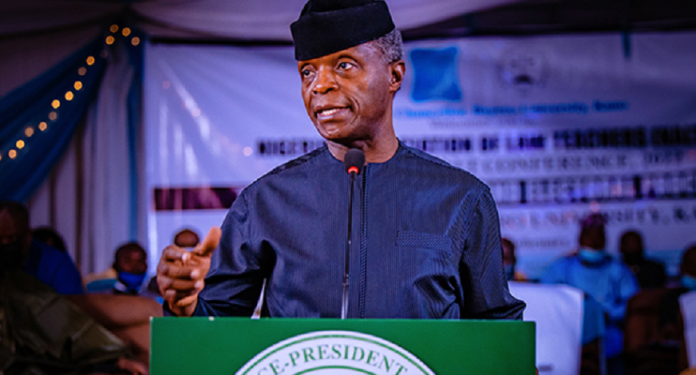
February 09, (THEWILL) – Vice President Yemi Osinbajo has faulted the decision of the Supreme Court that substitute the will of the electorate, insisting that the right of the people to elect their leaders must be protected by electoral laws and judicial interpretation in electoral cases.
Prof. Osinbajo spoke on Tuesday at the opening of the 53rd annual conference of the Nigerian Association of Law Teachers at the Bayero University, Kano.
According to the vce president, the will of the electorate is central to democracy and is demonstrated by people voting for candidates of their choice in elections.

“This means that electoral justice must not be for the candidates alone. Indeed the principal players; the electorate, must be front and centre of judicial reflection on how to determine electoral cases.
“The judiciary must be wary of substituting their will for the will of the electorate, they must seek every interpretation that leaves the people with the choice of who they prefer,” he said.
Citing the supreme court decision in the case of APC vs. Marafa in Zamfara State in 2019 (SC.377/2019), Osinbajo faulted the nullification of the elections of all candidates of All Progressives Congress (APC), who were voted by the people by the Supreme Court on the ground that the party primaries that produced them were not validly conducted.
THE WILL recalls that the supreme court had, in its decision on the election in Zamfara State in 2019, invalidated the elections of all candidates of the APC and ordered that candidates of the Peoples Democratic Party (PDP), be returned as winners.
“So here was a situation where the party that lost every seat from governorship down to house of assembly was given all those seats by judicial pronouncement.
“For the voter, this decision must have been at best puzzling. First, they had no idea that the candidates of their preferred party were disqualified before voting. Indeed, at least, one court had declared the primaries valid and it was on that basis that INEC gave the go ahead to the candidates to contest.
“Second, rather than giving seats to those that the electorate had rejected ordering a rerun would probably have yielded perhaps a fairer result in the opinion of those who went to the polls that day.
“The law, electoral processes, everything, must bow to the will of the people. The appropriate interpretation must favour the will of the people”, Osinbajo said.
He expressed hope that participants at the conference would interrogate the issues he raised in the course of their three-day engagement.
Speaking on the Electorate Act Amendment Bill, the vice president said, “it is a testament to our commitment to improving our electoral process that we have an Electoral Bill that is presently in the process of being passed.”
He said that the legislation that would emerge would be one that reflects a broad consensus between all the stakeholders.
“While INEC continues to improve its capacity to conduct credible elections particularly through the deployment of technology, we recognize that democracy is about much more than voting.
“It is also about constitutionalism, rule of law and respect for civil liberties. We must diligently work to uphold these principles,” he added.
Osinbajo Faults Court Decisions Substituting Voters’ Will
By Felix ifijeh
Vice President Yemi Osinbajo has faulted the decision of the Supreme Court that substitute the will of the electorate, insisting that the right of the people to elect their leaders must be protected by electoral laws and judicial interpretation in electoral cases.
Prof. Osinbajo spoke on Tuesday at the opening of the 53rd annual conference of the Nigerian Association of Law Teachers at the Bayero University, Kano.
According to the vce president, the will of the electorate is central to democracy and is demonstrated by people voting for candidates of their choice in elections.
“This means that electoral justice must not be for the candidates alone. Indeed the principal players; the electorate, must be front and centre of judicial reflection on how to determine electoral cases.
“The judiciary must be wary of substituting their will for the will of the electorate, they must seek every interpretation that leaves the people with the choice of who they prefer,” he said.
Citing the supreme court decision in the case of APC vs. Marafa in Zamfara State in 2019 (SC.377/2019), Osinbajo faulted the nullification of the elections of all candidates of All Progressives Congress (APC), who were voted by the people by the Supreme Court on the ground that the party primaries that produced them were not validly conducted.
THE WILL recalls that the supreme court had, in its decision on the election in Zamfara State in 2019, invalidated the elections of all candidates of the APC and ordered that candidates of the Peoples Democratic Party (PDP), be returned as winners.
“So here was a situation where the party that lost every seat from governorship down to house of assembly was given all those seats by judicial pronouncement.
“For the voter, this decision must have been at best puzzling. First, they had no idea that the candidates of their preferred party were disqualified before voting. Indeed, at least, one court had declared the primaries valid and it was on that basis that INEC gave the go ahead to the candidates to contest.
“Second, rather than giving seats to those that the electorate had rejected ordering a rerun would probably have yielded perhaps a fairer result in the opinion of those who went to the polls that day.
“The law, electoral processes, everything, must bow to the will of the people. The appropriate interpretation must favour the will of the people”, Osinbajo said.
He expressed hope that participants at the conference would interrogate the issues he raised in the course of their three-day engagement.
Speaking on the Electorate Act Amendment Bill, the vice president said, “it is a testament to our commitment to improving our electoral process that we have an Electoral Bill that is presently in the process of being passed.”
He said that the legislation that would emerge would be one that reflects a broad consensus between all the stakeholders.
“While INEC continues to improve its capacity to conduct credible elections particularly through the deployment of technology, we recognize that democracy is about much more than voting.
“It is also about constitutionalism, rule of law and respect for civil liberties. We must diligently work to uphold these principles,” he added.