
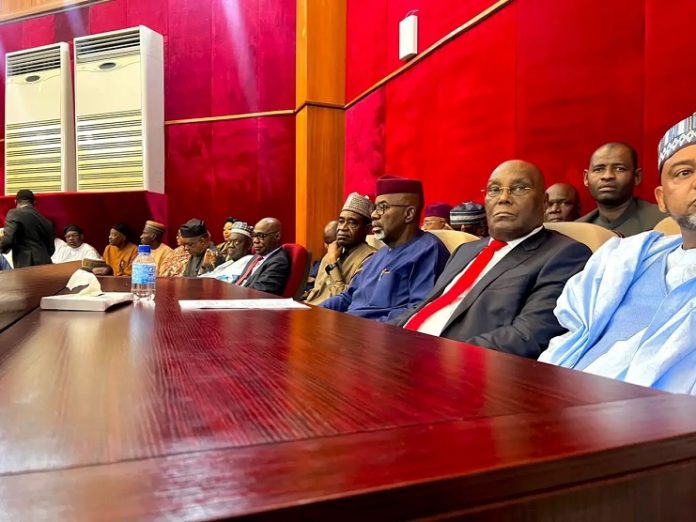
October 22, (THEWILL) – Presidential candidate of the Peoples Democratic Party (PDP), in the 2023 General election in Nigeria, Atiku Abubakar, has told the Supreme Court that there is no barrier preventing it from accepting fresh evidence of forgery against President Bola Tinubu, saying the Presidential Election Petition Court (PEPC), is not a tribunal that is statute-barred.
The former Vice President made this known in his reply on point of law to objections raised by the Independent National Electoral Commission (INEC), President Bola Tinubu and the All Progressives Congress (APC), to the presentation of the documents.
THEWILLL reports that the documents Atiku sought to tender before the apex court are the academic records of President Tinubu, released to Atiku by the Chicago State University on October 2, 2023.

The 32-page document was released to the former Vice President on the orders of Judge Nancy Maldonado of the District Court of Illinois, Eastern Division, Illinois, United States of America.
Atiku had argued that President Tinubu was not qualified to contest the February 25 Presidential poll because he allegedly submitted a forged diploma certificate to INEC.
But the respondents, in their separate replies, argued that the Supreme Court cannot, at this stage, accept fresh documents since the 180 days provided by law for the hearing of the petition against the February 25 presidential election had lapsed.
According to them, the apex court at this stage lacked the necessary jurisdiction to receive and decide on the fresh evidence having not been presented within 180 days.
But, in his reply to the respondents, the former Vice President through his lead counsel, Chris Uche (SAN), argued that contrary to the avowed position of the respondents, “there is no such constitutional limit of 180 days on the lower court to hear and determine a presidential election petition, such that can rob this Honourable Court to exercise its power in any manner whatsoever.”
He further argued that “the parties are agreed that the Constitution is the fons et origo and the grundnorm, and supersedes any other legislation.”
The former Vice President also stated that while establishing the election tribunals to deal with election matters from Houses of Assembly, National Assembly and Governorship elections, the Constitution gave the jurisdiction to entertain disputes from presidential elections only to the Court of Appeal.
“Thereafter, the Constitution was intentional and deliberate in setting the 180 days limit only for Election Tribunals, and not for the Court of Appeal. On the other hand, when it came to appeals, the Constitution clearly and expressly extended same to the Court of Appeal. The Constitution clearly excluded Court of Appeal in the preceding subsection”, he submitted.
Citing Section 285 (6) of the 1999 Constitution (as amended), Atiku argued that the framers of the Constitution limited the application of the 180 days specifically to election tribunals, excluding the Court of Appeal.
“On the other hand, when it came to the next subsection, namely Section 285(7), they intentionally included and mentioned Court of Appeal. The trite maxim, my Lords, is “expressio unius est exclusio alterius”, meaning that the express mention of one thing in a statutory provision automatically excludes any other which otherwise would have been included by implication.
“Furthermore, when granting jurisdiction to the Court of Appeal to entertain presidential election petitions, the Constitution did not pretend that it was conferring the jurisdiction on a “tribunal”; it clearly gave the jurisdiction to the Court of Appeal. Thus, section 239(1) of the Constitution specifically provides thus:-
“Subject to the provisions of this Constitution, the Court of Appeal shall, to the exclusion of any other court of law in Nigeria, have original jurisdiction to hear and determine any question as to whether – (a) any person has been validity elected to the office of President or Vice President under this Constitution”, he said, adding that when conferring on the Supreme Court the jurisdiction to entertain appeals arising from decisions in presidential election petitions, the Constitution limited itself to “Court of Appeal” and made no mention of ‘tribunal’.
He further cited Section 233 subsections (1) and (2)(e)(i) of the Constitution which provides that, “The Supreme Court shall have jurisdiction, to the exclusion of any other court of law in Nigeria, to hear and determine appeals from the Court of Appeal.
“An appeal shall lie from decisions of the Court of Appeal to the Supreme Court as of right in the following cases – (e) decisions on any question – (i) whether any person has been validly elected to the office of President or Vice President under this Constitution.”
In his submission, Atiku said it was based on the above facts that the Presidential Election Petition Court itself administratively refused to be referred to as the “Presidential Election Petition Tribunal”, but the “Presidential Election Petition Court.”
While stating that it is in fact derogatory to refer to the Court of Appeal as a tribunal, he “submit that there is no constitutional limitation to rob this Honourable Court of the jurisdiction to exercise its express powers under Order 2, Rule 12 of the Supreme Court Rules 1985 to receive this vital and constitutionally important fresh evidence relating to qualification of a candidate to contest election to the exalted office of President of the Federal Republic of Nigeria.”

