
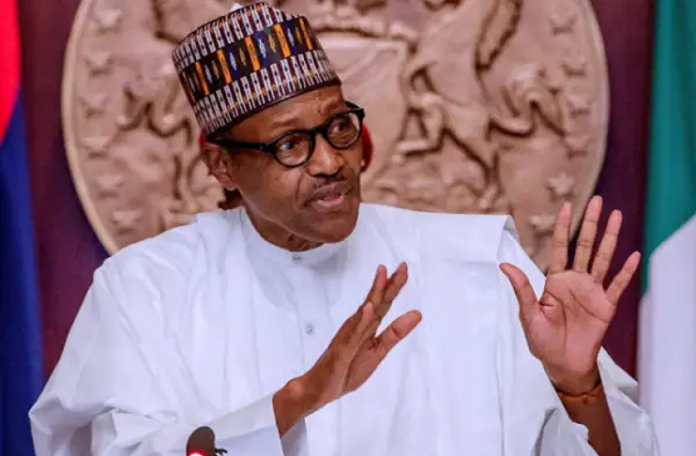
President Muhammadu Buhari has failed to meet the deadline for the rehabilitation of the Port Harcourt Refinery which was set for the first quarter of 2023.
The President had, through multiple sources promised, reassuringly, that the rehabilitation of the 60,000 barrels fuel plant would be completed by the first quarter of 2023.
On January 9, 2023, the immediate past Minister of State for Petroleum, Timipre Sylva, had revealed that the rehabilitation of the 60,000 bpd refinery was being completed and was going to be started by Q1 2023.

The refinery was initially scheduled to commence operations in December 2022.
“Our promise has been that the 60,000 bpd plant within the Port Harcourt refinery by the end of Q4 2022, it is being completed and is going to be started by Q1 2023 as promised,” Sylva said while giving an update on the Port Harcourt refineries during the ministry of petroleum resources 2022 scorecard in Abuja.
Similarly, the Group Chief Executive Officer of the Nigerian National Petroleum Company Limited (NNPC), Mallam Mele Kyari, had assured Nigerians of its resolve to complete the then ongoing rehabilitation of Port Harcourt Refinery by March, 2023.
“The promise was to start the fuel plant, which is the 60,000 bpd component of this activity by the last quarter of 2022, but it is not practical. So, we will start it off in the first quarter of 2023, otherwise every other process is going on,” Kyari stated.
About two months after the March 31, 2023 deadline, and two weeks to the end of Buhari’s administration on May 29, the refinery rehabilitation is yet to be concluded. It is now pushed forward to the incoming government to add to the pack of responsibilities likely to dither its performance.
Of major concern here is the huge public funds already committed to the rehabilitation of the 58-year-old refinery, which is part of the larger Port Harcourt refinery complex. Equally worrying is government’s attitude of embracing opaqueness in its oil and gas service delivery.
The Federal Executive Council (FEC) in March 2021 approved $1.5 billion (about N600 billion) for the rehabilitation of the Port Harcourt refinery complex, comprising the old and the new refineries.
Sylva said the contract was awarded to an Italian company, Tecnimont SPA, who, according to the minister, are experts in refinery maintenance.
Sylva further disclosed that the funding of the repairs would be from many components, including the Nigerian National Petroleum Corporation (NNPC), Internally Generated Revenue (IGR), budgetary provisions and Afreximbank.
“So we are happy to announce that the rehabilitation of productivity refinery will commence in three phases. The first phase is to be completed in 18 months, which will take the refinery to a production of 90 percent of its nameplate capacity.
“The second phase is to be completed in 24 months and all the final stages will be completed in 44 months and consultations are approved. And I believe that this is good news for Nigeria,” the minister said, adding that a maintenance company would also be put in place to ensure an effective maintenance culture.
The minister assured that rehabilitation works on Kaduna and Warri refineries would also be carried out on or before May 2023.
This top-of-the-roof optimism ended in a crashed hope with Nigerians suffering and paying more for petrol, directly and indirectly. Besides, the government has not been held to account for the “unending refinery rehabilitation” which has gulped a huge chunk of public fund.
The approval of the $1.5 billion to rehabilitate the refineries was not received as good news. It was promptly greeted with mixed feelings as the country had in the past spent billions of dollars on refinery maintenance. Despite such expenditure, however, the facilities have not worked with many experts calling for their privatisation.
The refineries spend billions of naira on salaries, wages and other benefits on workers despite producing no refined product in recent years. For instance, the Port Harcourt refinery reported no income in 2020 but incurred administrative expenses of N19.22 billion, according to its audited reports. The refinery employed 487 new staff members in 2020. Its directors received N99.75 million as emoluments in 2020, a 67 percent increase from N59.66 million in 2019.
The workers, among the highest paid in the country, earn their salaries, promotions, allowances and go on local and foreign training programmes while the facilities are idle.
The government in 2021 earmarked about $3 billion to fix the refineries: $1.5 billion for the repairs of the Port Harcourt Refinery, while $897.6 million and $586.9 million were approved for Warri and Kaduna Refineries respectively. The Minister of State for Petroleum, Timipre Sylva had said that the incoming government would continue from where this administration stopped in fixing the refineries “because government is continuum”.
With the N4 trillion provision for fuel subsidy in 2023, the government is now projecting to spend N7.35 trillion more than it will earn this year as it makes room for a nine-fold jump in petrol subsidy costs than earlier budgeted.
By this, the country will be recording the highest budget deficit in 23 years (since 1999) which amounts to about 5 percent of GDP
Nigeria spent N400bn monrhly on subsidy in 2022, according to Minister of Finance, Budget and National Planning, Zainab Mohammed. It spent $10bn on subsidy in 2022,
The Nigerian National Petroleum Company Ltd in February 2022, imported adulterated fuel that sparked outrage among Nigerians. It was later reported that the Corporation might need an estimated N201 billion worth of clean Premium Motor Spirit (petrol), to bring 170.25 million litres of adulterated products imported into the country up to standard. It was not known how this was resolved.
The Nigerian Midstream and Downstream Petroleum Regulatory Authority had at that time said that, for every 200 litres of the adulterated product, 800 litres of petrol with good quality would be required for the blending to be done.

