
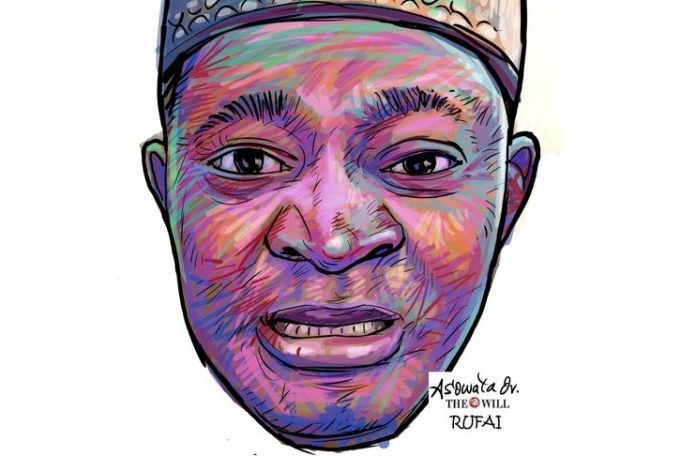
November 05, (THEWILL) – t is a renowned historian and a lecturer at the Department of History, Usmanu Danfodiyo University, Sokoto’. He is the author of a book titled ‘I’m a Bandit’, a decade of research in Zamfara Bandits den and warlords. He speaks with TUNDE OMOLEHIN about the causes of banditry in the North-West geo-political zone. Excerpts:
You are a renowned historian who has researched a lot on the issue of conflicts, especially banditry, in the North-West geo-political zone. Based on your knowledge, give us a foundational insight into banditry in Nigeria
It has a very long history of extortion, injustice, exclusion and impunity by different security agencies in the zone, with the support of traditional authorities and politicians. Banditry in northwestern Nigeria is a product of age-long misrule, impunity and high-handedness on the part of state actors.

Who are the drivers of banditry?
The fundamental actors are the pastoral communities. They are a broad category of people that include the local pastoralist in Nigeria and migrants that came through the international borders. These categories of people have played a very important role in the emergence and escalation of violence in the first instance.
Also, we have witnessed the activities of the Vigilante Group of Nigeria (VGN) and an upshot of this vigilante group known as ‘Yansakee’ operating differently across the northwestern part of the country. Basically, these are two principal actors when you look at the issue on the surface. But when you look at it deeply you see traditional and religious leaders, as well as local miners fueling banditry. Even foreign miners are not excluded.
In a nutshell, the idea of ungoverned or under-governed spaces within the context of the porous borders, movement of small arms and the lite weapons, and the rest of them, combine to escalate banditry in the North-West.
In your book titled ‘I am a Bandit’ you mentioned the names of some leaders of bandit groups operating within the North-West states, especially in Sokoto, Zamfara and Katsina. What are the hidden identities of these people?
Well, the identities of these warlords can be traced to their emergence in the early stage. First, these are just peer groups that are involved in communal violence within their communities. Virtually, most of the gangs are of the same families, living within the environment. They were childhood friends who became armed bandits.
One hidden identity of their operational system is that they exchange and trade in arms among themselves easily. Another one is the way and manner they convert rustled cattle into weapons. This means that they can have access to weapons wherever and whenever they like without giving out cash or travelling far. Arms, particularly the AK-47 rifle, is valued on the basis of herds of cattle. These people are not so much interested in the amount of naira or other monetary denominations you have. In a day, you see them equating numbers of rifles with herds of cattle. On a very serious note, these are some of the hidden identities that are very fundamental and principal in their operations.
Another aspect is that these warlords no longer live in the den, in the forest as they were wont to be in the past. Today, a large number of them are living in villages and hamlets and other rural settings, mingling and interacting with residents in the communities.
There are ongoing military operations against these armed groups within the North-West states and across the Lake Chad region. In your view, is the militarisation action winning the war against these groups?
Well, I don’t think the Federal Government is winning this war through their military operations. Because, each and every military operation has a certain level of collateral damages. These collateral damages are impacting on the number of targeted armed bandits and other civilians who are losing their families or relatives.
Majority of the casualties are civilians who have no business with the targeted bandits. Again, do not forget that this conflict is not intellectually driven by any scientific data, information or exact ideology of the root problems. For instance, you cannot go into this kind of war without proper mapping, proper understanding and research into different layers of the conflict, as regards the supply of small arms, the actors and inter and intra-bandit relationships. Most importantly, one should ask if the community you are fighting for has the will to support military actions? My answer is no and this is highly problematic. You see communities within the areas where bandits are operating are not giving vital information to the security agencies.
Communities must key into either the Carnatic or non-Carnatic approach of the government. But we see government fighting bandits and the community stands in the middle without taking sides with government. This is a very serious problem. Ordinarily, government is supposed to relate with these communities to know their problems and options about the military operations within their locality. Since these questions are not asked, they (communities) are closer to bandits than the government. That is why the problem persists.
The communities will tell themselves that the military operations do not last forever and they believe the military are not going to stay with them forever. Whatever it is, if the military succeeds in eliminating 10 bandits, leaving only two, the communities always have the fear that those two will always come back to attack them when the military are no longer there. That is why these communities take sides with bandits. They see the bandits as lesser evils than the military who sometimes cause collateral damages on innocent civilians in the course of their operations. That is why military operations witnessed a lot of sabotages within the communities they are operating. Some of these communities are informants to the bandits. Also, bandits use residents of the communities as human shields.
In your book you also mentioned 16 major bandit camps within the North-West. How do they operate?
Historically, the first armed group evolved in 2011, led by Kundu and the notorious Buharin Daji, both of Fulani background. The group operated underground in the forest, but its real motive started to manifest itself in 2012 when cases of cattle rustling began in Zamfara State. At the onset, membership of the group was restricted to the Fulani, especially during the recruitment exercise between 2011 to 2012. Recruitment was through conscription, use of cash and cattle, promise for sex and leisure, as well as intimidation of other Fulani people.
What is confounding about these bandits is that, although they are united for the same purpose, they are paradoxically divided along different camps. The quest for more sophisticated weapons was not largely motivated by the fashion for attack and killings, but largely against other rival groups. Arms procurement and inter-gang rivalry is a common feature of the groups.
Young and junior group members have free access to weapons and they can organise minor attacks, raids and kidnappings without the consent of their leaders. Consequently, to minimise inter-gang squabbles, the entire North-West was divided into bandits camps and each area/zone allocated to a particular leader.
You have researched extensively on banditry within North-West states. What are the resolutions you were able to come up with? Has any government (federal or state) looked at their merits to find a lasting solution?
As a student of history and a researcher in conflict, mine is just to make suggestions or recommendations which I have made. They are in the public domain. I don’t have the power or authority to implement it. It is the responsibility of government at all levels to implement them, if it so wishes.

Tunde Omolehin is an award-winning Journalist with prose in investigative and storytelling that is connecting the dots between the under-reported communities and policymakers to ensure good governance and accountability.
