
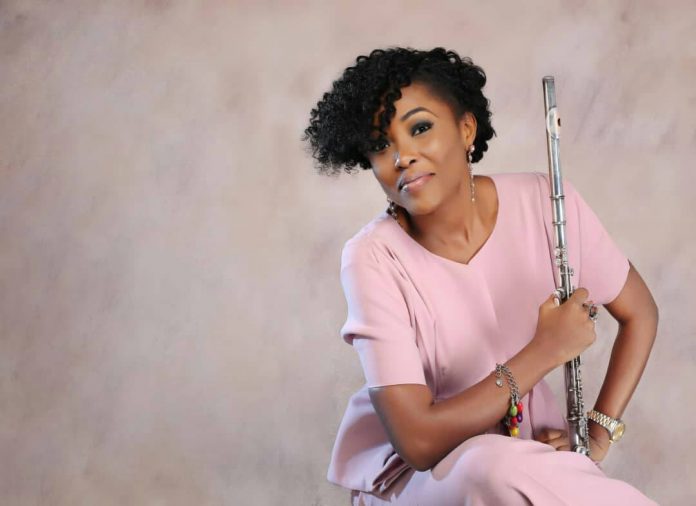
BEVERLY HILLS, February 14, (THEWILL) – For the ten or so questions emailed to Nigeria’s most recognized female flutist late in January, she used the word passion more than half a dozen times in her response. Not passion in the sense we understand it, like pining for a lover somewhere but for playing a reedy instrument weighing less than the arm of a man.
By her own admission, Ebele Ezeamakam, Nigeria’s first female professional flutist aka Ebele the Flutist, has played the instrument from age 14. Before then, she sang at home, eliciting sidelong glances and arched eyebrows from her parents and sibs. (Ebele is second child in a family of six.) Church was next as a chorister. Not contented with vocals alone, she took up flute playing as her preferred instrument, then it became a hobby and now a passion for life.
“It wasn’t something I really banked in for,” Ebele said in one interview about her fascination with the wind instrument. “But somehow I can say God ordained it to be that way. It was just like a hobby, let me just learn. Then I have to sing, I have to learn how to play an instrument. But I realized the hobby became a passion and today that passion is my career.”

In churches, concerts and musical video promos of her, you’d almost always behold her, lips glued to the flute nearly parallel to her right shoulder and blowing away like the Pied Pieper of Hamelin though without any intention of making away with her audience’s children. If anything, what Ebele has done consistently is capturing her audiences’ heart everywhere she has performed.
The older generation among her audience used to see a man by name Tee-Mac, afro-haired, moustache and goatee forming a T, do that many years back. There has never been any other famous flutist in Nigeria since then until Ebele arrived on the stage. Nothing suggests she’ll stop anytime soon.
True! If the passion was never there, you want to believe, it is doubtful if she would ever have contemplated quitting a secure and well-paying job in O&G for an uncertain future as a flutist. Or even dodged extramural classes for flute lessons as a secondary school student in Benin City where the Anambra state-born performer grew up.
Until she became famous some couple years back, not many people knew Ebele worked in a senior position in the Oil & Gas industry except, perhaps, colleagues and those close to her. Yes, with a first degree in Accounting and an MBA, the O&G industry seemed an ideal place to start off.
Today, most people recognize Ebele (starting with entertainment reporters and the industry itself to teenage fans and those who ask her to concerts) as the first female professional flutist in Nigeria. She herself is not unaware of that title going by her email address: ebeletheflutist01@…From several reports about the accountant-turned-flutist, nothing best describes her infatuation with the wind instrument than that very word: passion.
Thousands of her compatriots pray and fast week after week, month to month, year to year just to land a plum appointment in the industry. Once secured, thanksgiving services are sometimes not out of place, complete with special invocations by the GO himself or some such presiding pastor on behalf of the lucky lad for speedy promotions and job security.
But here is one woman who decided she’d had enough in her former metier, however lucrative or privileged it may have been, thus taking up one dearer to her heart, what she’d always wanted to do from her childhood.
When Ara the drummer girl began as a barroom delight in clubs around Apapa in the late nineteen-nineties, many thought she was a joker: a woman/ female fancying herself as a serious player of the talking drum usually the preserve of the male folk. Today, nobody doubts her talents as a player of the percussive instrument anymore.
In the coming years, it is possible those in the entertainment industry might look at Ebele in that light, if they have not already done so. She has been interviewed in more than half a dozen national newspapers, had scores of performances – public and private – in and outside Nigeria not only because she is the most recognized professional female flutist but because she is simply good at what she does.
“Music generally,” Ebele told me in one of her replies via mail, “and playing the flute has been a passion for me, and when something is a passion, it’s beyond you. It’s that God-given gift burning inside of you that you can’t ignore and if you are not doing it you cannot be fulfilled. You can’t find satisfaction in any other job.”
When my editor pitched the idea of speaking with Ebele this last January, what came to mind was a one-on-one meet, not through some impersonal medium which denies reporters the necessary background against which their stories are set. Besides, I hoped to be entertained through some demonstration by the flutist herself, if only to re-confirm the popular American saying that “journalists are those who are paid to enjoy themselves.”
It was not to be no thanks to the social distancing on account of Covid-19. Even so, the interview proceeded. If, as they say, you can tell about people from what they write, there is no question at all Ebele is truly passionate about her current profession.
But what is even more striking is applying common sense to pursue and live out what she is passionate about. With the entrepreneurial savvy typical of her compatriots in eastern Nigeria where she comes from, Ebele worked as an accountant in O&G to save up enough money for her career in music because, in her words, “music is capital intensive.”
The idea of a woman taking up flute playing would have been unthinkable a hundred or so years back in her natal state, let alone put her lips to the wind instrument for any reason or take it up as a fulltime job. The one who did, as narrated to us by the master storyteller himself, Achebe, was considered a failure (efulefu) among Umuofians, beginning with his own son, Okonkwo, eternally ashamed and scornful of his father, Unoka.
Ever the prescient writer, Achebe gave a hint of who the superstar was in pre-colonial Igbo communities so brilliantly fictionalized in Things Fall Apart. It was not the flawed tragic hero who put a rope round his neck in the end but Unoka who entertained himself and others with wine and music even though he indebted himself in the process.
Unlike Unoka’s pariah status then, Ebele is the darling of all today, wooed and courted by gospel bands and politicians, artistes like her. She has had a collabo with Tunde Aremu. One report in 2018 had governors top on the list of her admirers and even going after her, she was quoted to have said. We wanted to know how true that was. No, Ebele replied. “I didn’t mean it that way o. I like our leaders. Each time I see them in occasions, it gives me joy and they like my music and performance.”
On whether she is truly the first female flutist in the country, Ebele was non-committal, insisting that “there are a lot of female flutists in Nigeria. You can find them in some music schools like Musical Society of Nigeria (MUSON) and also in churches. I am the first female flutist because I am the first female doing this professionally.”
Part of the reason for lack of appeal to performers, according to her, is “the flute is not seen as a lucrative instrument like the saxophone. It’s seen as an instrument you can only use in enclosed settings like orchestral settings. But I broke the idea.”
In the entertainment industry today in Nigeria, no one can deny Ebele broke the barrier or spawned the idea of being the first professional female flutist considering her ever widening fan base. Only last December, she performed for high-profile guests somewhere in Lagos where those in attendance observed the social distancing rules. She also said she was well paid.
Though Ebele never had any pioneer flutist to look up to in Nigeria, she believes she can inspire other youngsters, something she’s already began. In 2018, she ran a project of “training in different locations in Lagos state. A lot of females were involved and many indicated their interest in flute.”
One other thing she loves doing apart from playing the flute is reading, something she considers a hobby, browsing mostly inspirational literature, books that “influence me positively and get me closer to God.” The Purpose Driven Life by Rick Warren, for instance, is her favourite.
Growing up with her parents and sibs in Benin was great, Ebele recalled, although both parents baulked initially when she took up flute playing. But by the time they “realized how good I was, they supported me.” The rest, as they say, is history.
We could not resist asking one final question: her personal life. True, Ebele admitted she isn’t married but hopes to soon. For now, however, Nigeria’s first female professional flutist is completely devoted to what she embraced from her teenage years – the flute.

Michael Jimoh is a Nigerian journalist with many years experience in print media. He is currently a Special Correspondent with THEWILL.
