
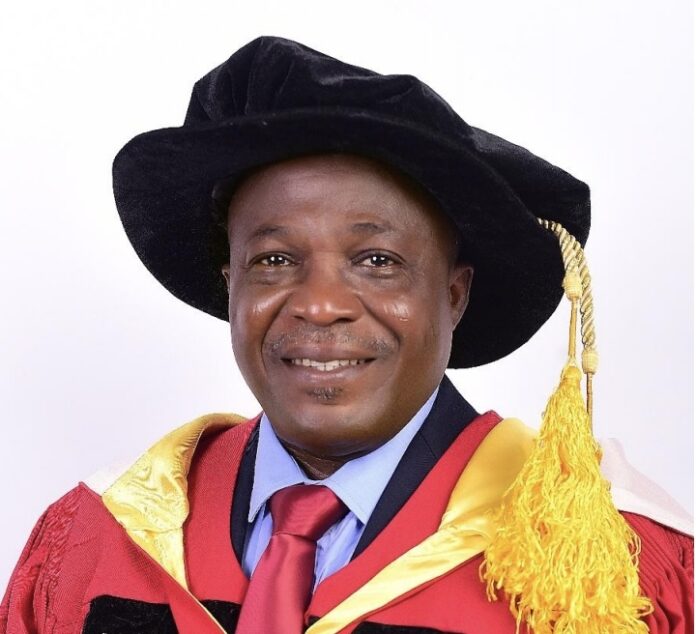
April 07, (THEWILL) — At the iconic Ade Ajayi Auditorium within the University of Lagos, scholars, students, and policy stakeholders gathered on Wednesday, April 1, 2026, for an intellectually rich inaugural lecture delivered by Professor Amidu Owolabi Ayeni.
The lecture was not merely an academic ritual, it was a compelling call to reimagine knowledge systems through a multidisciplinary and interdisciplinary lens rooted in indigenous realities.
A Professor of Environmental Geography in the Department of Geography, Faculty of Social Sciences, Ayeni drew from decades of research and field experience to interrogate the limitations of conventional Western-centric epistemologies.
He argued that solving Africa’s complex environmental and developmental challenges requires a synthesis of scientific methods with Indigenous Knowledge Systems (IKS), which he described as “contextually grounded, culturally adaptive, and empirically rich.”
Positioning environmental geography as a convergence discipline, Ayeni demonstrated how insights from climatology, sociology, urban planning, and anthropology can be integrated with indigenous practices such as local weather forecasting, land stewardship traditions, and community-based resource management.
According to the professor, this integration is not optional but essential for sustainable development, particularly in rapidly urbanising regions like Lagos.
He emphasised that Indigenous Knowledge Systems are not relics of the past but dynamic frameworks that have sustained communities for generations.
By embedding these systems into formal policy and academic discourse, Ayeni maintained that Nigeria can develop more resilient and inclusive environmental strategies.
The lecture also underscored the urgency of interdisciplinary collaboration across academia, government, and local communities.
Ayeni called for curriculum reforms that elevate indigenous perspectives alongside scientific inquiry, urging institutions like the University of Lagos to take the lead in redefining knowledge production in Africa.
In a thought-provoking conclusion, Ayeni challenged policymakers and researchers to move beyond siloed thinking.
“The future of environmental sustainability in Africa lies at the intersection of disciplines and at the heart of our indigenous wisdom”, he asserted.
The event marked not just a personal academic milestone for Professor Ayeni, but a broader intellectual moment, one that reaffirms the value of integrating diverse knowledge systems in shaping Nigeria’s environmental future.
At the heart of contemporary scholarship, geography is increasingly asserting itself not just as a discipline, but as a unifying intellectual architecture, one that bridges fragmented domains of knowledge while drawing strength from Indigenous Knowledge Systems (IKS).
This central thesis, drawn from the inaugural lecture of Professor Amidu Owolabi Ayeni at the University of Lagos, positions geography as both a mediator and synthesiser in a world defined by complexity and interdependence.
Geography’s enduring identity lies in its role as a “discipline of last resort”—stepping in precisely where others reach analytical limits. Rather than operating in isolation, it interrogates the real-world manifestations of theoretical constructs developed in fields such as physics, economics, and political science. By doing so, it transforms abstract principles into spatially grounded realities, offering a more holistic understanding of the Earth system.
From the physical sciences, geography inherits foundational principles but extends them into landscapes, climates, and ecosystems, translating theory into lived environmental experience. Within the social sciences, it introduces spatiality as a critical variable, explaining disparities in development, culture, and population distribution across regions.
In environmental science, geography transcends narrow thematic focus by examining interactions among air, water, land, and human systems across multiple scales.
This integrative reach continues across disciplines. In earth sciences, geography connects geomorphological processes to human habitation and risk. In economics, it interrogates spatial inequalities and locational advantages that shape prosperity or deprivation.
In health sciences, it maps disease diffusion and links epidemiology to environmental and socio-spatial determinants. Engineering benefits from geography’s spatial intelligence in designing sustainable infrastructure, while political science intersects through geopolitics—where power, territory, and resources converge.
Equally significant is geography’s engagement with cultural studies, where it deciphers how landscapes shape belief systems and, conversely, how human culture inscribes itself onto space. Its foundational role in geospatial sciences, such as GIS, remote sensing, and cartography, further reinforces its analytical capacity, enabling data-driven spatial decision-making.
However, Ayeni’s most compelling argument lies in the rejection of disciplinary silos. In a globalised era characterised by climate change, pandemics, and transboundary resource flows, isolationist thinking is not only obsolete but counterproductive.
Geography, by contrast, thrives on relationality—mapping flows of capital, people, information, and ecological processes across scales. It reframes global challenges as inherently interconnected, demanding interdisciplinary and even transdisciplinary responses.
Within this framework, Indigenous Knowledge Systems emerge as indispensable. These systems, rooted in centuries of lived experience, offer context-specific, adaptive strategies for environmental management. Whether in traditional land-use practices, local climate prediction, or biodiversity conservation, IKS complements scientific methodologies by embedding knowledge within cultural and ecological realities.
Ayeni underscores that integrating these systems into formal research and policy is not merely inclusive—it is epistemologically necessary.
The lecture further situates environmental geography as a critical subfield, examining the bi-directional relationship between humans and their environment.
Concepts such as geo-ecosystems, ecosystem functions, and spatial-temporal ecological change illustrate how environmental processes are both shaped by and responsive to human activity. Through tools like GIS and remote sensing, geographers are able to visualise, analyse, and predict environmental dynamics with increasing precision.
Ultimately, geography’s strength lies in its capacity to connect disciplines, systems, and knowledge traditions. It provides the spatial grammar through which the complexities of the environment can be understood and managed. In doing so, it not only enriches academic inquiry but also equips policymakers, planners, and communities with the insights needed to navigate an increasingly interconnected world.
In Ayeni’s vision, geography is not confined by boundaries, it transcends them, offering a blueprint for a more integrated, inclusive, and sustainable future.
The event was attended by the Vice Chancellor, The Deputy Vice Chancellor (Academics and Research),The Dean, Faculty of Social Sciences, The University Librarian, The Deputy Vice Chancellor (Development Services), Heads of Departments, The Deputy Vice Chancellor (Management Services), Members of the University Senate, Technical), The Provost, College of Medicine, The Bursary, The Registrar, Deans of Other Faculties, non academic staff of the University and students.

Anthony Awunor, is a business correspondent who holds a Bachelor of Arts Degree in Linguistics (UNILAG). He is also an alumnus of the Nigerian College of Aviation Technology (NCAT), Zaria Kaduna State. He lives in Lagos.
