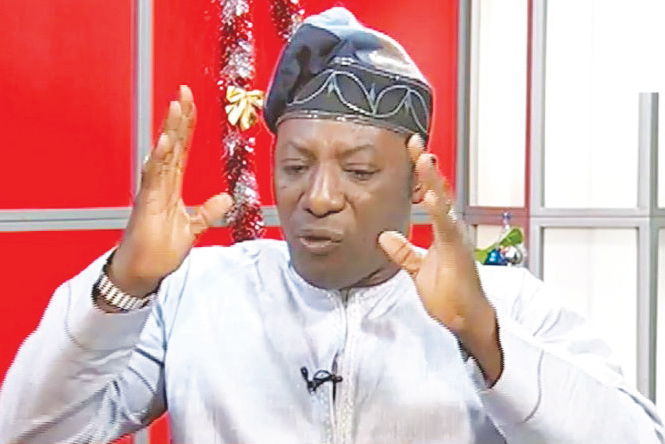
April 25, (THEWILL) – Pro-democracy activist and National President of the Campaign for Dignity in Governance (CDG), Comrade Razaq Olokoba, speaks with AYO ESAN on insecurity and how to tackle it. Excerpts:
What do you think can be done to effectively tackle the security challenges facing the country?
First, without mincing words, I want to make it clear that weak security institutions are responsible not only for the security challenges facing our country but also for our economic woes and political setbacks. All we need to do as a serious country is just to create a base for our security institutions and rework the security layers to accommodate a federal layer, state layer and local layer.

This is the only panacea because there is no way that a single layer of security architecture can secure about 250 million Nigerians, no matter the kind of training they have received or the volume of bullets and number of guns in their possession.
Do you agree with Governor Nasir el-Rufai’s suggestion that hiring mercenaries might help the Federal Government to check the activities of terrorists?
I am not in support of el-Rufai’s suggestion. We have a home-grown solution to our security problem, if we are prepared to utilise it. We don’t need foreign bodies to intervene in domestic affairs that are not beyond our capacity to handle.
I have said several times that restructuring our polity that would accommodate state and local police is imperative, if we are serious about seeing the end to our security problem in this country. I insist that social crisis and political instability will not cease to be recurring decimals in Nigeria unless the agitation for restructuring of the nation’s polity is addressed.
You would recall that I sounded a note of warning some time ago when I described the encounter between the Governor Babajide Sanwo-Olu of Lagos State and a police officer over a parcel of land at the Magodo Housing Estate as embarrassing. I wondered aloud how the governor, who is supposed to be the overall security boss of his state, could not control the security apparatus under him. I made it abundantly clear that such a thing could not have happened in a situation where the polity was restructured in such a way as to place matters related to security firmly in the hands of state governors.
I expressed the conviction that, with the situation of things n Nigeria vis a vis the composition of the security apparatus, there is no way disturbing and embarrassing clashes like what happened in Lagos could have occurred if the governors were constitutionally fully in charge of security in the state. It is unthinkable that a police man in Lagos would have to call his boss in far away Abuja before listening to the man given the mandate by his people to administer their affairs!
In a clearer term, what exactly do you want the authorities to do about the issue under discussion?
Judging by various developments, it is crystal clear that there is a need to decentralise the police structure. I would suggest to all the 36 state governors and other relevant stakeholders across the country to analyse the gains of having various levels of security to President Muhammadu Buhari and explain to him that imposition of the military structure on the police will not work in a multi-ethnic country like Nigeria.
This discourse has been long overdue. But doing the right thing now will attest to the saying, ‘better late than never’ because the state governors will always be held responsible for funny occurrences.
Against the foregoing, the Nigerian Governors Forum, as I had said somewhere else, should reach out to Mr. President to examine the suggestion about another layer of the country’s security architecture and let him realise that the present one-way police arrangement cannot effectively address the country’s security challenges.
Come to think of it, how can a Sokoto man posted to Ogun State understand the terrain and peculiarities of the culture, tradition and behaviour of Ogun residents? If the security apparatus is localised, people within a community know themselves. So when a crime is committed, it will not be difficult to trace the culprits. If a strange face surfaces within that community, he will be marked out for monitoring. His host or landlord will be asked questions. It will not be a case of one running from pillar to post to solve a crime puzzle after the deed is done.
A local policeman will understand the language and mannerism of his people and through training, be able to study body languages of every individual within his vicinity. But in a situation where the security officer does not understand the language and culture of a community where he is posted to operate, there will be hindrances here and there that will not allow him to operate effectively.
Are you indirectly suggesting restructuring of the polity in the country?
Yes, of course. I believe that harkening to the voice of wisdom over restructuring of the polity as regards to decentralisation of the security institutions in the country would go a long way in addressing the security challenges in the country. And the earlier we do that the better because a stitch in time saves nine.
Also there is the fear that engaging mercenaries could lead to another form of colonisation because the mercenaries may refuse to leave after their assignment. And they may have hatched a plan to take control of our security structure and start to dictate to us what to do and what not to do.
AYO ESAN, has been actively reporting and analyzing political events for different newspapers for over 18 years. He has also successfully covered national and state elections in Nigeria since the inception of this democracy in 1999.