
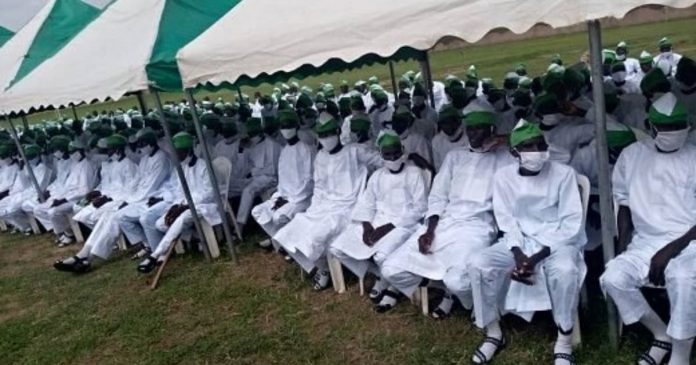
April 26, (THEWILL) — The public outrage that has greeted the de-radicalisation programme announced by the Federal Government as one of its counter-terrorism measures, is telling. From retired Army generals to civil society, the critics have been unanimous in condemning what they see as a measure to pardon the killer and ignore the victim.
As announced by the government recently, the 744 repentant terrorists will be reintegrated into the society after they had undergone six months of de-radicalisation and vocational training, civic education, religious orientation from the De-radicalisation, Rehabilitation and Reintegration Camp under Operation Safe Corridor.
According to military authorities, the exercise is a strategic intervention to dismantle extremism in the country and across neighbouring countries of Niger, Chad, Cameroon and Burkina Faso, whose nationals also benefitted from the programme.

On the face of it, the programme is well-intended. All over the world, countries that have had to deal with terror-related problems have adopted non-coercive counter terrorism measures to tackle the problem at the root cause. So, when the programme kicked-off effectively in 2015 after the amnesty and disarmament programme offered Boko Haram by the President Goodluck Jonathan administration failed, it made some sense that the hard and soft approach to the war against terrorism was in order.
Data shows that 601 repentant terrorists have so far graduated from the Mallam Sidi Camp in Gombe State meant for male defectors,p while 1,935 have been released at the female camp in Bulumkutu, meant for women and children. The latest batch of 744 de-radicalised terrorists shows that the programme still retains it attraction for repentant terrorists.
Given the worsening insecurity at the time and the helplessness of affected families, it is safe to ask whether the programme is making the desired impact in tackling terrorism. Noteworthy as the programme is, there has been observable flaws in need of urgent attention and remedial action.
During a recent appearance on an ARISE TV programme, National Coordinator for Operation Safe Corridor, Brigadier General Yusuf Ali, said, among other things, that there was no available data to measure the extent of reintegration of the repentant terrorist.
Alarmingly, findings by a Senior lecturer in the department of Political Science and International Relations at the Nile University of Nigeria, Abuja, Hakeem Onaola who conducted a research into the programme three years ago, has exposed the default mode of the programme.
There was a lack of community engagement. The people affected by the conflict, Onaola found out, were not significantly involved in the programme. This has led to a deepening of the negative perceptions communities have about the programme, leading to a total rejection of the rehabilitated defectors because the reintegrated former terrorists were still perceived as dangerous and unfit for the society by the people around them.
He also found out the need for genuine reconciliation and forgiveness. This means that the programme does not address the “horrendous experiences of victims in the hands of the individuals who have repented.” This has led to a growing belief that the government is paying more attention to the repentant terrorists than their victims.
Indeed, recent reports show that over 1,000 Nigerians who were abducted in many locations in the country since January this year are still languishing in the den of the terrorists and no rescue seem to be in sight for them. Parents and relatives who can afford the ransom demanded by the kidnappers make the payments and secure the release of their children and other relations. Some villages in Kwara and Nasarawa states have been abandoned due to serial invasion by terrorists. People who have lived in such communities for generations, lament and justifiably so, that the government has abandoned them.
Failure to address these concerns and developments has frustrated attempts for true reconciliation and forgiveness. These are needed for the programme to be successful.
The research also highlighted the need to adopt pre-emptive measures to prevent radicalisation of those who have been exposed to terrorists’ ideologies. Alongside this is a weak post-reintegration plan.
Some of the repentant terrorists among the 744 reportedly claimed that post-rehabilitation promises by government were never kept. Most important in the researcher findings, is the issue of public trust.
“A continental survey of public trust in 37 African countries showed that Nigerians trust state institutions the least. This means that new state programmes are looked at with a great deal of suspicion. This mistrust extended to the outcomes of the programme. People didn’t trust the claim that the ex-terrorists have been rehabilitated and were fit for reintegration,” the research found out.
To crown it all, there is the issue of increasing poverty and hardship in the land. The poor state of the economy would deal a blow to any serious rehabilitation programme as many of the de-radicalised terrorists would find it hard to fit into the society.
We urged the government to proceed with this programme with a more balanced approach. There is urgent need for both the victim and the assailant to be accommodated in the programme. Those who have paid ransom to secure their relations must be compensated; villages that have been abandoned must be rebuilt and secured for their inhabitants; terrorism financiers and sponsors must be prosecuted and jailed. The government must devise a way to make its presence felt in ungoverned places in the country.

