
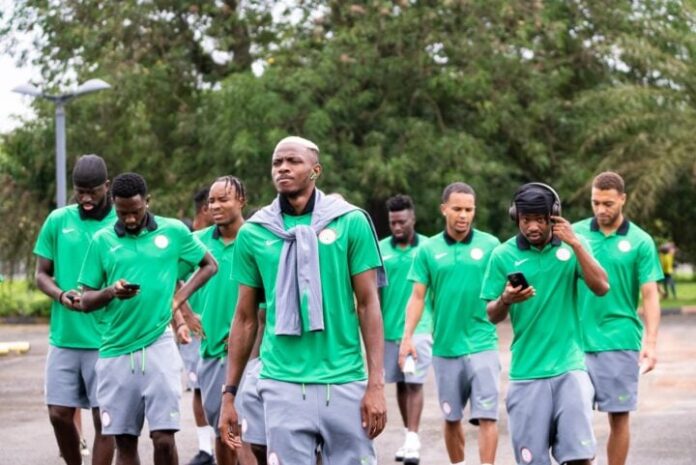
January 11, (THEWILL) — Nigeria’s Super Eagles stand on the brink of Africa Cup of Nations glory, unbeaten in four matches and the tournament’s highest scorers. Yet instead of fine-tuning tactics for their quarter-final against Algeria, the squad has halted training in Fes, refusing to travel to Marrakech until the Nigeria Football Federation settles outstanding bonuses totalling $42,500 per player. This is not merely a labour dispute. It is a national disgrace that exposes the rot at the heart of Nigerian football administration.
The players’ demands are hardly extravagant by international standards. They are owed $30,000 for three group stage victories and a further $12,500 for their commanding 4-0 demolition of Mozambique in the Round of 16. These are contractual obligations for work already completed, performances that have thrilled millions and positioned Nigeria as genuine contenders for continental supremacy. That professionals must down tools to secure what they have earned speaks volumes about the dysfunction they face.
What makes this crisis particularly galling is its predictability. Just two months earlier, in November 2025, the same squad threatened to boycott a World Cup qualifier against Gabon over identical grievances. That dispute was resolved only after considerable disruption, yet here we are again, with federation officials offering familiar reassurances about approvals and central bank procedures. The pattern suggests not administrative incompetence alone, but a fundamental failure to treat national team duty as the professional contract it ought to be.

The historical context deepens the indictment. Nigeria’s women’s team, the Super Falcons, staged hotel sit-ins after the 2019 World Cup over unpaid bonuses stretching back to 2016 and 2017. Beach soccer players have contemplated retirement from international duty after repeated non-payment of dues. Most poignantly, the late Christian Chukwu, captain and coach during Nigeria’s football golden age, reportedly died still pursuing $128,000 in unpaid wages from his coaching tenure that ended in 2006. Whilst federation officials disputed these claims after his death, the very existence of such allegations surrounding a national icon reveals how deeply mistrust has taken root. In other cases, delayed fulfillment of promises made to victorious national teams came long after some of those squad players had passed on.
Today, government interventions have provided only temporary relief. The approval of N17 billion in 2024 cleared some arrears but failed to address the underlying causes of this malaise. When structures meant to support elite sport require eleventh-hour public pressure to function, the problem is systemic. Players preparing for matches of immense physical and psychological demand cannot perform optimally when burdened by financial uncertainty and administrative betrayal.
From the group stage to the Round of 16, the Super Eagles earned their place among Africa’s elite through exceptional performances on the pitch. Their 12 goals across four matches demonstrate quality that deserves better stewardship. Instead, the narrative surrounding Nigerian football achievement is perpetually undermined by preventable crises that shift focus from sporting excellence to bureaucratic failure. The federation must settle these debts immediately if Nigeria is to pursue the trophy its players have worked diligently to advance in.
Yet, beyond this emergency, transparent financial management and dedicated funding mechanisms must be established to ensure future squads receive contracted payments without protest. To do otherwise will be to dishonour those who represent the nation and to perpetuate a cycle that damages Nigeria’s sporting reputation whilst eroding the very foundations of professional football in the country.

