
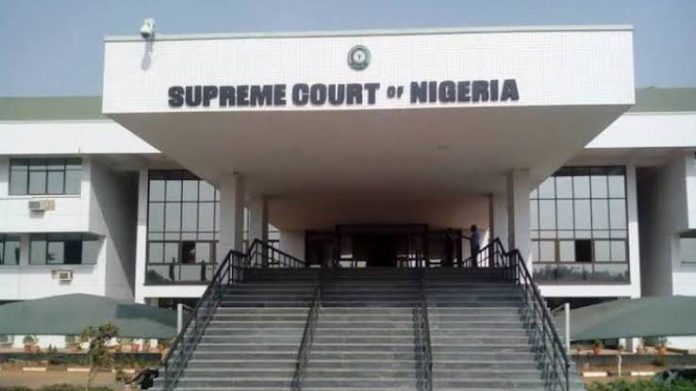
February 01, (THEWILL) — The allegation looked flat and a political gamesmanship until the clarification. Smarting from the recent defection of his political godson, Governor Abba Yusuf from the New Nigeria Peoples Party, NNPP, to the rival All Progressives Congress, party, APC, recently, the National Leader of the NNPP, Dr. Rabiu Kwankwaso, made a remark indicting Supreme Court Judges, last week.
Kwankwaso admitted that he visited the homes of Supreme Court Judges in company with the governor to beg over the outcome of the 2019 governorship election.
“I had forgotten that in 2019, I took him to the homes of all the supreme court judges in Nigeria to beg them. I and the governor met them in their villages and towns,” Kwankwaso claimed. Retired Justice of Nigeria, Mohammed Dattijo immediately issued a clarification, thus providing a platform to interrogate the matter further.

The retired Justice challenged the former governor of Kano State and former Minister of Defence to sustain his allegation by providing the names of the judges he visited over the inconclusive governorship poll of that year. Justice Dattijo stated that he was speaking strictly with respect to himself and insisted that at no time did he meet Kwankwaso or Kano State Governor, Abba Yusuf, whether in connection with the election or any other matter, while he served on the apex court.
According to the retired Judge, the onus of responsibility was on Kwankwaso to prove his claim; he should state when and where such meetings occurred, who was present and which justices were involved, noting that careless generalisations risk damaging the integrity of judicial officers who may have had no involvement whatsoever.
Needless to say, that the politician’s claims has generated so much damaging remarks on social media about the integrity of judicial officers, as Justice Dattijo rightly observed, but also to add that it has also raised questions about the impartiality of the judiciary in election matters, particularly as Nigerians prepare for another general election in 2027.
The context makes the public fear and questions severe. Recall that the 2019 governorship poll in Kano was as contentious as the 2023 general election. In 2019, the Independent National Electoral Commission, INEC, declared the Kano governorship election inconclusive with the margin between the top two candidates less than the cancelled votes.
Yusuf, then candidate of the Peoples Democratic Party (PDP), had polled 1,014,353 votes ahead of Abd ullahi Ganduje, then candidate of APC, who secured 953,522 votes, which left a margin of 26,655 votes. A total of 100,873 votes were cancelled.
In the ensuing supplementary election that took place in the 28 affected Kano LGAs, Ganduje was declared winner after he polled 45,876 votes, while Kabir of the PDP got 10,239 votes.
The total results showed that Ganduje scored 1,033,695 votes, while Yusuf polled 1,024,713 votes. Of course, the Supreme Court upheld the Appeal Court ruling, dismissed Yusuf’s appeal as lacking in merit and affirmed Ganduje’s victory, in January 2020.
However, in 2023, Yusuf was elected governor of Kano on the NNPP platform. At the Appeal Court, Justice Oluyemi Akintan-Osadebay, held that some ballot papers that were relied upon to declare Yusuf as the winner of the governorship contest, were neither signed nor stamped by the INEC.
It proceeded to declare 165,663 of the votes that were credited to the NNPP candidate as invalid. Following the deduction of the said invalid votes, Yusuf, who was initially declared winner of the governorship poll with a total of 1,019,602 votes, had his tally reduced to 853, 939 votes.
With the development, his closest rival, Ganuwa, emerged as the winner of the election with 890,705 votes. The Supreme Court, however, overturned the rulings of the Appeal Court and restored cancelled votes, thus declaring Yusuf duly elected governor. He had polled 1.02 million votes to his rival.
The current controversy stirred by Kwankwaso feeds on these seeming ambiguities. And the optics are bad for the electoral process. We urge the former Kano governor to heed retired Justice Dattijo’s call and name names. We also urge the apex court to issue a clarification. This is not a time when silence is golden. Supreme Court Justices retire at 70 and can serve for more than 10 years, depending on what age they were appointed.

