
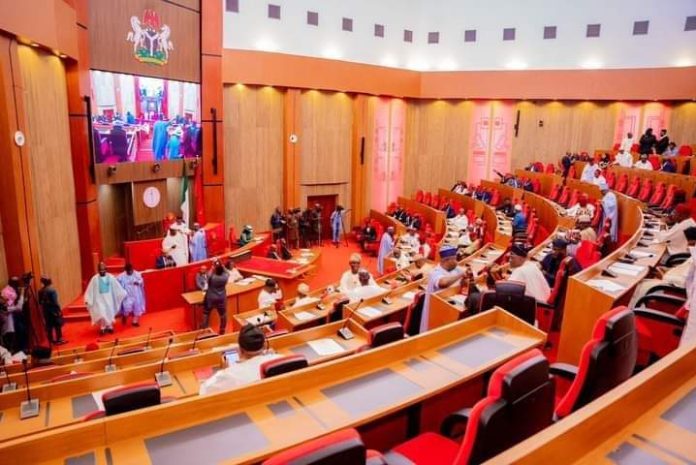
February 15, (THEWILL) — The 10th Senate seems to have a penchant for doing the wrong thing for the wrong reasons. Ambiguity and wrong footing appears to be its wont in recent times. Only last week, it had to be forced by public outrage to vote clearly and directly on the Electoral Amendment Act 2026 after, surreptitiously, it appears in hindsight, to have passed a bill on the amendment in which senators debated whether the words “transfer and transmission,” meant the same thing, even as the President of the Senate used the gavel to signify that the Upper Chamber had voted for the retention of the section in the 2022 Act that gave the electoral umpire the discretion to transfer or manually release election results.
Just before then, the Senate entertained a proposal for a review of the current revenue-sharing formula among the three tiers of government, seeking to allocate more funds to the Federal Government.
The proposal which is contained in a constitutional amendment bill titled ‘Constitution of the Federal Republic of Nigeria, 1999 (Alteration) Bill, 2026’, is being sponsored by Senator Karimi Sunday, representing Kogi-West. The proposed bill has passed first reading.

Coming amid ongoing calls for a new revenue formula to favour states and local governments, the bill argues for an increased federal share from the existing formula, under which the Federal Government receives 52.68 percent, States 26.72 percent while local governments get 20.60 percent.
According to Senator Karimi, the Federal Government is overburdened by responsibilities, such as the rehabilitation of dilapidated Trunk A roads and rising security costs. He said the available funds are no longer sufficient.
The very reasons Senator Karimi gave for his proposed bill are the grounds for its defeat. The rising insecurity over the years, predating the current government, has no doubt more to do with money to pay, train, equip and sustain personnel and maintain infrastructure. But if we factor in recent trends dealing with response and timing of security personnel to threats and attacks in the country, it would be safe to say that the central government needs to decentralise rather than centralise. An example is the recent killings of over 170 persons in the Worro community in Kwara State.
The Community leaders got a warning letter, which he forwarded to the security agencies. A military detachment was sent, which left two days afterwards because troops could not be tied down when they were needed in other parts of the country where attacks had taken place. Then the attackers struck for more than ten hours and destroyed everything in sight. Up until now, 11 days after people are still missing and the death toll is yet to be fully known.
It was in view of situations such as these, which have recurred in many troubled spots across the country that the Federal Government proposed to create state police. After all the state governors, major social and political organisations and traditional rulers agreed to the idea, the same government that proposed it failed to finalise the arrangement for its take-off. Similarly, for reasons best known to it, the Federal Government, which without prompting got legal backing for its local government autonomy, has aborted it through lack of political will to pay LGAs directly as directed by the Supreme Court in a ruling on the matter.
So, if the central government plays politics with fiscal federalism, what are the guarantees that more money would make it tow the path of rectitude? What does it say of our practice of federalism that the central government is seeking to take more responsibilities when, in actual fact, the units in the two other tiers, are where the citizens live and therefore should have more resources to perform and discharge their duties? Why has the central government rejected repeated calls, even by its officials, for a drastic cut down of cost of governance through urgent structural reforms, scrapping overlapping MDAS, reducing political offices and digitising administrative processes to tackle corruption.
Already, the existing formula, under which the Federal Government receives 52.68 percent, the states 26.72 percent, while local governments get 20.60 percent, is undemocratic and stunts the country’s march to the practice of true federalism. More Nigerians live in the states, particularly the local government areas, where more money is required for social and economic development. Most of the bandits that are hard to track operate in ungoverned spaces located in local government areas.

